Friday is constituency day

It’s a much more divided week than before I was a Minister. Basically now – Monday through Thursday is Government/Parliament – and Friday, Saturday Sunday is constituency as a basic rule of thumb.

So yesterday (Friday) as usual I did my advice surgery in Wood Green library in the morning and then a number of engagements.

First off was a visit to Area 51, a relatively new Learning Difficulties Service which has just moved to new premises next to the Chocolate Factory in Wood Green. Nicki Quarterman (who started it with George Chrysostomou) – showed me around the most fantastic spaces (old warehouse converted) where young people with complex – really really complex needs – were doing art, computers, cleaning and so on. It’s a kind of university for this very very vulnerable group, for whom generally facilities once leaving school are very limited and unchanging.

Here, in what Nicki described as a second window of opportunity to develop their skills, these young people are able to develop. It is a real challenge to provide for young people and adults with severe or profound learning difficulties in a mainstream environment because of the high level of resourcing required compared to other areas. Here there is the specialist training actually needed. For example – several of the young people eat through tubes. You can’t have the specialised individuals needed in every further education establishment or give the same degree of supervision and care.

Anyway – it was a real pleasure to meet such a dedicated and committed team of people.

Funnily enough – I also visited Treehouse (our exemplar autism foundation) in Muswell Hill a bit later – to meet the relatively new Chief Executive, Jolanta Lasota. Area 51 had just that morning made contact about some possible link ups. As well as meeting the new CEO – there were a number of pressing concerns about how things will work under the new-coalition government. It wasn’t just about funding per se – but a concern that without protection to the funding for their services – local authorities might not continue to fund their placements there in the same way as before. This is all authorities – not talking about Haringey in particular.

I will raise the issue with the Government – but ultimately giving power back to local areas and removing ring-fencing is to enable local areas to make those decisions locally. I trust that all local authorities given back power – will use it wisely and will of their own volition ensure that those providers for the most vulnerable are able to continue to provide such vital services.

The last stop of the day was to be one of the judges at Mecca Bingo in Wood Green. They had a ‘Mecca’s Got Talent’ contest (yes – obviously based on Britain’s Got Talent -who they sponsor). It was clear from the judging that I was the Simon Cowell one (I would have liked to have been Amanda – but am just not that nice). I did mention that one of the very brave contestants was a bit ‘pitchy’. In the end – a very talented and engaging young singer, Aisha, was our winner – who performed a song she had actually made up. It was only the second time she had ever sung in public.

So – it was a yes from me!
ID Cards – the beginning of the end

The ‘getting rid of identity cards’  Bill (for which I am the No2 and was on the front bench for the 2nd Reading this week) was, in a way, the culmination of a long-fought campaign by many groups- NO2ID, Liberty, LibDems andthe Conservatives et al. It felt so good to be able to take part beginning the process of getting rid of identity cards – and the database as well!

Damien Green, who leads for the coalition on ID cards, told the House during his closing remarks on the debate, that his one, single rebellion throughout his opposition years to a three line whip was on ID cards – so most fitting that he is the man to bury them!

It was pretty interesting to note too – when it came to the vote on 2nd Reading – Labour abstained. Given this was their cherished flagship policy – one might have thought they would vote against its imminent demise.

I long, long ago wrote an article on ID cards – which slightly amended and adapted – I have pasted below.

Our Liberal Democrat long standing opposition to ID cards was based on – well quite frankly – many many things.

Cost: ID cards would have cost a fortune and that cost would have been born by the public.

IT track record: the last Government hardly had a brilliant track record in introducing large scale IT systems. Systems in the Post Office, Air Traffic Control, Passport Office, Probation Service and the Child Support Agency, among others, ran massively over budget. Did anyone really expect the most ambitious system, for ID cards, to be any different?

Discrimination: ID cards would have lead to discrimination and harassment. As one of the given ex-Government reasons to introduce ID cards was to encourage the police to detect illegal immigrants and terrorist suspects, black and Asian people would inevitably have been disproportionately targeted. I have no doubt that what Labour introduced as voluntary would have, at the next opportunity, have been made compulsory. It is in their DNA – so to speak.

Confidentiality: The introduction of ID cards would have allowed our personal data to be shared without our consent. Even the tightest security would eventually have been breached. ID cards would only have held limited information but there are 52 categories of ‘limited’ information which would have built up a pretty comprehensive picture of us and our lives.

How could anyone guarantee that ID cards would not have been used to spy on citizens or restrict civil liberties? How could anyone guarantee that ID cards wouldn’t have eventually been used to monitor individuals or groups or restrict our entitlement to services? This was the thin end of the wedge – and given the Labour ex-Government’s predilection to pry and control……

Security: How safe would the National Database have been? The DVLA sells information. There would have inevitably been commercial pressures. The ID card would ultimately have been available to all government departments. Would it have stopped there? No – it would have been accessible under the principle of availability to all EU member state law agencies and so on. It would have been a target for fraudsters and a gift for those intending harm – legitimised by an ID card.

Effectiveness: Perhaps the most salient argument against ID cards was always that they would not have succeeded in any of the areas they claimed they would. ID cards would not have prevented benefit fraud. They would not have halted identity fraud or identity theft. They would not have stopped illegal working. They would not have assisted in the fight against crime or terrorism.

Some benefit fraud may have been prevented by forcing people to show an ID card when claiming benefits. ID cards would, however, have had no impact at all on the most common type of benefit fraud – people misrepresenting their circumstances rather than their identity. Countries that have ID cards still have benefit fraud.

Indeed, the value of ID cards as a guarantee of identity and the access they provide to valuable services would have   made them a target for forgery for criminals and fraudsters. They would have ushered in a new era of identity fraud and theft. Labour claimed that the technology couldn’t be forged, but I think history, had ID cards come into force fully, would have proved them wrong. It’s a common, common pattern – new encryption, new security, put it on a device that gets widely distributed, and it gets cracked. In a relatively recent case in Germany, criminals forged an ID card that included biometric data.

By forcing people to show their ID cards in applying for a job in the UK, the former Labour Government expected to prevent illegal working. That would not have happened. Industries with high levels of illegal labour are already required to check identities . ID cards would not have thwarted unscrupulous employers.

Similarly, ID cards would not have helped fight crime or terrorism. Generally, the police’s problem is not identifying those arrested but catching criminals in the first place. The terrorists responsible for 9/11 and the Madrid bombings all carried valid identity documents.

Knowing someone’s identity is different from knowing how they will behave – so let’s work on behaviour – ie the causes of crime. There’s a novel idea.

Orange Digital Election Award – to me!

I have so often blogged here about being nominated and/or shortlisted for an award – from Stonewall’s politician of the year to Chanel 4 Rising Star. And have always been the bridesmaid – never the bride.

Today Orange changed all that. At the launch of their Digital Report on the election authored by Anthony Painter, they also announced the Orange Digital Election Awards.

Paul Waugh was there, Deputy Political Editor of the Standard and Rishi Saha, Head of New Media for the Conservative Party and Paul Farrelly, MP chaired were there to give the view from their perspective on the digital side of the election.

I won the top prize – ‘best use of digital campaigning by a candidate’.

I was really delighted. I have been blogging for about seven years. I had a new website designed in the last year for the election. I have been collecting emails for twelve years and now twitter and facebook are also part of the repertoire. So – to get acknowledgement for all of this was really heartwarming – particularly as this is an award awarded by the cognoscenti.

Simon Dickson of Puffbox built my site – and when we first met – he got it. He really understood what I wanted from the site (the life stream, the active nature of the site and he found an ace designer – Jonathan Harris – who understood what I wanted it to look like design wise too). And Mark Pack – my long time campaign manager and original web-master – was my technical adviser. Together we created the site.

There is no doubt in my mind that internet campaigning is now a must have – or rather – must do for those who enter elected politics. Particularly if they want to be elected.

But in the end the internet in all its forms is about communicating – hopefully two ways. It’s about creating a relationship between the politician and the people. Because in the end – you can’t market a bad product (well not for long) and you can’t use it cynically – just for didactic statements and vote getting (people aren’t stupid).

Politics is a people business – so in the end – this is all about that relationship. And just like any relationship – you have to work at it!

So – thank you Orange!

Great Ormond Street Hospital – no confidence in CEO

I missed this on the news – but caught it on the BBC website this morning.

Over 40 consultants have apparently signed and handed over a letter of no confidence in the CEO and senior management of Great Ormond Street Hospital.

Ever since I got involved with the excellent child paediatrician, Kim Holt, who tried to raise concerns over the management and processes in Haringey’s child protection health team (which was managed by Great Ormond Street and included the doctor who failed to recognise Baby Peter’s condition) and who has been on ‘special leave’ ever since for her trouble – I have wondered whether the management would ever be brought to account.

I have been working on Kim Holt’s case now for three years.

Kim is supported by thousands of her colleagues who recently handed in a petition to the Secretary of State for Health.

I succeeded in getting an ‘independent’ investigation by NHS London into her case a while back – which reported about six months ago.

Ms Holt is a senior child paediatrician with an unblemished and exemplary record (as stated in the investigation by NHS London report) but she has been blocked from returning to her post for three years now – since she raised concerns about the management of child protection in the Haringey health team. The report recommended mediation as a route back to work.

However the Trust needs to be a party to the mediation in order for the dispute to be resolved.

Given that the Trust is the organisation against whom Ms Holt was a whistle blower, the Strategic Health Authority should ideally be commissioning the mediation process. Otherwise this is tantamount to handing back to the organisation that Ms Holt has made allegations about, the full responsibility for determining her future.

So – to find today – that over 40 consultants have taken such a serious step as signing a letter of no confidence in the CEO Jane Collins – would seem to back up everything that Kim Holt has experienced in trying to get her job back!

New Wood Green police front counter opens today!

From 1pm today, Wood Green Front Counter Service is moving to the Fishmonger’s Arms which is next door to Haringey Civic Centre. Sensibly – this is much nearer the heart of Wood Green where there is a high foot fall. It is literally a couple of hundred metres from Shopping City, the excellent transport links and the bus garage.

What is so much better is that the interview areas are separate from the waiting area – so privacy is maintained. There is also a hearing loop facility and low level counter – compliant with Disability Discrimination Act legislation.

Its actual address is Fishmongers Arms, 287 High Road N22 8HU and it will be open 24/7.

But people have got to use it. Having fought for so long to get 24 hour opening – I know that the local commander will be monitoring closely how many people use it during the unsocial hours. If it is not used – he will come back to me and argue that it is not cost-effective and be looking to go back to the old hours.

There are many ways to report crime, visit met.police.uk/reporting_crime for more information. In an emergency always dial 999

Gender Identity and Human Rights

It’s something that most of never even give a thought to – our gender. We just are what we are. But that is not the case for those in the trans community.

Readers of this blog will know – especially those who followed my blogging during the passage of the Equality Bill through its parliamentary stages – that one of the protected characteristics in the Bill was ‘gender reassignment’. (A protected characteristic is a ‘strand’ which receives protection from discrimination under the Equality Act such as sexual orientation, disability, race, religion and so on.)

Gender reassignment as a protected characteristic is there to protect one of the smallest but very vulnerable groups.

I lost my argument in the Equality Bill to have this ‘strand’ termed ‘gender identity’ rather than ‘gender assignement’. I was arguing on the basis that there are many trans people who never live in the other gender let alone make the actual change hormonally or surgically and therefore the term reassignment did not cover those who made no change or who were indeterminate in gender identity. In the course of discussion however, the Solicitor General, who led for the then Government, clarified that it was intended to cover the wider group.

Anyway – I was very pleased to be able to send a message of support this week to the International Congress on Gender Identity and Human Rights. It starts today and is being held in Barcelona and runs until Sunday.

It is the first ever International congress to look at the human rights of transgender people.

The conference, originally proposed by the Human Rights Watch organisation, is supported by several governments (Spain, Netherlands, Norway, Catalonia) along with a coalition of Spanish and international LGB &T groups.

My message of support for the Congress said:

“The UK Government is totally committed to creating a society that is fair for everyone. We are committed to tackling prejudice and discrimination against transgender people at home and around the world.

The Government wishes the International Congress on Gender Identity and Human Rights every success when considering how to improve the rights of transgender individuals around the world and in tackling transphobia.

We need concerted government action to tear down barriers and help to build a fairer society for transgender people.”

The Hampstead Hug

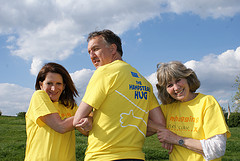
I met up with Nicholas Graham Smith (who became involved with the Hampstead Hospice because of his wife’s tragic death) and Deborah Wolton (author of a book on Hampstead Heath walks) to support and promote ‘The Hampstead Hug”.

This is a walk for charity on Hampstead Heath (two choices – 2.5 miles or 6 miles to suit all the family – the two walks join up so everyone can finish together). The money raised goes to support the Marie Curie nurses who help the terminally ill and their families so much. It will take place on Sunday July 4th 2010 and comprises two new nature walks. The money raised will go towards the Hampstead Hospice in Lyndhurst Gardens.

You can read all about it here.

Malawi – the right response

Upon the news that a gay couple in Malawi, Mr Tiwonge Chimbalanga and Mr Steven Monjeza, were to be jailed for 14 years for unnatural acts, myself as Minister for Equality, foreign minister Henry Bellingham and international development minister Stephen O’Brien issued a joint statement.

The statement said: “We are deeply dismayed by the conviction for buggery and indecent practices of Mr Tiwonge Chimbalanga and Mr Steven Monjeza.

“We are also very concerned by the allegations of their mistreatment in police custody.

“Malawi has made significant progress on human rights in recent years.

“The government has signed up to international human rights treaties and Malawi’s constitution protects the rights of all its citizens.

“Infringement of these rights is intolerable. The conviction and sentencing to the maximum 14 years’ imprisonment of Mr Chimbalanga and Mr Monjeza runs counter to a positive trend.

“Britain has a close and strong partnership with Malawi and it is in this spirit that we raise our concerns. The UK believes that human rights apply to everyone regardless of their sexual orientation or gender identity.

“The UK urges the government of Malawi to review its laws to ensure the defence of human rights for all, without discrimination on any grounds. The UK, along with our international partners, will continue to press the government of Malawi on this issue.”

International partners from around the world did indeed also make representations. And the response was that Malawian President Bingu Wa Mutharika pardoned the couple at the weekend and was rightly praised by US President Barack Obama and by British and Malawian gay rights groups.

U.N. Secretary General Ban Ki-Moon was visiting Malawi at the time of the pardon and called Sunday’s release of Steven Monjeza and Tiwonge Chimbalanga from prison a ‘courageous decision’.

President Bingu Wa Mutharika made clear that the pardon was granted on strictly ‘humanitarian grounds’. Homosexuality remains against the law in Malawi.

Malawi is not alone, sadly, in respect of its views and laws on homosexuality. The Stonewall Report ‘No Going Back’ (published last week) makes it terrifyingly clear how urgent and important this agenda is: Consensual acts between same-sex adults are criminalised in 80 member states of the United Nations and homosexuality results in the death penalty in six of these countries. In many countries lesbian, gay and bisexual people face execution, torture, rape and murder from people in their own community or from their government.

How do you begin a long journey? With a single step – followed by a lot more steps – as quickly as possible!

David Laws

I thought David Laws’ resignation was dignified and full of integrity – as is he – but very sad to watch.

This matter is now for the authorities to investigate – and will take its course. David’s brilliance is a serious loss to our government and our country – particularly at this time of great need.

But outside of the proprieties or otherwise of David’s arrangements for housing and financing thereof – what I saw when I watched his resignation statement – was the personal pain of an individual who has not felt able to be open about their sexuality.

However progressive our laws are – we have not yet reached the point where young people feel completely free about coming out. Iain Dale has a very good piece in the Mail on Sunday about his own experiences and the difficulties of coming out to his family and friends – and coming from a small village. Yes things are changing – but these personal matters are still not easy for the variety of reasons that Iain sites.

We also know that homophobic bullying in our schools is still a major problem. 98% of schools have anti-bullying policies but only 6% have specific policies to tackle homophobic bullying. Six out of ten children experience homophobic bullying.

During anti-bullying week at the end of ’09, Nick Clegg said:

‘It’s a sad fact that looking or acting ‘gay’ can instantly make someone a target in thousands of schools across the country’.

‘Until we deal with homophobia in schools, we’re never going to stamp out wider discrimination in society’.

 
Both Liberal Democrats and Conservatives highlighted this issue in their manifestos. In the coalition agreement it appears thus: ‘We will help schools tackle bullying in schools, especially homophobic bullying’.

David Laws’ untimely and sad departure from the cabinet demonstrates how very far we still have to go and how very right the coalition is to pursue this issue – for all our sakes.

Hornsey School for Girls – another brilliant event

YPI (Youth and Philanthropy Intitiative) is a program developed in Canada and now in schools here which raises awareness among young people about philanthropy.

On the ground – what this means is best described by the event I went to last night. The girls were in teams of about four or five. They had over a series of ten weeks chosen a local charity, visited and worked with them to understand what they were about and for this occasion – put together a presentation to judges (and us in the audience) to win the £3000 prize which would go to that charity.

I could only stay for the first three presentations. The first team were championing Noah’s Ark Hospice – incredibly moving – with computer images in the back ground and a role play and song. Then Action for Kids was the next team’s charity. I know this group very well having visited them several times. The words and the staging were fantastic and you could see that the girls who had gone to visit had really got it – understood the value of young people with all sorts of disabilities, including learning disabilities, having somewhere to train and work. The last one supported a charity which helped victims of domestic violence. What was so compelling in their presentation was the depth of understanding of what domestic violence does – not just to the direct victim – but to the family around.

All three were quite extra-ordinary – so I look forward to hearing who won the cheque for their charity –  but I can’t imagine how the judges could choose between all worthy causes and brilliant presentations.