TB and HIV in Southern Africa

Here’s a final blog from my International ministerial visit to Southern Africa last week:

I ended my trip to southern Africa with a meeting on TB in the region’s mines.

The two are closely linked as HIV dramatically increases susceptibility to TB which helps explain why Africa is the region most affected by TB, and Southern Africa shouldering an incomparably high burden.

And the disease is most prevalent in the mines –it’s estimated that half a million mine workers have the highest TB incidence in the world and three to seven per cent of miners are becoming ill with TB every year.

Rightly, there is a lot of interest from Parliamentarians on this subject back home – from both MPs and Lords.

I want to reassure them – and you – that DFID is committed to support the fight against these two diseases, TB and HIV. With the British  Government’s support, the Stop TB Partnership is active across southern Africa and we’ve been working closely with the Chamber of Mines and other partners to build a more co-ordinated approach to the problem of TB in mine workers, the local mining communities and labour sending areas.

The UK has contributed to the 25% reduction in TB deaths among HIV positive people globally since 2004 and the 28% reduction in Africa over the same period.

We will continue to highlight and support the problem of TB and HIV among the miners in the Southern African region and we now need all those involved in improving miners’ lives to build a stronger regional response through a more harmonised approach and follow-up of people with TB.

Hope and HIV in Malawi

Blog from Malawi – also available on Huffington Post

It took 10 minutes for me to witness despair in the optimistically-titled ‘Corridors of Hope’.

It must seem like a cruel name to those being tested for HIV in the small, sparse rooms along this hallway in Dedza District Hospital in Malawi.

There was little hope in the eyes of the father I sat with shortly after he learnt he was living with HIV. Cradling his son in his arms, together they faced the agonising wait for the boy’s test results.

In just 600 seconds, the four-year-old would hear whether he was the latest of 930,000 people in this small African country who are HIV positive.

But there is hope.

2013-07-11-IMG_7662_sq.jpg

Lilian Hara is a Community Health Nurse at the HIV Testing and Counselling Centre in Dezda. Picture: Emily Gray/DFID

While 68,000 people die of AIDS-related illnesses here every year, HIV/AIDS no longer needs to be a death sentence. I am in Malawi to see how the Department for International Development‘s support is making an impact on the ground and reviewing how British development aid can be made even more effective.

Our funding means the father I met will become one of thousands of people who receive counselling and advice on living with HIV and the much-needed anti-retroviral treatmentswhich will help him lead a normal life.

The hospital also sees 5,000 pregnant women every year and for those who test positive, helps prevent transmission of the virus from mother to child. The work of this hospital and others like it has helped bring HIV prevalence rates down from 11.3% to 7.5% in the last 10 years.

2013-07-11-IMG_7918.jpg

The local centre is helping to stop HIV being transmitted to children in the Dezda area. Picture: Emily Gray/DFID

Preventing the spread of HIV is vital if we are ever going to reach our ultimate goal of the ‘three zeros’ – zero new HIV infections, zero stigma and discrimination and zero AIDS-related deaths.

Because the high rate of infection is closely linked to gender disparity and violence against women and girls, I also visited a pioneering policing unit to support victims of gender based violence.

More than 40% of Malawian women have experienced physical or sexual violence – while 60% of girls and 35% of boys have also experienced some form of abuse. For the first time, those in Dedza have a safe haven where they can report the crimes, receive counselling, mediation and advice.

Prosecutions are being pursued more vigorously now – though this may be little comfort to those victims left with HIV. That’s why the Department for International Develompent (DFID) is also working with the poorest communities so they can set up support groups to tackle the spread of HIV/AIDS and help those who are positive live healthy lives free from discrimination.

One HIV positive lady I met told me she set up a support group because her best friends looked at her husband and her “like dead people” and children refused to play with her kids when they learned of her status.

She said the work of the support group has reduced the stigma attached to HIV and the despair of those living with it as people realise “there is still a life to live”.

That’s her message to the devastated father sitting in the Corridors of Hope.

With continued commitment from the Government of Malawi, support from NGOs and donors such as DFID, and real effort from the communities themselves – we can turn hope into certainty.

The one certainty I can pass on now is that after the 10 minute wait, the father’s four-year-old boy tested negative. I just hope he stays that way.

We want your views! Click here to find out how the UK helps to prevent HIV in the developing world and have your say in our open consultation.

Tackling HIV/AIDS in Southern Africa

The British Government has made some impressive commitments to improve the lives of the world’s poorest people. I am incredibly proud of the huge number of children we’re vaccinating, girls we’re educating and families we’re providing with clean water.

But one of our most challenging ambitions involves the smallest number  – 0. The UK remains committed to the vision of getting zero new HIV infections, zero discrimination and zero AIDS-related deaths. This matters as much to people in Britain as it does to the poorest parts of the world. Infections do not respect borders.

I am currently in Southern Africa – the global epicentre of the HIV epidemic – to see how the Department for International Development’s support is making an impact on the ground and review how British development aid can be made even more effective.

Although we are not going to reach our eventual targets of “the three zeros” overnight – we will reduce by at least 500,000 new HIV infections among women in sub-Saharan Africa by 2015. In the last year alone, we’ve developed four new HIV prevention programmes in sub-Saharan Africa (Zimbabwe, Malawi, Zambia and across the region). We are doing this by investing in a diverse range of projects, supporting civil society organisations, research and development, multilateral organisations (in particular our contribution to the Global Fund) and working with the private sector.

But more needs to be done. There are an estimated 11.3m living with HIV/AIDS in Southern Africa, an increase of nearly a third from ten years ago. Despite the increasing numbers on treatment, the number of people becoming newly infected  each year still exceeds the number of new people treatment.

I am keen to know what more DFID can be doing and how we can do things differently to reach our eventual goal of ‘zero new infections’. As part of a review into our strategy, I met with the Deputy Director of the UNAIDS Regional Support Team, politicians from across Southern Africa and a range of NGOs as well as researchers. The high rates of  HIV infection is closely linked to gender disparity and violence against women and girls, and I also met with South African counterparts and civil society stakeholders on how to jointly work on this important challenge.

What I heard was a message of hope and with so many people committed to the fight against HIV/AIDS. My message to them, and for all those living with HIV/AIDS – including those in the UK as well as in Southern Africa – is that DFID will work harder and more flexibly to make what we do count even more. It is my hope that our work will count towards zero – zero new infections, zero discrimination and zero AIDS-related deaths.

Nick Clegg visits Hornsey and Wood Green!

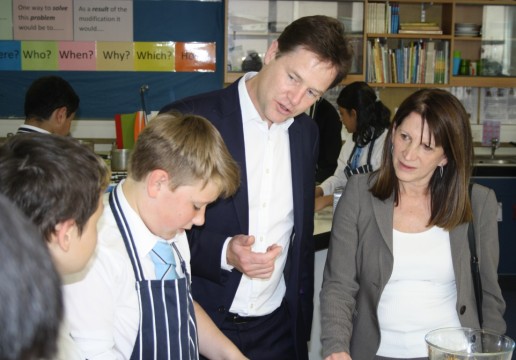
On Friday, it was an honour to welcome the Deputy Prime Minister Nick Clegg to Highgate Wood – a fantastic school in my constituency.

The head teacher Patrick Cozier and I greeted Nick at the gates, and then had a meeting to discuss how the school is using its Pupil Premium money.

The Pupil Premium is a Liberal Democrat flagship policy that is being delivered by the Coalition Government. It targets extra money to schools depending on the number of children from disadvantaged backgrounds they have.

Schools will receive £900 per eligible pupil. For Highgate Wood, this means a whopping £413,100 in extra funding for 2013/14.

Already, the school is doing great things with the extra money – for instance taking on new staff to support children with troubled backgrounds and subsidising school trip fees for poorer pupils. I can’t wait to see what they do with this year’s increased allocation.

After the meeting, Nick and I were shown around the school and popped into some lessons – history, English and food tech. It certainly brought back memories! We ended the visit by looking around a fantastic art and photography exhibition, put together by 6th form students.

After the visit, the head teacher commented – “It’s a complete honour to have someone as significant as Nick Clegg to come to the school and to see what we’re doing.  The Pupil Premium is great for the school. It allows students from disadvantaged backgrounds to engage in activities and get individual support to make progress.”

Nick said: “It is great feeling for a politician to come to school and actually see how ideas like the Pupil Premium – which I have fought for as a politician – are working out in reality. Highgate Wood is a great school, and I’ve been hugely impressed by what I have seen today.”

A great day all round!

Whittington Hospital set to announce a rethink..?

News has broken about the Whittington Hospital. At a Camden Council meeting last night, the Hospital’s medical director Dr Greg Battle told councillors that there has been a ‘complete rethink’ of their strategy.

The controversial hospital strategy – announced in January without consultation – would have seen hospital buildings sold and money reinvested in other services. It also included a reduction in hospital staff and beds, as more care is moved into the community.

Understandably this caused great concern. That’s why the Lib Dems and I campaigned for months to get the hospital to listen to residents – and for no loss of services. After presenting our petition signatures, the hospital agreed to engage residents in their plans, take their views on board and amend their strategy accordingly.

Dr Battle’s comments indicate that this has happened – and in that respect, a rethink is welcome – and potentially a great success for the Lib Dems and local residents.

However, I would urge everyone to err on the side of caution at the moment. Dr Battle has pre-empted the hospital’s official announcement – and we do not know the full details yet. I am meeting the board on Friday, and will be sure to get confirmation and assurances then.

I have also contacted the acting Chairman and Chief Executive of the hospital to attempt to get concrete information more quickly.

Watch this space.

One Million Jobs

Here’s my latest column for the Ham and High – also available on Lib Dem Voice

The Liberal Democrats in Government have helped businesses create over one million jobs. Now we are working to create one million more!

Work is so important to individuals and families in the UK. It pays the bills, gives us purpose and fulfilment, and provides security for our long term futures.

I was so happy when I got my first job with a small design and advertising company in the West End – and my first pay packet. I remember feeling so grown up as I caught the tube to work along with the rest of the world. That sense of a daily somewhere to be and something to do has always been incredibly important to me – as it is to everyone.

Work is particularly important for young people leaving school or university. I regularly visit schools in the local area – and am always so pleased to see youngsters with such ambition and enthusiasm. We should be doing all we can to give them the best chance to succeed – which will benefit our economy too.

But – it’s not long since youth unemployment was rising fast under Labour, leaving so many young people without the opportunity to get on in life.

That’s why creating more jobs – particularly for young people – during these tough economic times is top of the Lib Dem’s list of priorities.

The million jobs we have helped create span a number of different industries. We’ve supported industries such as manufacturing by investing £5.5bn extra into science, high-tech manufacturing and renewable energy – in turn creating thousands of new jobs. £15.3bn has been invested into creating building jobs, which will improve Britain’s roads, railways and housing.

Our strategy is working. On top of the million more private sector jobs, youth unemployment is down. Here in Hornsey and Wood Green, youth unemployment has fallen by over a quarter from May 2010 to now.

Overall unemployment in the constituency is also down from 5.2% to 4.5%.

That means hundreds more people in this constituency have been employed since the Lib Dems entered the Coalition Government!

There has also been great success with apprenticeships. In Hornsey and Wood Green alone, 530 new apprenticeships have been created – so now there are three times as many apprentices as 2010!

In order to create a million more jobs for a stronger economy, we are turning our attention to these apprenticeships, and looking to continue the great work. In short – we want to double the number of businesses that take on apprentices.

I am planning on holding an event in the constituency, which will attempt to match up potential employers with apprentices, helping more of our local youngsters get in to work.

Everyone can get involved in this. Just visit the campaign website at www.amillionjobs.org to register your support for our national campaign for more apprenticeships, and to find out more information.

Visit to Marsabit County – Kenya

I’m in currently in Kenya on an international ministerial visit. Here’s a blog following today’s visit to Marsabit County:

Very little grows in the arid lands of northern Kenya and farmers, their families and livestock face a daily struggle for survival.

In the searing heat of Marsabit County, drought and poverty collide often with horrific consequences –  acute malnutrition rates regularly sit above the 15 per cent emergency threshold.

DFID is working constantly to prevent a repeat of the severe food crises that have devastated whole regions of Africa. And on a trip to the region, I saw today how British taxpayers are helping communities in this unforgiving environment protect themselves from disaster.

Livestock owners are able to make a good – and sustainable – living if they are able to get their animals to market. And now they are able to insure their goats, sheep and camels against the lengthy dry season that can decimate the valuable herds.

I met a group of 11 – mainly women – who told me how by paying GBP1 a week to the DFID-supported scheme, they can fund themselves during droughts and are less likely to need emergency aid.

I also sat with beneficiaries of our Hunger Safety Net Programme, which supports 69,000 households with small cash payments.

This enables families to save and pay their own way when times are hard – spending the money on food, healthcare and education for their kids without needing further handouts.

But I’m a realist. We’re not going to end hunger overnight as these programmes take time to help the poorest help themselves. That’s why we still provide emergency care to those in grave need.

I met some of the 65,000 mothers and  babies being treated for malnutrition who are also being taught how to prevent it in the future, thanks to support from the UK.

We are also strengthening the health system of the Government of Kenya so they are better placed to prepare for and respond to spikes in demand.

While few plants and crops survive in Northern Kenya’s harsh conditions, the confidence of those in greatest need has grown. Thanks to these relatively small interventions they now have a cushion to protect them when drought and poverty next collide.


Cutting Edge Press – 'good stories well told and with social relevance'

Went to Cutting Edge Press summer party this week.

This is a publisher with a social conscience – publishing such books as ‘My Beautiful England’ which deals with women coming to England and suffering domestic violence. Not only a good read but a book that will empower women to access support services which can help them.

‘Gorilla Land’ – dealing with the conflict in Congo, child soldiers and the legacy of colonialism and the current impact of the UN peacekeepers and NGOs.

And many more.

Given how closely this relates to my work in International Development – what a pleasure it was to meet the authors, agents and production teams who are part of the Cutting Edge Press’ stable. Martin Hay (CEO and Finance Director) is the driving force behind Cutting Edge Press – and  it is his vision and intellect that has made this such a special publishing house.

Supporting our High Streets

Here’s my most recent Muswell Flyer Article on supporting our local high streets

One of the best features of Crouch End, Highgate and Muswell Hill are their unique high streets. Instead of endless chain stores, we have a rich range of diverse independent shops, which add so much character to our local area – and I want to keep it that way!

We are going through tough economic times, and without the support of multinational head offices, many of our independent retailers are struggling.

The Labour-run Council hasn’t helped, either. They’ve raised parking charges on the high streets to a whopping £3 an hour – which puts off potential customers who want to stop and browse. One local resident contacted me and said: “I do not shop on the high streets in Highgate and Muswell Hill because of the ridiculous parking rates.”

A local independent retailer also contacted me and said: “I run 3 shops which have suffered badly from the huge increase in parking charges.”

That’s why the Lib Dems have been campaigning for reduced parking charges and for 30 minutes free parking across the Borough. The campaign has gained a great deal of momentum. The traders had already put together a 5000 strong petition calling for lower charges.

We now have a very large number of signatures in support of 30 minutes free parking. You can add your name here: http://eepurl.com/tvXkH.

Residents have been vocal in their support. Local resident Denis Jones said: ‘I feel that it would help trade in the Broadway. If there was 30 min free parking I would use the shops instead of going to free parking trading estates.’

The ruling Labour Group at Haringey Council remain stubborn. They have refused to change their parking charges to date. It is such a shame that they will not listen to residents and common sense arguments. Local residents and retailers really deserve better.

Nonetheless, the Lib Dems and I will carry on campaigning and pushing the Council to do more to help our local independent shops and high streets.

In other news – I have also been running a competition in my constituency to find the best local independent shops. The voting has now closed, but the results still have to be announced.

This will happen on Saturday 29th June (from 11am – 3pm) at a summer fete style event on the forecourt of Hornsey Town Hall. There will also be a draw to see which lucky voter will win £100 to spend in the shop they voted for.

A number of our favourite shops and community groups have already agreed to have a stall and exhibit at the event, and there will also be games and face painting for children, snacks, music and picnic space.

This will be a fantastic community event, which will help promote and publicise many of our best independent stores. I hope to see as many of you there as possible!

Meeting the Somali Bravanese community

The fire at the Somali Bravanese Centre on Coppetts Road two weeks ago has been shocking for the whole community. It has now been confirmed as an act of arson by the Police and it is hard to comprehend what goes through the mind of someone prepared to risk the lives of others in an act like this.

Last Friday I met with members of the Somali Bravanese community following the fire so that I could express my sadness but, more so, to offer my help. It was an opportunity for me to listen to their concerns and find out what can be done.

Lynne Featherstone MP meets with members of the Somali Bravenese community

Two weeks on, the leaders of the centre are determined – determined to move forwards, to rebuild, to reunite the community and come back stronger than before. The group spoke to me of the history of the Bravanese people and it is clear that they have a long tradition of carrying on, even in the face of adversity and I feel that this situation – though challenging – will prove no different.

The leader of the centre explained to me that their most pressing concern at the moment is finding a temporary location and equipping an office so that they can get back to work. A number of Somali Bravanese children and teenagers used the centre and it is vital that they have somewhere to go while the current building is out of action.

We also discussed what needs to be done in terms of getting the centre rebuilt as quickly as possible and I have written to Barnet Council in order to highlight some of the concerns raised. I will continue to offer my help in whatever way I can.

In the meantime, support from local residents has been overwhelming – I have received numerous emails asking me what can be done to help and I know those from the centre have received many more. It just shows how united the community is – if anything, now more than ever.