New push for LGB and T equality

Today the Government announced, as part of our commitment to advancing equality for lesbian, gay bisexual and transgender (LGB&T) people – that religious buildings will be allowed to host civil partnership registrations. 

The change, which will be entirely voluntary and will not force any religious group to host civil partnership registrations if they do not wish to do so, is being introduced as part of the Equality Act. It will give same-sex couples who are currently prevented from registering their civil partnership in a religious setting – the chance to do so.

As the Home Secretary says: ‘This Government is committed to both advancing quality for LGB&T people and ensuring religious freedom of religion for people of all faiths -which is why we will be allowing religious organisations to host civil partnership registrations if they choose to do so’.

The government’s LGB&T action plan, which was published last year, included a commitment to look at next steps for civil partnerships, and giving religious organisations the right to host registration is the first stage in that process.

We have also identified a real desire to move forwards to equal civil marriage and parnerships, and will be consulting further as to how legislation can develop, working with all those who have an interest in the area.

Over recent months I have spoken to many LGB&T people and campaign groups, and it quickly became clear that there is a real desire to address the differences between civil marriage and civil partnerships.

I have always been completely clear that equal rights means exactly that – the same rights not different rights.

So I am very, very pleased to be able to announce that we are going to be the fist British government to formally look at what steps can be taken to address this.

Freedoms Bill

On Friday – the Protection of Freedoms Bill was introduced to Parliament.

Liberal Democrats have long campaigned for this piece of legislation. A “Freedom Bill” had its first incarnation four years ago when the Liberal Democrats proposed it while Nick Clegg was the party’s Home Affairs Spokesman.

The Bill will protect millions of people from unwarranted state intrusion in their private lives and marks a return to common sense government. It steps up our commitment to restore hard-won British liberties, lost under Labour, with an array of sweeping reforms that will put an end to the unnecessary scrutiny of law-abiding individuals.

PROVISIONS
The DNA database will be reformed along the lines of the Scottish model; the data of hundreds of thousands of innocent people will be removed from the database

Schools will no longer be able to take the fingerprints of children under 18, without obtaining prior permission from their parents.

Safeguards against the misuse of counter-terrorism legislation – reducing the maximum period of detention without charge to 14 days.

Replaces the powers to stop and search persons and vehicles without reasonable suspicion with a power that is exercisable in significantly more restricted circumstances.

Millions of law-abiding householders will be protected from town hall snoopers with the introduction of new safeguards in the use of surveillance powers (the Regulation of Investigatory Powers Act) to better protect the public from disproportionate surveillance.

A new statutory code of practice for local authorities and police on the use of CCTV and ANPR to improve effectiveness and ensure proportionately. We will also appoint a new Surveillance Camera Commissioner to provide, for the first time, a single framework to which all users of such systems can operate.

We will ban wheel clamping without lawful authority but will strengthen the enforcement arrangements with regard to ticketing, by enabling the owner or occupier of land to reclaim unpaid parking charges from the keeper of the vehicle instead of the driver

We will return the Vetting and Barring Scheme and the disclosure of Criminal Records to common sense levels. But the maintenance of effective and robust public protection arrangements are paramount and we will continue to maintain a list of all those barred from working with children or vulnerable adults.

We will amend the Freedom of Information Act to ensure that public authorities proactively release datasets, and extend it to companies wholly owned by two or more public authorities

Any man with a conviction for consensual gay sex will be able to have it wiped from police and other official records.

Remember, under Labour:
Britain had 1% of the world’s population but a fifth of the world’s CCTV cameras. In 2008, the Metropolitan Police revealed that one crime was solved for every 1,000 CCTV cameras in London. Privacy International ranked the UK as the only “endemic surveillance society” in Europe, alongside Russia, China and Malaysia.

There were 6m people on the DNA database in the UK – nearly 10% of the population. The database was the largest in the world. It is estimated there were one million people on the DNA database with no record on the Police National Computer.

Labour used the fear of terrorism to establish the longest period of pre-charge detention in the free world. And tried to increase it further to 90 days.

The Regulation of Investigatory Powers Act 2000 (RIPA) was set up to deal with organised crime and terrorism. In reality, however, it has been used to spy on ordinary people, their children, their pets and their bins. Only 8 public bodies were able to use RIPA when it was first passed. This figure is now over 900!

So – hurrah – and I will be taking the Bill through its committee stages (with James Brokenshire) in Parliament- fantastic!


Late Shift Tour

Last night at the National Portrait Gallery – All Walks Beyond the Catwalk – Erin O’Connor, Debra Bourne and Caryn Franklin held a fantastic event offering new views and reflections on women and representations of beauty.

All Walks are working to encourage greater diversity in the fashion industry. Obviously – given the Government Body Confidence campaign to push back against the relentless pressure on young people of impossibly perfect images – I was more than happy to support the evening.

Firstly, Rankin, celebrated photographer had worked with All Walks to create a more diverse portrait of the Spring/Summer 2011 catwalk designer collections on a wider range of models. The images – of women young and old, larger and smaller and all shades were on display in the Gallery alongside the portraits of the great Masters.

Apart from tours of the galleries – the key event of the evening was a panel debate on image and fashion. Caryn Franklin chaired the debate and the panellists were: model Erin O’Connor, Elle magazine editor Lorraine Candy, myself, psychologist Linda Papadopoulos and Kiki Kendrick – playwright, actress and former advertising creative.

The debate ranged across the various issues of conformity of image, fashion’s place in this, the psychological effects of repeat images and so on.

It was a great success and demonstrated more clearly than ever – that this issue is rising and rising on the agenda. Congratulation to All Walks!

Labour failed to tackle health inequality in Hornsey and Wood Green says Lynne Featherstone MP

Labour’s stewardship of the NHS has left “a legacy of missed opportunities” according to local MP Lynne Featherstone, after research revealed that Haringey’s levels of childhood obesity are higher and life expectancy lower than the England average after 13 years of Labour government.
 
Despite announcing in 1997 that reducing health inequality would be a key priority for the new Labour government, figures show that in Haringey, childhood obesity and life expectancy still lag behind the national average.
 
A report from the Public Accounts Committee also found that the gap in life expectancy between the poorest areas and the national average grew by 7% for men and 14% for women over the last 13 years. The report also revealed that people living in the poorest neighbourhoods in England die almost two years before those in the rest of the country.
 
Under proposals put forward in the Health and Social Care Bill by the Coalition Government the responsibility for public health will be returned to local government. By giving Local Authorities the responsibility for commissioning the majority of public health services, local communities will be empowered to come together to tackle the challenges they face.
 
After 13 years of Labour Government:
 
o   Britain has amongst the worst levels of obesity in the world.
o   Smoking claims over 80,000 lives a year.
o   1.6 million people are dependent on alcohol.
o   Over half a million new sexually transmitted infections were diagnosed last year, and one in ten people getting an infection will be re-infected within a year.
 
Lynne Featherstone MP comments:
 
“New Labour entered government in 1997 and announced that they would put reducing health inequalities at the heart of tackling the root causes of ill-health. Instead after 13 years of government Labour’s real legacy is a story of missed opportunities.
 
“Tackling health inequality only became a NHS priority in 2006, and primary care trusts were not required to report back on them until 2007. That is why in Haringey we have among the highest levels of childhood obesity in the country.
 
“Councils are best placed to bring together all the local agencies who can work together to tackle public health challenges. The Coalition’s proposals to return the responsibility for public health to local government will ensure that tackling health inequalities and improving people’s health is given a local focus to fit local circumstances.
 
“As a result of these changes, local government won’t just be commentators on health but will instead have a new role shaping the direction of local health services.”

Prisoner Voting 2

Having just seen the actual motion from the back-benchers on prisoner voting for the debate on Thursday – it’s negative. Basically it calls for the status quo – ie prisoners to continue to be denied the vote.

So I won’t be able to vote for prisoners to have the vote on Thursday as that is not on offer – and will abstain. However, my opinion remains as per my previous post – and I will have to wait a further opportunity to vote for a lawful outcome.

Lynne Featherstone MP speaks to local students about lobbying and campaigning

Lynne Featherstone with year ten students from Highgate School To help inspire students to engage in the local community and make a difference through campaigning and lobbying, Lynne Featherstone MP on Friday spoke to year ten at Highgate School.
 
The Hornsey and Wood Green MP was speaking to the students as part of their citizenship class about the workings of Parliament, lobbying MPs, and what can be achieved through local campaigning. The Liberal Democrat MP gave the students a range of examples of where the local community has come together to effect change, like the successful 603 bus campaign, and the campaign to save the Whittington A&E.
 
Lynne Featherstone MP comments:
 
“It’s pretty amazing the way things can be changed when local people come together to fight for a cause. I have seen it over and over again as a local MP.
 
“It was great to be able to show the young people here today that it can be done, and that as a citizen you have the opportunity to influence politics and the world around us. And they sure are an inquisitive lot, so I guess it’s just a matter of time before they start lobbying me on Government policy!”

Lynne Featherstone and local Liberal Democrats launch campaign on better access to GPs

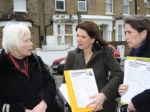
Lynne Featherstone and Katherine Reece surveying a local resident in Stroud Green about her access to GPsHaringey Liberal Democrats have just launched a campaign to make sure residents living near the Borough boundary can access GPs in neighbouring boroughs.
 
The action comes after residents in Stroud Green have complained of not being allowed to register with GPs surgeries just over the border in Islington.
 
Last Friday, Lynne Featherstone MP, Stroud Green Cllr Katherine Reece and Health Spokesperson Cllr David Winskill launched a GP survey to hear from residents in Stroud Green about their access to GPs. The health campaign is also looking at access to NHS dentists and gathering residents’ opinions on the standard of local health services.
 
Local councillors Katherine Reece and Richard Wilson have already met with NHS Haringey who acknowledge that registering with a GP can be a serious problem for residents in Stroud Green.
 
Nationally the Liberal Democrats in government are pushing to give patients the right to choose to register with the GP they want, without being restricted by where they live.
 
Lynne Featherstone MP comments:
 
“It’s ridiculous that residents on the north side of Stroud Green Road cannot always use GPs on the south side of the road due to bureaucratic wrangling.
 
“We are surveying residents in Stroud Green to find out just how bad the situation is, and will be bringing the results to health bosses.”
 
Stroud Green Councillor Katherine Reece adds:
 
“It’s great that Liberal Democrats in Government are working on changing the rules about where you can register for your GP. We want to do our bit here in Stroud Green.
 
“However Islington PCT is refusing to recognise there is a problem with cross-border GP access.  We hope this survey of local residents will change their minds and force them to work with GPs to widen access.”

Prisoner voting

The European Court of Human Rights ruled in 2005 that the UK’s ban on prisoners voting was unlawful. The matter has now wended its way forward in time to a need for action.

So – should prisoners get the vote? As far as my own vote on Thursday (in what is a debate accepted by the Back Bench committee) I will vote for prisoners to get the vote. It is not one of the issues that exercises me hugely – but I understand from the tabloids that it is an issue that does exercise a lot of people.

Apart from the issue of Britain being in breach of the European Court of Human Rights and as a Minister voting for a lawful outcome – I have always believed prison is the punishment – the removal from society and being kept in a cell. Outside of that – I think it would be a good thing if prisoners had any interest in outside matter and current events – although I fear many may not even be interested in voting.

Should prisoners get the vote?

Making tax fairer

We are changing the tax system to make it fairer by lifting the poorest workers out of Income Tax altogether and cutting taxes for most people. This April 880,000 workers will stop paying Income Tax when the lower threshold is raised from £6,475 to 7,475.

The Institute for Fiscal Studies says the tax changes will mean the richest tenth will lose around 3% more of their income and that the main winners from the 2011 tax changes will be lone parents who are not working, and low-to-middle income households.

The IFS report concluded that:
· The main winners from the 2011 tax changes will be lone parents who are not working, and low-to-middle income households
· For example a family with two children and one person earning £20k will be £530 better off
· Those earning up to about £42.5k a year (including tax credit) will also be better off owing to the changes being introduced in April
· The biggest losers are the very richest households owing to restrictions on the amount that can be contributed to a private pension. They have also been affected by the 50% income tax rate on earnings above £150,000 and withdrawal of the income tax personal allowance above £100,000.

Lynne Featherstone MP meets top police boss over worries of cuts to Safer Neighbourhood Teams

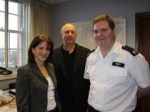
Lynne Featherstone and Cllr Martin Newton with acting Borough Commander Chris BarclayPolice bosses in Haringey have given assurances that local residents’ safety concerns will be paramount to any decision on the future of Safer Neighbourhood Teams (SNT) following a meeting, last week, with Lynne Featherstone MP and Cllr Martin Newton. The Acting Borough Commander, Chris Barclay, also assured Liberal Democrats that Muswell Hill Police Station will not close unless an equal or better alternative with front counter provision is in place.
 
Commander Barclay was presented with a collection of residents’ views on policing priorities, after local Liberal Democrats surveyed local people on their views about SNT provision. The Liberal Democrats issued their own survey on SNTs, as the Metropolitan police launched a review of the ward based teams.

In the survey, local people highlighted issues around perceptions of safety, and the knock-on effect on local crime rates if SNT numbers were cut.

A particular preference was expressed for more police presence late at night in areas like Muswell Hill Broadway. The Acting Borough Commander assured the Liberal Democrats that residents’ views will be considered before any changes are made to Safer Neighbourhood Teams.

Lynne Featherstone MP comments:

“The Safer Neighbourhood Teams have done wonders for our local community. With well-known faces out on the beat, and a high police visibility, residents clearly feel safer, and crime goes down.

“Residents echoed the same sentiment in many of the survey responses: ­ they value and cherish their local police team, and don’t want to see their numbers cut.

“I’m delighted with the assurances that local people’s views will be given full consideration before any changes to SNTs take place, and I’m equally delighted with his assurances on Muswell Hill Police station!”

Haringey Liberal Democrat Crime Spokesperson Cllr Martin Newton adds:

“These are uncertain times, and the police have had a cut to their budget. We understand that tough decisions have to be made, but at the same time we feel that it’s critical that top bosses understand just how much the local community value their Safer Neighbourhood Teams to keep crime down in their local area.

“I believe we have given the police a strong message today: local policing matters, and local people don’t want to see any drastic changes to their local Safer Neighbourhood Teams.”