The Red Hedgehog

Carols in Pond Square (Highgate), followed by Archway Road Residents’ Association Christmas party at the Red Hedgehog (255 – 257 Archway Road). Paul McLean-Thorne has really driven this residents and trader group to begin to form a real community on a stretch of road that has had too little love and attention in the past.

Now, thanks to his and the group’s efforts, there are flower tubs, a fight to mitigate the ugly fence in front of the railway embankment, a competition for the best shop front – and close working with the local police Safer Neighbourhood team, who were also at the party.

But I confess: I hadn’t been to The Red Hedgehog before – and talking to Claire (Clare?), one of the owners, was thrilled to bits that we have such a venue come to Hornsey & Wood Green. The Red Hedgehog titles itself as: ‘Music, Cafe & Gallery’. The party was in the cafe bit – and I didn’t see the performance space -so am going back to have proper look round and proper discussion with her.

What is astonishing is that to this new venue come world-class performance artists – from James Gilchrist to Jack Liebeck. And to add to that – they are absolutely committed to encouraging those who come to the Red Hedgehog to travel sustainably – and if they do, their reward is a discount. And I sense a campaigner here – so we agree that I will come back and we will have a chin wag, for we agree – climate change is the big threat!

For more information, you can visit www.theredhedgehog.co.uk

Who should elect council group leaders?

For just over four years I was the leader of the Liberal Democrat group in Haringey. It was a good period for the party – from winning our first three seats in Haringey through to growing to a group of fifteen at the next elections, for years on. But there is one thing about my experience as group leader that I have real doubts over. It’s the question of how the party elects its group leader.

Group leaders – especially those where we run the council or are challenging to run the council – are some of the most important people in the party in terms of real power wielded that affects people’s lives.

Group leaders vary hugely – from the leader of a small group through to the person who runs a multi-million council and has more power than many MPs – but one thing they all have in common is that party members do not get a say in who they are.

And this is my cause of doubt. I have had to campaign for votes from party members for all sorts of things during my time in the party but for group leader – it was only fellow councillors who got a say. Now – when there were only three of us councillors back in 2002, divvying up the roles of leader, deputy leader and chief whip wasn’t the most competitive or angst-ridden of processes! Between us, we were all happy with who did what. But even where there is real choice and disagreement – and where the result determines who heads up a council, one of the most important political jobs there is – party members do not get a say.

As I type this I can just imagine the thoughts going through some councillors’ minds at the idea of members electing their group leader rather than they themselves.

So – I want to take you back to the start of this year. I just want you to imagine if our party leader was elected in the equivalent way to the way in which our council group leaders are elected. That is, by the MPs alone with party members not having any say.

Imagine if we had had an election that way at the start of the year and I had then come along to the recent London Liberal Democrats conference to say how well I thought the process worked, how the leader is the leader of the MPs – so of course it should only be MPs who should get a say – and maybe made a joke or two about some oddball members and asked if you really wanted to entrust the very serious and important choice of leader to people like that?

I don’t think I’d have been very popular – and rightly so!

So instead I ask – think of all the reasons why it was right and proper that I and everyone else in this room had one vote in the selection of the leader, and then ask – why doesn’t the same reasoning apply to the leader of council groups? Of course, a council group leader needs to have support of their councillors and they are the people who know the candidates best – but that can be dealt with by the nomination rules (as with party leader where a candidate has to currently have the support and be nominated by 7 MPs).

This isn’t just a theoretical question, because think again – think of where local parties have gone horribly off the rails, falling apart into infighting and dispute. Almost always, a large part of the story is that the council group and members have gone off in different directions with splits opening up between councillors and party.

Having the group leader elected by members could be an important piece of glue holding the party together.

So it might be that this is the right thing to do not just in its own terms – democratic – but also the right pragmatic thing to do – to help head off some of the problems of division we’ve sometimes had in the past. And don’t forget the benefits too of encouraging councillors to remember how important members are, to retain them and to communicate with them – whilst also giving more members more of a say and a participation in local politics and decision making. That’s what we’re about as a party, aren’t we?

The logic of what I have written sounds pretty good to me – and the various people I’ve tried it out on seem to agree too. Yet within the party, I can’t recall any move to introduce these sorts of changes? So have I got it all wrong, or is it time we changed things?

This article first appeared on Liberal Review.

Visiting Royal Mail

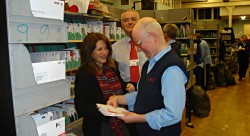
Visting Royal Mail's Hornsey delivery officeWhen I looked at my diary yesterday and discovered I had a 6.30am visit to Hornsey N8 Royal Mail delivery office I did ponder for a moment as to whether this was just cruelty or revenge by my diary secretary. However, having done the event, it was well worth it.
I conducted a huge survey of postal services in the constituency during the year. It had a huge response and whilst many people did say how good the service was and how pleased they were with their own postman, – there certainly were a lot of complaints – late delivery, mis-delivery, no delivery and wrong delivery – amongst others. All of which I had agreed with Royal Mail that they would address and answer individually. They have been very cooperative on this front.

I am setting up a Hornsey & Wood Green MailWatch group to work at local level with local offices to deal with these sorts of issues and form good local relationships – so that when and as things happen, there is method of dealing with them directly and locally. Human relationships rather than amorphous gargantuan organisations are much better – and the more local the better too.

So, I arrive at the Horsney Delivery Office – which whilst the rest of the world is just stirring, is in full swing. Keith Headland (the local manager) and John Bull (area manager) both greet me and take me into the warehouse. Here there are different functions performed along the long alleyways formed by sorting shelves, or grids (that hold runs) and so on.

When I arrive the post team (lots of staff) are working on the initial sort. All N8 mail comes here from the North and East London sorting office. When the N8 mail gets here it is first sorted into packages, parcels, letters, etc and then into its street areas. Then the staff move to the grids – which are like extended letter racks in rows where the letters are then not only sorted into the delivery runs but put in order. So you can imagine how annoying it would be to get to the end of a long road and then find the last letter you have actually should have been delivered at the other end of the road.

And so on and so on. This isn’t meant to be a blow by blow account of the system – but it is only fair to try and give some idea of the major logistics operation that delivering the post is – and, given the issues I’ve raised, only appropriate to actually come and see the reality myself.

One of the key problems at Hornsey is the lack of space. It really is not easy to do what they do in that little space – but the commercial realities of their existence these days against a competitive market means they cannot (or their central office cannot) accommodate them in better premises.

And that is the real battle – the Royal Mail has to deliver the Universal Post and their competitors do not. And whilst MailWatch will hopefully work together with local offices so that we can together improve local postal services for local people – the bigger question is how they can survive against this playing field and against the backdrop of a Government which seems to be hell bent on destroying our local social fabric by destroying and closing our local post offices.

There is going to be a statement today about further closures. It is lunacy!

Meanwhile, the staff I met this morning seemed really pleased that I had come to see them as previous politicians who had criticised the service had refused all invitations to do so.

Overall, I was much encouraged both by the attitude of the local office (and this is just one of the ones I need to involve) and by the response to my call for people who want to be involved in setting up and running MailWatch West Haringey. If you are interested – please contact me.

Parliamentary Carol Service

The highlight today – outside of my work itself – was the Parliamentary Carol Service held in St Mary’s Church, Westminster Abbey. I didn’t go last year – but this year I decided to attend (with one of my daughters) as there are just some things that you want to experience and one day when I am not an MP again (it comes to us all) I won’t have the chance.

I do not follow any faith – but like many others, enjoy much of the celebratory traditions of Christmas (tree, food, sherry and presents) and carols and carol services. Even if you don’t follow a faith – you can recognise that there is something compelling about worship, ceremony and commitment.

Anyway – the choir was beautiful. I love the sopranos when they soar out above all the other voices. The lessons were read by a rainbow coalition of Ming Campbell, David Cameron and Hilary Armstrong. The charity being supported was Westminster Medical Research to buy a particular rare and expensive piece of equipment. By a strange stroke of co-incidence and without going into personal detail – the very piece of equipment that my daughter had needed some years earlier. Strange – hey?

The GLA Bill

Yesterday was the second reading in Parliament of the GLA Bill. As London Spokesperson I sat in for the whole session trying to get called – and succeeded!

[UPDATE: You can now read my speech on Hansard.]

For me the key is the new planning powers given to the Mayor – for it takes away power from local people and local authorities who know the situation on the ground. Even without extra powers to direct the granting of an application – the Mayoral nose has already been stuck into local planning applications where it wasn’t his business, wasn’t wanted and wasn’t strategic. Result: horrible lowest common denominator development of tower block housing dumped on the most deprived who don’t have fancy lawyers to fight for them – and in Hornsey a concrete batching industrial plant right in the middle of a residential area.

And at both those enquiries the lawyers at appeal were able to wave letters of approval from the Mayor – who at this point has no actual power but whose influence is used by developers as carte blanche for their profit.

I support the Bill and the devolution – but we have to have checks and balances on the Mayor so that he can’t drive through what he wants without local people having their say to him – and without making sure public services and infrastructure can cope with the new developments he wants. Currently, we we get warm words but no infrastructure – just broken promises.

I also suggested that when conditions are applied to a mayorally driven granting of a planning application – it should be the Mayor that foots the bill for ensuring that conditions are implemented and enforced – not the local authority that turned it down in the first place. Grrrrrrrr!

LIB DEMS SLAM LABOUR MAYOR'S NEW, CARBON-UNFRIENDLY BMW

Haringey Lib Dems have slammed the Labour Mayor’s choice of a BMW 7 series as the replacement of the official mayoral car.

The luxury purchase comes as the Haringey Council struggles to cut £2m from its budget- and merely a fortnight after Labour leaders signed the Nottingham Declaration, where they publicly committed to encourage Haringey residents to reduce their own greenhouse gas emissions.

The Lib Dems are pointing out that the cheapest ‘book’ price of a Series 7 BMW is £50,875 with a minimum 3 litre engine size, with the largest model having a 6 litre engine. Under urban driving even the most environmentally friendly of the Series 7 range does only 44 mpg.

Councillor Bob Hare, Lib Dem Environment Spokesperson comments:

“The replacement of the mayor’s vehicle would have been the ideal opportunity for Labour in Haringey to demonstrate its commitment to tackling the causes of climate change.

“It is disappointing that the Labour has chosen to put their own personal comfort and status before the environment. It shows their commitment is largely just warm words.”

Councillor Ed Butcher, Deputy Lib Dem Environment Spokesperson adds:

“This is hardly leading by example.It is difficult to see how our community partners will take the council’s pleas to be less polluting seriously when at the first opportunity they buy something just a few steps down from a Sherman tank on the pollution scale.

“It is a real worry how hollow Labour’s commitment is to the environment: a case of do as I say not as I do.”

National Offender Management Bill

Yesterday afternoon was taken up with the National Offender Management Bill – which basically begins to break up the Probation Service and give it to private providers. Whilst the Probation Service has undoubtedly come in for a lot of bad headlines for things going wrong – this Government solution really means that another part of our criminal justice system will be outsourced to the private sector. I made a speech at LibDem conference about this issue – so for your delectation, here’s the link.

New police presence in Wood Green

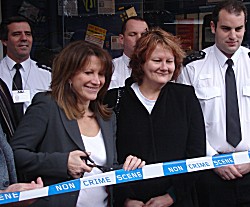
Lynne Featherstone opens the Wood Green Safer Neighbourhoods shopOfficially opened the Safer Neighbourhood Shop in Wood Green. Shopping City has kindly given a prime position for this drop in shop for three weeks over the Christmas period. If you go in (right next to entrance to Shopping City) you will find the local Noel Park Safer Neighbourhood Team (aided and abetted by the local community wardens and the local fire fighters) handing out advice and free gadgets to help deter and prevent crime.

At a time when thieves carry on – even taking presents from around a Christmas Tree as we read to our horror every year in the newspapers – it is important that people take as many sensible precautions as possible both for their home and when out.

There are also smoke detectors from the Fire Fighters – as Christmas is also a time when candles can lead to accidental fires and there is an awful lot of cooking going on at the same time as a bit of celebratory sherry!

So – drop in and take care.

Has Tony Blair been copying me?

Over the weekend I caught up on exactly what Ton Blair said in his recent speech about race relations … and it looks like what he’s now saying is (in some key respects) remarkably similar to what I’ve been saying! Perhaps he’s been reading my chapter on race relations in the recently published book – Britain after Blair

Not sure how I should react to finding he’s now saying the same things as me!

One of the topics was twinning faith schools together (in my chapter as co-siting faith schools) and my thesis that our historic state funding, albeit with the best intentions, of separateness with different races or faith groups in different community silos has to change to state funding for togetherness.

Now perhaps too we can update our history to better reflect what makes the country it is – knowing about Suliman the Great matters rather more now than the unification of Italy in understand the backgrounds that make up our country.