The three keys to international development

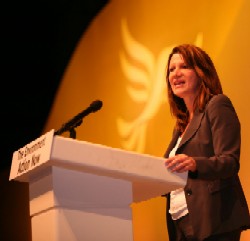
Lynne Featherstone speaking at conference. Photo credit: Alex Folkes/Fishnik.comThis afternoon was my big set-piece speech in the main conference hall – on international development of course!

We need to recognise that one of the big problems with effective foreign aid is that the most effective development projects are the small scale and local – like solar cookers.

But these small scale projects don’t scale up well to making a difference to a whole population, to a whole country or to a whole region.

So what is to be done?

Answers in the full speech on my website.

Are you responsible at work?

This morning it was corporate social responsibility at a Social Market Foundation breakfast meeting. I’ve put up on my website the full length version of the speech, which I slimmed down to fit the time today.

My take on the issues around how companies should behave, whether corporate social responsibility drives are welcome or cynical window-dressing, and so on, starts with the individual:

I want to look at the issue from a different angle. Because companies are made up of individual people. Those decisions – they aren’t being made by companies, they are being made by individuals in the companies.

The real questions are about how should humans behave – and what responsibilities do they bear to others, whether it is at home, at work, somewhere in between or somewhere completely different?

My starting point is that I don’t believe that those responsibilities suddenly cease when you walk through a doorway and enter your company. You can no more excuse immoral behaviour by saying “but I was only at work” than you can by saying “but I was only following orders”. Individual responsibilities stick with you always.

Click here to read the full speech on my website.

Why are so many people unhappy?

Discontent with our modern lot – that was the theme of my speech at last night’s launch of Reinventing the State: Social Liberalism for the 21st Century:

I started out on my chapter just thinking about how often friends or colleagues bound up to me and say, “Hey Lynne, I feel fabulously happy and I there’s nothing I would want different.”

Duh! Never! We appear to wander round in mild to severe discontent with our lot. It’s not actually the ‘fabulously happy’ answer that I really hope for – but I do wonder what it is that makes us feel such dissatisfaction.

It was a packed fringe meeting – and also featured speeches from Chris Huhne, Nick Clegg and Steve Webb. A good evening all round!

Click here to read the rest of my speech and click here to buy the book now.

What should be done about immigration?

That’s one of the topics at conference today, as you can see from my latest conference webcast diary:

http://video.google.com/googleplayer.swf?docId=-5552532388958574261
Running time: 91 seconds

More details about the immigration debate are on the party’s website – and you can also see the other conference webcasts (from Ming Campbell and Conference Committee Chair Duncan Brack) by clicking here.

Why housing policies make me angry

Yesterday I also spoke at the Shelter fringe meeting on housing. I started by highlighting one scandalous case from Hornsey and Wood Green:

I went to visit in their own home a constituent with a housing problem. “Housing problem” doesn’t begin to describe the situation. Nice three bedroom flat – but the flat didn’t start until the first floor. And to get to the first floor you had to mount a narrow and long staircase.

Now, the daughter – quadriplegic – had to be carried up and down that staircase. That was barely manageable when they moved in and she was five – but now she was eleven. The father worked and his work meant he wasn’t there to help. And the little brother was too small and young.

When I went in, I met the daughter – who was strapped vertically to a contraption that enabled her to be placed in front of a television to entertain her in the hours and hours that she had to spend immobile. She had no movement in any limb, couldn’t speak, but she could see and hear and her brain function and understanding were normal. I can’t even begin imagine what that is like.

For over five years since they applied to move to a ground floor – they were told – no three bedroom ground floor accommodation had become available – in the whole borough!

Five years – no progress. I mean, goodness me, the council could have gone down to the local estate agents and purchased a new house – if they’d really wanted to fix the problem. Because you see – this wasn’t a case of the council saying, “sorry, we’ve got no money” – although that often is an issue – but instead it was a case of the deadhand of bureaucracy mindlessly churning through the administrative wheels without any real desire to fix the problem.

I want on to talk about how we should change the housing system, as you can read about in the full speech.

Liberal Democrat Blog of the Year

Speech given to the Liberal Democrat Blog of the Year awards ceremony, Brighton Party Conference, 2007

I was a judge last year – and a new blog-star was born – Stephen Tall! And how right we were!

Last year was also the first blog awards for the Liberal Democrats. This year – it’s a matter of more awards and a bigger room (thankfully, remembering how hot it all got last year!).

Clearly, subsequently there must have been much blog fornication – as bloggers have begot bloggers – and, if I may say, gone forth and multiplied somewhat.

Judging this year, it was great to have not only an there an explosion of categories – but also a veritable army of Liberal Democrat blogs competing for the honours.

And such high quality. I want to take the opportunity to thank all who valiantly put their thoughts out in there in public. The nominations were many and various – and the task even to get to a short-list was pretty tough – not to mention time-consuming. But blogging is now as much part of the political scene as the Chamber of the House of Commons – well that’s not hard!

Across the internet, Liberal Democrat bloggers have argued, chastened, exposed and rubbished all comers. There are undoubtedly dangers for politicians and political parties in partaking in the blogosphere – but in the end –the greater good is by having our views, discussion and arguments out there. Yes – there can be abuse and misuse – but life’s for living.

I want to congratulate all those shortlisted in their categories. It does take time and effort – but it is sooooooo worthwhile.

For myself – barred from the best elected blog category as a judge again! – I would say that blogging is a crucial defence we politicians have to present ourselves as we really are rather than through the cynical veneer the media nearly always applies to its political reporting.

The media’s instincts are to always portray us as self-seeking, egotistical, lazy good for nothings who only care about self-promotion, getting our snouts in the trough and doing sweet FA for our constituents. Clearly we drink ourselves into oblivion and eat lavishly every evening, all evening at the House of Commons. We go on junkets to foreign places at the expense of the public purse, get whacking allowances for staff and expenditure and put our family on the pay roll. In life’s pecking order – we are the bottom of the pile.

Well – that’s what how we lot are variously described – and it is wrong.

It isn’t an accurate description of the majority of MPs – and it’s interesting how often the public rate the politicians they know so much more highly than politicians overall.

Blogging gives us our means to fight back, to cut out the crap from the middle men and tell our side, our vision our version of events.

And all the bloggers blog for a reason. Blogging is the poetry of the 21st century. We all go off and commune with out thoughts – to send out our feelings, our messages our words. It can be done by anyone – and despite competitions and awards like this – that freedom of expression, that liberty to say and put out there the outrageous, the unthinkable and the fantasy – is the medium of our day.

So in this brave new world, tonight we will see winners in each of these categories.

And hey – this is just so Academy Awards – but why, again, have no designers phoned me to beg me to wear there frock? When Georgio Armani phones me to say, Lynne I’d like you to wear my new creation for the Lib Dem Blogger awards – then we will have made it. Never-the-less – with only one year under our belt – this is the event to be at this Conference!

Before presenting some of the awards, I want to take this opportunity to pay credit to one very special blogger who didn’t make the short list. But his blog, a very particular blog, earned the respect of experts from all parties in its field of expertise – defence and foreign affairs. His blog was the blog of a man whose wisdom, clarity, experience, professionalism, liberalism, humanity and integrity earned the respect of all political parties and political pundits.

I am sure that everyone in this room will know that it is to Tim Garden and Tim Garden’s Foreign & Security Policy Weblog that I want to pay public tribute.

Tim’s last posting sums up well his expertise and clarity:

MISSILE DEFENCE SITES FOR EUROPE?
Reports that Tony Blair has been asking to have US missile defence facilities in the UK have again raised the question of whether this is a good idea. It has many drawbacks: not least that it does not work.

Very succinct. Very to the point. Very Tim. And if you were to click on read more – you would then find a merciless dissection of the failure of missile sights over the years and ruthless condemnation of Blair for acceding and in secrecy.

It was – and still is – well worth clicking on all Tim’s read more labels – for you will find a sharp political analysis combined with real knowledge and expertise. It is no wonder that Tim commanded respect and admiration across the political divide and from the media. We will miss him for many, many reasons – this is just one of them. Our party was fortunate to have such a man – and we are all bereft by his premature and untimely death.

So – Tim – as bloggers and as fellow Liberal Democrats we remember you with affection and respect.

Ethical labelling

I believe that, deep down, all humans are good. That is a comforting ethos, handling a portfolio of international development where you are constantly faced by cries for help. People want to help each other if they are able to and if they know how to.

I also believe that countries which have increased their standards of living have done so through trade. It is therefore important to make the point that trade is overall a good thing – the least developed countries are those which have virtually no trade at all, whereas countries like China and India are getting wealthier and seeing big falls in poverty because of trade. These two premises could and therefore should be combined.

Buying a foreign product might help encourage trade and cut poverty. Yet buying a foreign good made by a child who should have spent the day in school and not at an 18 hour-day factory will not. Similarly, in some stores, British shoppers can earn more through their club card points than the people who produce the goods they are buying – that is also unlikely to cut poverty. The practice of Corporate Social responsibility (CSR) therefore has immense potential to connect British shoppers with the hidden face of those who made the goods in the first place. We deserve to know the human cost of our choices and we are beginning to demand an opportunity to make an informed choice when buying goods.

However, while there has been significant progress in this area there is a real danger of CSR becoming window-dressing, a promotional gimmick, rather than actually doing some good in the world. The proliferation of ethical labelling schemes and own-brand fair trade products are especially threatening to the integrity of the voluntary codes of ethical trading initiatives. Shoppers are being overloaded with information – can anybody honestly decipher the myriad of different labels we find on our products? The proliferation of labels of this kind will not only lead to confusion, it will also undermine confidence in labelling in general. Moreover, with so many different labels, how can a shopper judge who is telling the truth, who is bending the truth and who only discloses part of the truth? Different standards allow unscrupulous producers to claim ethical values – and charge a premium for them – which is unfair on those companies who do actually apply ethical standards. This creates a perverse incentive to reduce standards rather than make them better.

It is clear that voluntary codes of ethical conduct have not done enough and it is time to face facts – we need to legislate to give British shoppers the chance to prove that deep down all humans are good and will want to treat others fairly and ethically.

Subsequently, I have often asked the question why there can’t be a single simple label measuring both the environmental and the human cost in producing a good. That would mean that any good would have the same type of label – be it an apple, a radio, or a jumper. The answer from people on the street has always been “yes, why can’t there be such a label?” The answer from supermarkets and companies has so far been “it’s impossible”. But it is possible. We have seen simple standards across areas such as organic food and labelling. My question now, therefore, is why do we have a European wide legal standard for the treatment of vegetables, but not for people?

This article originally appeared in House Magazine

(c) Lynne Featherstone, 2007