The angels that are Macmillan Nurses

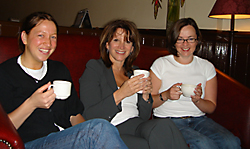
Coffee morning in support of Macmillan NursesYesterday my pub – well I say my pub because my constituency office is upstairs – had a coffee morning this morning to support Macmillan Nurses. It was part of a national thing today – and I love The Three Compasses because they really are a community pub and do community things such as this – and have Fairtrade products and care about all of it.

Seemed to go pretty well with a steady, if small, flow of people coming in to support the campaign.

It’s funny, you know, for all of us who have been supported by Macmillan nurses when our loved ones have been dying – we all turn to each other and say ‘they are angels’. For those who are lucky enough not to have had to come into contact with them personally – these are the most wonderful beings who come into your home and do the things for the dying that make them comfortable – as comfortable as possible – as their ending comes. And it is also the comfort they bring to the family tending the dying person.

I know when my mother was dying – those last couple of days (and more importantly nights) were gruelling and the weeks before had been gruelling – but when the Macmillans came, some of the lonliness and anguish was reduced. It’s really hard to explain.

So as I say – for those of us who have experience of Macmillan nurses – we can’t sing their praises high enough. I am pictured with Ellen on my left and Kerry on my right. Ellen and I briefly shared the fact that both of us had had parents where Macmillans had come in – and agreed – they are definitely angels.

Our community’s secret vice

But it’s a wonderful vice – it’s growing things! Having attended a number of horticultural shows this summer, including the Highgate, Muswell Hill and Hornsey Horticultural Societies – I have been staggered not only by the produce and exhibits – but the commitment and participation by so very many local people to this raging passion.

Now a veteran of a number of local shows – I am wise to the fact that most of the First in Show honours are collected either by Gary Sycamore or Eric Gurman – who basically clean up on each occasion. However, as one woman who kept coming second to Eric said to me at the Muswell Hill show – that when she does get a First Prize and beats him – it really means something to beat such a master. And there are so many categories – that others do get their chance to shine.

A tremendous amount of effort goes into organising and arranging these shows – and they are all incredibly well attended and very much enjoyed by everyone. Personally, I love them. I cannot grow things myself – for two reasons: a) incapable and b) time poor! But one day, when I have time – it’s on my list – because it is such a joyous thing to do.

I am always amazed at how such beautiful flowers and vegetables come into being – despite last summer with no rain and this summer with nothing but rain. Over my two years of shows, I am learning about what makes a perfect vegetable or bloom and that the National Horticultural Society judging has very strict, high and testing criteria.

It is also clear that there is a wonderful community that grows up around allotments and horticultural societies. This year I ‘launched’ the new ‘shed’ for the ‘Golf Course’ allotments – the result of lots and lots of work in terms of bidding for a lottery grant. Now we have a splendid shed – and a community who all know each other, where the kids can play and where actual food is grown! This isn’t just about shows – this is a real opportunity to bring people together, make people feel part of a community – and to produce wonderful vegetables which save a lot of money.

I was given a basket of vegetables to take home from the Muswell Hill show – and the vegetables just tasted heavenly – completely different from the ones I buy. It makes you think!And it is not just the taste that appeals – it is knowing that there is a vibrant community behind the growing of the fruit and veg that appeals too – because so often, especially in our urban areas, community ties are so weak and hardly anyone knows anyone else.

Anyway, this is just one of the best of local community activities and individual pastimes that you can get. I ran into one of my Liberal Democrat colleagues at the Hornsey show, Cllr Errol Reid (Hornsey) who is now campaigning to expand horticultural horizons. Errol wants to get the National Horticultural Society to extend its judging categories to window flower boxes and stuff grown inside – so that not lucky enough to have access to an allotment or garden can join in the fun!

(c) Lynne Featherstone, 2007

Fair funding for Harnigey's schools

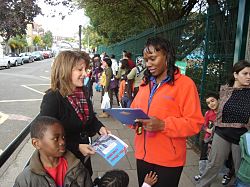
Collect Lynne Featherstone campaigning against the £736 per pupil under-funding of Haringey schoolsmore signatures for my Fairer Funding for Haringey Schools – outside Rokesly School today. The basic issue is straightforward – Haringey schools don’t receive as much money per pupil as schools in neighbouring boroughs – hence my petition (click here to sign it online).

From the reply from Ed Balls so far – he acknowledges there is a problem and that a simpler formula is needed, is carrying out a review and hopefully in 2011 (!) will introduce an improved funding formula.

So – pressure to be applied, because our children and teachers shouldn’t have to wait until possible changes four years hence – though the good news from his response is that it suggests pressure may yet succeed as there’s a chink of light there already.

Nick Robinson refuses to show me his balls

I had my hopes up when lovely Nick appeared on the TV this evening … but alas, they were dashed.

Another BBC news reports about Gordon Brown, general election date and all the will he won’t he dithering.

On to screen strides Nick Robinsonhe whose balls I wish to see – and we see him confront the Home Secretary about general election date – but what then happens? Soft question, easily batted away.

None of the tough questions about why in a democracy the PM should be able to pick the election date that most suits the PM’s electoral prospects. None of the tough questions about the hypocrisy of Brown saying he wants to get on with governing – whilst at the same time happily stoking up election date speculation.

Now – I know Nick Robinson can be a tough interviewer when he wishes – indeed, I still remember him clearly chasing Sir Ian Blair (London policeman) down the stairs, along a corridor and through to the outside, thrusting microphone in his face and asking tough, aggressive questions.

So come on Nick how about it next time – how about addressing the tough questions to Labour?

What's happened to Tony Blair?

I have been astonished at the lack of Blair at Labour’s party conference. Obviously not in person – but it is as if the collective guilt of those he left behind has painted him out of their history. Hate to point it out guys – but you all (with honourable exceptions) voted for the war, kept quiet or in Gordon’s case – signed the cheques.

You can’t lay it all on Tony – you were all there, cheering and voting him on. New Gordon? Doesn’t wash with me!

The pressures on young girls

In a class a couple of years above me at my secondary school was the most beautiful girl imaginable.To those of us less physically blessed teenagers – she embodied all that we wished for. She became a model at about sixteen gracing the covers of the top fashion magazines. One day at assembly, the Headmistress said she had some sad news to give us. This girl, this beautiful being, had been found dead in a suicide pact with her boyfriend in New York.

Of course, I don’t know the story behind what happened – but it was a salutary lesson about how there is so much more to life and happiness than physical appearance.

We all have a hard time growing up. Some of it really painful. Much of it to do with will I be liked? Will boys ask me out? And even if they do -that never really assuages the self doubt. And even if it does – just wait until you next see the TV, read a newspaper or pick up a magazine. Look younger now, Be slimmer tomorrow. The pressure to be self-conscious and anxious about your image is nearly relentless – and that much harder to deal with the younger you are.

At the recent Liberal Democrat conference in Brighton, I was invited to speak at a fringe meeting where the report ‘Under 10 and Under Pressure’ was launched. The Girl Guides along with Beat (the UK’s leading eating disorder charity) had commissioned research into girls between 7 and 10. It seems incredibly young – but there is an increase in eating disorders amongst this age group – and that’s only one aspect of the pressures so many young children seem to be under from our modern society and media And what kind of identity does Western society offer to women and girls? Why does this lead to such dramatic problems of self-esteem, such as depression and eating disorders?

Well – if you ask a woman what she likes least about herself, she will rarely say “I hate my personality”; instead she will say “I hate my teeth”, or thighs, or some other physical attribute. I am as guilty as the rest.

Of course, the younger a person is, the less capacity they have to counter negative influences, due to their lack of experience and intellectual maturity. Children will be influenced by myths of perfection much more easily than adults. And it is becoming increasingly difficult for them to resist, given that ever-younger demographics are being targeted by advertisers, acting on behalf of business wishing to sell products to a new market.

Now, it’s very easy to blame the media as regards promoting these superficial values, where physical perfection is prized over internal integrity. And certainly, the media IS the primary arbiter of our culture; its influence is ubiquitous and provides the benchmark by which we judge ourselves. However, laying the blame solely at their door is not desperately constructive.

The lifestyle of the pre-teens has been the focus of a relatively recent campaign of commercialization, including adult-style clothing and makeup at the same time as they have unprecedented access to the media via the internet.

So the pressure to become mini-clones and mini-consumers is immense – and the effect on some girls has clearly been the same as on their teenage counterparts.

The answer is to seek balance – to value forms of status other than simply appearance. So, friends, activities, sport, study – and just being a nice person – kindness, humour, gentleness – need to become valued virtues.

Part of the solution lies with the media – and what a fantastic service it is that the BBC provides with its CBeebies channel, allowing children to enjoy the best of what TV can bring – the fun, the entertainment, the education – without being subjected to a commercial barrage of advertisements. That is public broadcasting at its very best.

But the clear message from the research was how important peer relationships are to young girls’ self-esteem.

This is why girl-guiding, or groups such the Girl Guides are so important, as they offer the perfect environment for girls to develop in a safe and secure environment – helping them to improve and develop positive self-esteem and to see values both in life and in their compatriots that go beyond appearance.

(c) Lynne Featherstone, 2007

Gordon Brown and election dates

Having complained before about how easy a ride the media are giving Gordon Brown over his rather arrogant attitudes towards election dates, treating our democracy as if it is his own personal plaything – full credit to Jonathan Freedland for writing:

The absurdity that the timing of our elections is in the hands of the prime minister has to end. It doesn’t just destabilise our politics; it is grotesquely unfair. British elections are running races in which one of the contestants gets to fire the starting gun. So when Gordon Brown finally names the date, let him also vow to be the last prime minister to exercise that privilege. Let’s give our parliaments fixed terms – and end this guessing game once and for all.

Well said!

UPDATE: And also good pieces over on Paul Linford’s blog and The Herald.

Plans for the NHS

Well, well, well! So Health Secretary Alan Johnson has outlined plans which aim to make the NHS more user-friendly for patients in his speech to the Labour conference. He said patients should be treated close to home and GP surgeries should open “at times and in locations that suit the patient, not the practice”.

I will be quoting this incessantly at Haringey PCT if they try and move our GP practises into the polyclinics! That’s the point I keep making. We need to be treated close to home.

As for this shenanigans with Brown and the election – a real man, a real Prime Minister – would put the country first! I rest my case!

South Africa: the difficulties of admitting you have AIDS

Back to blogging some more on my brief trip to South Africa the week before last – on my last day we were taken to the mines – open cast coal mines – by Anglo-American. (Click here for photos from the trip).

Brian Brink of Anglo American, who is a doctor whose energy and commitment to tackling AIDS seemed limitless and who had pioneered their program over years, had been with us throughout the tour. Today was to see the actual work going on – on site.

Not going detail by detail – but to capture the picture – the landscape as we approached the mining area was stark beyond belief – punctuated by the machinery of mining, sticking up and dominating the horizon with little oases where head offices, hospital facilities or clinics occasionally were to be found.

I confess I thought it a god-forsaken place to live – and the truth is that it is a pretty harsh life out there for the miners in a hard industry. But what struck me most throughout the day was that the workforce and their well-being was at the heart of this business – not in a touchy feely sort of way – but because decent treatment meant a healthy work force and a healthy work force meant productivity.

As we arrived at the first Head Office – we were greeted by John Standish White – and what a character he was. He put me in mind of a commanding officer – fair but firm, loved by his men and unafraid of tackling whatever issues came forth. In the room were all representatives from the three unions, the medical staff and the key managers. Briefed as to the prevalence of AIDS and the programs Anglo-American (AA) had put in place – we set off to see it all for ourselves.

The first group we met were ‘peer educators’ – a group of women (all volunteers) whose role it was to go amongst the workforce explaining what AIDS was and HIV – and that coming for voluntary testing and counselling was good because now (as opposed to only a few years ago) there was treatment – the anti-retrovirals – that meant you could live with AIDS.

We went onto to see the skills training area where women were being taught how to sew, embroider etc and were making gorgeous tableware. Next door there was restaurant / cook training. Those learning were generally the family of the miners. With relatively little possible employment in the area – skills training is vital. Likewise we met trainee metal workers and visited a youth centre.

All the while we are on Anglo American territory and all of these schemes are Anglo American programs. And we visited a clinic where the workers go for voluntary testing and counselling. We meet Peter – one of the very, very few miners who have ‘disclosed’ their HIV positive status and who are invaluable in trying to encourage and educate others to come forward. The stigma is still severe and fidelity not a local strong point.

At Kleinkopje colliery they are (now) having remarkably high numbers come forward in most of the departments – with the hardcore miners remaining the most difficult nut to crack in terms of persuading them to get testing. But the new incidence rate is still too high – albeit the trend is downwards. And ultimately to beat the disease they want to see no new infections.

We were then put into protective clothing to visit one of the open cast mines. We heard the blasting loud and clear before we leave the office block – and we bumped along a road constructed solely to reach the mines. What is particularly interesting in this stark, empty terrain of deep pits where coal has been mined is that there now is in place a program of refilling the mines and putting the earth back to how it was before it was mined. The scars of extraction removed and the landscape reinstated.

At the pit itself, we posed for photos with the excavating digger behind us. Massive piece of machinery with a cradle which could hold a London bus. I asked John about Anglo American’s views on moving into renewables etc – and it would seem that they are already planning in that direction. As I would hope.

Anyway – I want to get onto the last stop of the day – which was to Anglo American’s piece de resistance. Their hospital – brand spanking new and for all their employees. We had a presentation from Dr Pienar who runs the hospital – but the main event was to meet the local community.

We were told that it is possible that some members of the community may ‘disclose’ their status during this meeting. We entered the room where around I guess eighty or so people were seated – some are miners, their families, health workers from the hospital and so on. We sat – and there was another presentation about the work Anglo American are doing with AIDS and HIV – and then they ask a young guy, one of the health team, to come to the front and they announced that this brave young guy is willing to stand there, publicly and say he is HIV positive. And he did – and then asked if anyone else in the room who is HIV positive wants to come down and join him and disclose their status.

There was no movement at first. And then a guy in the front row stood up and moved towards the front – and then another and another and another. A whole torrent of people come down and faced the room. All HIV positive. All ‘disclosing’ for the very first time. This had never happened before.

Dr Brink said that this was the day they had waited for for many years. And then each of those who had come forward told their story. I was weeping. It was the most extraordinary occasion. And I would like to think that whilst there were many reasons and good things that came out of us three MPs visiting South Africa – this ‘event’ had partly happened because just by us being there we provided a catalyst for the occasion.

It was so moving. They were so brave. And I guess that from this will grow a support group for people living with AIDS and HIV for the first time.

It was quite something!