Ending violence against women and girls – the missing target in the MDGs

Here’s my final blog from New York, where I represented the UK at the UN Commission on the Status of Women. Also available here.

As I’m sure you know by now, I am passionately committed to tackling violence against women and girls wherever it occurs, and this issue was the theme of my last speaking event at CSW before heading back home.

The Millennium Development Goals have led to remarkable achievements in poverty alleviation over the last 15 years. But for all their good, the MDGs omitted a crucial element – a target for ending gender-based violence.

I’m proud that the Coalition Government is absolutely committed to the principle that every woman and girl has the right to live free from violence or the threat of violence. And that every women and girl should be empowered to take control over her own life.

So in the post-2015 international development framework discussions, we are focused on pushing for a stand-alone goal to empower girls and women and achieve gender equality, and mainstream gender across the whole framework. Within this, we are pushing for a target on eliminating all forms of violence against women and girls.

Over the last year, I have spearheaded a new multi-million pound programme to tackle one of the most extreme manifestations of gender-based violence – Female Genital Mutilation. And because of this solid foundation of work and momentum, this July the Prime Minister will host a major summit to tackle FGM as well as early and forced marriage – both domestically and internationally. Our aim is to galvanise political and popular support to end early and forced marriage and FGM within a generation. An ambitious goal, but women’s rights campaigners have always been ambitious! And I believe this goal is achievable – but only if we work together and ramp up our efforts to support this African-led movement.

Ending gender-based violence has been and will continue to be a long-fought struggle. And research shows we need to use a whole range of approaches and work across multiple sectors.  This includes addressing the entrenched social norms and gender inequalities that drive violence against women and girls.

There is a great need for more robust evaluations of initiatives that engage men and boys as partners and that create new social norms. Men and boys are crucial – we’ll get nowhere if women continue just to talk amongst ourselves.

So we need to invest in evidence to understand the causes of violence against women and girls, so that it can be effectively prevented.

That is why I was delighted to announce today that DFID is investing £25m in a new research and innovation programme called What Works to Prevent Violence led by the South African Medical Research Council. This flagship programme will support national governments and the international community to understand better what works in preventing violence against women and girls. It will also fund innovation grants for new interventions that have the potential to be taken to scale.

This research will take time. And we’ve got a long road ahead. But I believe if we all, men and women, work hard enough together we really can create a world where women and girls no longer live in fear of violence.
 

FGM event at the UN Commission on the Status of Women

If I needed any reminder of the degree to which female genital mutilation (FGM) has shot up the international agenda in the last couple of years, the scrum to attend this morning’s FGM event at the UN Commission on the Status of Women did the job. I was speaking alongside the First Lady of Burkina Faso, who I met on my recent visit there, ministers from Italy and Somalia, the head of UNESCO, NGOs and, most importantly, young people from across the world to discuss how to empower youths to end FGM. The energy in the room was palpable, and the panel represented some of the strongest commitment in the world to ending FGM.

FGM is one of the most extreme manifestations of discrimination against women and girls. It is violence against women and girls. I am very sure if we were talking cutting off men’s penises, this issue would be a priority – and it would have ended centuries ago! But FGM has carried on for thousands of years, and still goes on today.

That is why, as a DFID minister, I began my campaign to end FGM – a mission that fits well with my role as ministerial champion for tackling violence against women overseas. I have learnt from some of the most inspirational women – campaigners, activists, leaders – many of whom were in the room today. Bold, ambitious women who believed that change could happen. And I was told by African women and leaders that they wanted support. Now, I have heard some amazing young people add their voices to that call – including a young brother and sister duo who both spoke passionately about ridding the world of this abuse.

The young people who spoke today told us that they have been desperately trying to get leaders to listen to their calls to tackle FGM for years – and that finally they are in the room, and telling us not to ignore them any longer. They have felt the fear as they or their friends or sisters have been carried away to be cut. They know the feelings of sadness and shame and fury that their bodies no longer belong to them. They asked for our support to help them end this violence.

I will rise to that challenge and support these brilliant young people, who are the agents of change. I hope you will join me to end FGM in a generation.


Clean energy access for women and girls

Here’s my fifth blog from New York – this time on clean energy access for women and girls. Also available here.

There’s a key ingredient to women’s equality that just hasn’t made it far enough up the agenda, yet could literally power development: energy access for women and girls.

So, this morning, I spoke at a meeting hosted by the Global Alliance of Clean Cookstoves, of which I am a leadership council member, and Energia. I was also joined by Cathy Russell, US Ambassador for Global Women’s Issues. We were there to work out how to get clean energy access for women and girls firmly on the development agenda.

Women and girls’ limited access to clean energy has extremely negative consequences on their quality of life, as I’ve written before.  Put simply, without energy access, women and girls in the developing world are even more time-poor – time spent collecting fuel and water is time not spent on education or on paid work. They are least safe when they are out collecting fuel and water. And smoke-related illnesses are one of the greatest causes of ill-health for women and children.

That is why I have launched a DFID campaign to improve the economic opportunities, safety and health of girls and women through clean and affordable energy. I am working closely with the UN’s Sustainable Energy for All initiative – which took up my suggestion to focus the first two years of the Decade of Sustainable Energy for All on women and girls. And I am working to raise the profile of the women and girls’ limited access to clean energy, and to advocate for the international community to do more.

Research is an important first step to demonstrating the extent of the issue and developing and scaling up practical solutions. In May, DFID will be co-hosting a conference in London with the World Health Organisation and the Global Alliance of Clean Cookstoves to bring together research on clean cooking. Just last week, research that DFID and the Alliance jointly conducted was commended by the UK Climate Week awards. This research supports the Alliance’s target to enable 100 million households to adopt clean and efficient cooking practices by 2020.

The energy and development communities are finally beginning to understand and respond to the gravity of this issue and the need for action. But there is a need to improve awareness and action more broadly, and to push the international community to recognise that energy is a critical element in building gender equality and improving women’s health and economic opportunities – one that really can power progress on development.

UN Commission on the Status of Women – part 4

Here’s my fourth blog from my recent visit to New York for the UN Commission on the Status of Women. Also available here.

As long as there is gender-based violence, we will never achieve gender equality.  The Prime Minister appointed me as Ministerial Champion for Tackling Violence against Women and Girls Overseas in 2010 for exactly that reason.  And today Poland organised their first ever high-level conference on women’s equality, which I have just attended and which focused on this issue.

67% of women will experience gender-based violence at least once in their lives.  This doesn’t just cause short-term damage.  It can silence women’s voices, stop them from accessing work and economic opportunities, and prevent them from making choices about their lives.  It closes down women’s freedom and opportunities, but it also has a knock-on impact on families, societies and countries as a whole.  This makes combating gender-based violence a prerequisite for achieving gender equality and reducing poverty.

This afternoon I had the chance to share the UK’s experience on tackling gender-based violence.

In 2010 the Coalition Government published its Call to End Violence against Women and Girls strategy.  This strategy is a public declaration by the government that violence against women and girls is unacceptable and is an issue that we are committed to tackling together – in the UK and overseas.  We launched our latest National Action Plan to deliver this strategy on 8March to mark International Women’s Day.

The UK government announced this weekend that we will hold a summit this year on FGM and early and forced marriage – two examples of gender-based violence that we are committed to eradicating, and that link the domestic picture in the UK with our work in developing countries.

In the UK, our Forced Marriage Unit provides assistance to victims as well as reaching out to practitioners and communities to ensure that people working with victims are fully informed of how they can help.  Overseas, the unit provides consular assistance to victims prior to or after a forced marriage to secure their return to the UK.

In 2012, the Prime Minister announced that the Government will make forcing someone to marry a criminal offence.  In doing so, we are sending out a clear message that this brutal practice is totally unacceptable and will not be tolerated in the UK.  That legislation is currently being progressed.

Internationally, the UK government is driving change throughout the humanitarian system to ensure that girls and women are protected from violence during an emergency; leading the way on tackling sexual violence in conflict through our Preventing Sexual Violence Initiative; leading a flagship programme on female genital mutilation (FGM) at ending the practice within a generation; and investing in evidence of what works to prevent violence against women and girls in the first place. DFID supports programmes to address violence against girls and women in over 20 countries.

We believe that our approach and actions in the UK are making a difference, as well as making a strong contribution to our international work – and in turn our international work is intrinsically linked to how we make progress here in the UK.  But we are not complacent – there is much more to be done.  We will never stop our efforts to tackle violence against women and girls until we have achieved our ambition that women across the world can live productive and happy lives, safe from violence and abuse.

Changes to the 263 Bus – have your say

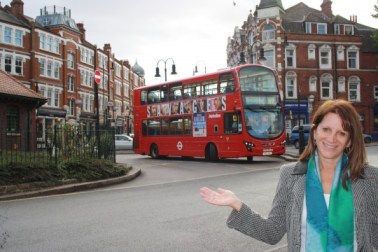
Lynne with approaching W7 busTfL are planning to extend the 263 route which currently runs between Chambers Road and Barnet Hospital. I am aware that many constituents use this service, which stops at Highgate, Muswell Hill, and Fortis Green on its way to Barnet.

The plan is to extend the route along Holloway Road, stopping at Highbury and Islington station and terminating at Highbury Barn. This will mean a more frequent service along Holloway Road, but three current stops will no longer be used.

TfL are consulting on this to establish how local people feel this will affect them, and so please do let them know what you think. The consultation closes on 11th April – more details and the survey can be found at https://consultations.tfl.gov.uk/buses/bus-route-263.

Everyday sexism

Here’s my third blog from New York – where I am representing the UK at the UN Commission on the Status of Women. Also available here.

There is immense power in the act of naming. Naming something so widespread that is passes almost without comment, like breathing or gravity, or the colour of the sky. And yet, for women everywhere, it has a huge impact on our lives.

Such is everyday sexism, the topic of a UK-Denmark panel event I just participated in at the UN Commission on the Status of Women.

I pay tribute to the work of the Everyday Sexism Project, which has collected thousands of testimonies from across the world. Some of them are really chilling, others more banal. But of course the crux of the issue is the banality of the evil: that any one catcall can be shrugged off. But the cumulative impact of the drip drip drip of unwelcome sexual advances and unrelenting critiques of women’s bodies and abilities have a corrosive effect upon all of us – men and women – and on the societies in which we live.

From a very young age, most girls learn to mentally brace themselves before they walk out the door each day. Women and girls develop coping strategies – smile nicely, find a cheeky riposte, get angry, pretend not to hear, put our heads down and quickly hurry past. Frankly, we’re expected to be big girls about it and lighten up. Well, I’m not lightening up.

And don’t think women politicians are immune from this treatment. We experience everyday sexism and then some. The online trolling some of my colleagues have suffered is disgusting. And in the House of Commons itself, if ever a female MP makes a pertinent point, it’s not uncommon for her to be told “calm down, dear”.

Everyday sexism is not inevitable, it is not harmless, it does matter, and it can and must stop.

It matters because it drives girls and women into a crippling self-consciousness and self-objectification. When the world tells you how you look and what you wear are all that matters, it’s no wonder so many girls’ psychological development is damaged.

In the UK, our primary focus has been on creating a supportive framework of equality legislation, and we are world leaders in doing so. There has to be a bottom line that women are entitled to equal treatment and the state will step in to enforce that.

We also have an inspiring campaign to prevent sexual violence among young people, called ‘This Is Abuse’. This year we are particularly focused on reaching boys, encouraging teenagers to re-think their views of violence, abuse, controlling behaviour and what consent means. Men and boys are crucial to this change: we’ll get nowhere if women and girls are just talking amongst ourselves and everyday sexism.

We have also taken action to tackle stalking and harassment, which includes harassment and abuse via social media.

I could go on for sometime outlining all the Coalition Government is doing, but suffice it to say we are enforcing the law and encouraging conversations about gender roles and stereotypes generally. To be clear, it’s not for government to tell parents how to raise their children, or to tell men and women how they should feel about being men and women. But I believe it is entirely appropriate for us to question barriers to an individual’s control over her own life and do all we can to empower that individual – I am a liberal after all! And I’m grateful that countries like Denmark are helping us spread this work internationally.

Joining the CrossSafe campaign for road safety

Lynne Featherstone MP discusses the safety issues at the Junction with local CrossSafeN10 campaignersLynne Featherstone MP last week met with CrossSafe N10 campaigners to discuss the problems with the junction on Alexandra Park Road, Colney Hatch Lane, and Pages Lane.

The residents have long been campaigning for better safety on and around the junction.

On the site visit, the residents described the problems faced on a daily basis – including drivers not realising that there is a second red light and driving through, pedestrians not being able to see oncoming traffic, poor phasing of traffic lights, and no ‘green man’ signalling to guide pedestrians.

Campaigners say that these problems pose a safety risk – and that they have seen many near misses.

The Liberal Democrat MP – who has previously made representations on this issue – has now written again to both Transport for London and Haringey Council (who share management of the junction) and requested a site visit with them and the local residents.

Lynne Featherstone MP commented:

“These residents have done a fantastic job of raising awareness of this issue and campaigning for better road safety at this dangerous junction.

“I am happy to get involved to support their cause. I have now written again to both TfL and Haringey Council, demanding a meeting with them on site so they can see the problems for themselves.

“I hope this will lead to action – vast improvements on this junction may well be necessary to prevent a serious accident here in the future.”

UN Commission on the Status of Women – girls and disability

Here’s my second blog from the UN Commission on the Status of Women, where I am representing the UK as International Development minister. Also available here.

The world has been guilty of turning a blind eye to the challenges, discrimination and abuse people with disabilities – especially women and girls – can face every day. They are disproportionately some of the poorest and most marginalised in the world, meaning there is a direct link between gender, disability and poverty.

This was the theme of the first event I participated in just now at the annual UN Commission on the Status of Women.

Being a woman or girl with a disability often also brings the risk of violence and abuse – anecdotal evidence suggests even twice as much. And this abuse comes even, sometimes especially, from their closest family members.

As the DFID minister responsible for disability and as the UK’s ministerial champion for tackling violence against women overseas, I have made it my mission to ensure both disability and violence against women become key priorities in international development.

Although DFID is already doing some great work on disability – particularly around inclusive education, water and sanitation, and social protection – I felt this work was not mainstreamed enough. That’s why I announced new DFID commitments last year: that all schools directly funded by DFID will be fully accessible and to improve the data on disability which is so essential to understanding where and what the exact challenges are. And I’m working on more new commitments, so watch this space over the coming months!

But this is a global challenge and it needs a global effort to tackle it.

We now have a once-in-a-generation chance to finally put disability high up on the global agenda. Over the next 18 months the world’s leaders will negotiate the post-2015 development framework, and I’m going to be doing everything I can to make sure that no one is left behind.

UN Commission on the Status of Women

I am currently in New York representing the UK at the annual UN Commission on the Status of Women. Here’s a short blog from day 1 – also available here.

I’ve always said that, as great as ‘international days’ are at galvanising action on an issue, when it comes to women and girls we need to take action on the other 364 days too.

That’s why I’m so pleased that the Prime Minister will host a summit in July to tackle Female Genital Mutilation (FGM) and Early and Forced Marriage (EFM).  I’ve been spearheading the Coalition Government’s work on tackling FGM at home and abroad over the last year and the Prime Minister’s summit will send a clear signal of just how seriously we take this issue.

And that’s why, hot on the heels of attending the brilliant Women of the World event at the Southbank Centre for International Women’s Day on Saturday, I’m here in New York for the annual UN Commission on the Status of Women (CSW).

I’ll be attending a whole load of events as well as talking to my counterparts from around the world to ensure the CSW negotiations lead to a commitment to finish the job of the Millennium Development Goals (MDGs) and to support the inclusion of a stand-alone goal on women and girls in the development framework that replaces the MDGs when they finish in 2015.

I’ll be posting short blogs over the two days I’ll be here on a range of themes – and I invite you all to join the conversation on women and girls that the UK government is leading in 2014.

Demanding answers from Homes for Haringey on Noel Park repairs

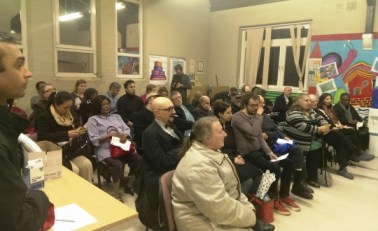
the audience at Lynne Featherstone MP's public meeting on the Noel Park estateLynne Featherstone has contacted Homes for Haringey to demand an update on urgent repairs to the Noel Park estate.

The Liberal Democrat MP held a public meeting in Noel Park three weeks ago, to give residents the chance to have their say and raise issues with housing chiefs from Homes for Haringey and Haringey Council.

Dozens of residents spoke of their need for urgent repairs, which Homes for Haringey agreed to fix as a priority.

The Wood Green MP has also contacted residents to ask them about the progress made.

The public meeting was called because of the lack of Decent Homes and urgent repair work being made to the houses on the Noel Park estate – a real let down to residents, particularly in light of the recent Homes for Haringey bonus scandal.

Lynne Featherstone MP commented:

“Increasingly, residents from the Noel Park estate are coming to me for help with their housing, because Labour-run Haringey Council and Homes for Haringey just won’t listen to them or take action.

“Enough is enough. It is so unfair for residents to live in such bad conditions, while Homes for Haringey repair staff receive £3.7 million in bonuses.

“I will keep chasing Homes for Haringey to make these repairs. I am asking residents to keep me informed, too, to make sure I get the full picture.”