The financial crisis

Here’s my column from this week’s Ham & High:

Hey diddle, diddle – are we the mugs who got diddled? As one financial institution after another crashes into trouble, will it be just Northern Rock the taxpayer has to bail out, or will be end up picking up the pieces for even more blunders?

Between them HSBC, RBS, Barclays and HBOS (as was) have written off $52.9 billion – without any individuals being held responsible. Imagine the outrage there would be if the government had lost even a fraction of that amount of money.

At least we’re not US taxpayers – who are going to have to foot the bill for bailing out a huge chunk of their financial system. The “masters of the universe” turned out to be rather puny – not nearly as smart as they thought but – just to add a grating edge, leading their firms into disaster hasn’t stopped them walking away with huge pay packets and pension pots, either in the US or in the UK.

When it comes to bombs or banks – governments always find the money to send in the troops or to bail out the banks. That’s certainly not the story when it comes to public services like health, education or the police – or post offices for that matter!

The ability of a bank to come crashing down with wider consequences does make them a sort-of special case, but this knowledge that the taxpayer may have to bail them out should come with consequences: not just effective regulation, but also personal responsibility. If you make cause a firm to crash, why on earth should you still be picking up bonuses for your performance? That is an obscenity.

And lo and behold – Gordon was in full agreement with me about this last Sunday in his television interview with Andrew Marr – but outside of trying to gain brownie points for being against obscene bonuses – had no methodology to deal with them. Also – ‘scuse me – but wasn’t he Chancellor for the last 10 years when he did absolutely nothing to stop the orgy of irresponsible borrowing, lending, cheap credit and obscene bonuses?

Much of the crisis management we’ve seen in the last few months has been about merging firms. Understandable in the circumstances – but is a financial system of fewer, bigger firms really going to be more resilient in the long-run – and that’s leaving aside the worry that fewer firms will means less competition will means even more banking rip-offs for you and I.

I fear that driven by the desperate need to keep things going now, we are going to end up with a financial system that can very easily fail again because with a smaller number of larger firms, the fallout from one going wrong in the future will be much, more worse.

Strength in the financial system should come from diversity – a large number of firms so that one mistake doesn’t infect the whole system (and also so that most are small enough that those running them can’t simply assume that if they get it wrong someone will bail them out). It’s not just nostalgia to think back warmly to the days of local banks and building societies – there is real merit in promoting diversity too.

But we should also turn our eyes to the auditing profession. Where have the auditors been? We now know just how risky the financial plans were of many firms – but where were the warnings from the auditors about the assumptions that the businesses were staking their futures on? There is a question about the relative roles of auditors and non-executive directors in supervising and highlighting risks – but between them they failed. Just as we are seeing major restructuring amongst firms, we should also see a major rethink amongst auditors. If they fail to warn properly about the sort of financial risks we have seen come home to roost, are they really doing all that we should want auditors to do?

So all in all – it’s us who are being diddled. At every turn our financial well-being has been last on anyone’s list!
How to overcome my aversion to lobbyists

A short piece I wrote for Insight Public Affairs’s 2008/9 guide to lobbying:

I developed an aversion to lobbyists when I was a candidate for election to Parliament. Given it is the job of lobbyists to seduce actual and would-be MPs, so that they will regard their cause or client favourably, you might think something had gone wrong. It had!

And it’s a shame – because so many of the organisations and causes that lobbied me had views that should have found me a willing audience.

What went wrong? Generally lobbyists didn’t understand how and when to present their case. As it’s simplest – candidates in elections are at their very busiest in the immediate run-up to an election. So is that the best time to approach? No! Yet many organisations stay quiet for four years and then suddenly think the four weeks of a general election are the best time to make contact. There are good and bad times all through the Parliamentary cycle – and you’ve got to know them.

And the amount of money organisations pour into the glossy brochures and lobby companies needs to be well spent. From what I could see – it was more about the lobbyists ticking boxes and telling their clients that they had contacts x-thousand of candidates and had x responses.

No – my advice to those who seek my support is to think about me. Think about my time commitment. Think what will really benefit the cause – and what you really want me to do, and how to break it down into simple, easy to get started requests. Then you will build up a dialogue and in time a long-term relationship.

My life is over-flowing with information. You may want me to take onboard your information, but what’s the reason why I should? No matter how worthy your cause or how persuasive your case – there is not enough time in the day for me to take on board every worthwhile or relevant scrap of information. So how do you make your own cause really stand out?

You have to know me, and think of me as a person – not as one of a group of MPs or candidates. It’s not all touchy feely by any means. Top statistics to support a cause are the absolute bees knees for me personally. The lobbyists who provide local statistics, local activities, local information etc – they are the ones who really get through.

Tick box campaigning begets tick box support. Make it real. Make it worthwhile. Make it genuine. I am nobody’s fodder!

One Minute

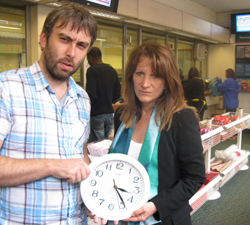
Went to the theatre last night to see a play directed (and co-produced) by a constituent – Robert Wolstenholme. One Minute (Courtyard Theatre) is the story of the disappearance of a young girl who goes missing in the middle of a crowded West End. The only witness isn’t sure of what she saw. It is completely brilliantly acted and directed and very, very cleverly staged. The set was really ingenious. So – nice break from campaigning for Nigel Scott in the Alexandra by-election – but it was back to the campaign trail first thing this morning – as you can see from the photo.

Good news on the monarchy

So – Downing Street has at last seen the light – and is making noises (obviously following my recent campaign – and honourable others over the years) to end the discrimination in accession to the throne. The first born boy has always, literally, ruled supreme and shoved any earlier born sisters out of the way. But from reports in the papers Downing Street is considering bringing in laws to reform that tradition – and also the bar against Catholics taking the throne.

Sadly they are talking about implementing them if Labour won a fourth term. Don’t wait! It’s such a bleeding obvious thing to do – no need to wait. Just get it done promptly!

UPDATE: Coverage in the Daily Mail here.

Down with focus groups

I’ve had a bit of a bloggoliday – as you may have noticed from me largely posting speeches etc. – just felt like it. Is that a sin in bloggology? Probably! Anyway – am easing myself back into it.

Follow up on my Question Time appearance last week where Ian Hislop (now famously) gaffed. Ian said in answer to a discussion about what Sarah Palin had done for McCain’s campaign amounted to, something like she brings glamour to the political world where there is none. Now Harriet Harman and I may not be totally gorgeous – but hey – we ain’t that bad! The gaffe was very funny (possibly the best bit of QT) – I thought – and Ian said it had now gone all over You Tube etc. The BBC have even put it on their own site – which I thought was a bit mean!

Upshot of guilty conscience was invitation from Ian to a Private Eye lunch – which I went to yesterday. So – Ian – you are forgiven!

Talking of Sarah’s – what on earth was Mrs Brown doing? I cannot bear spouses being brought on stage at the end of speeches to make their spouses look human and present family values. Having them on at the beginning a la Obama style is even worse. I know it’s the done thing stateside – but I thought full marks to Nick Clegg for not dragging Miriam up on stage after his speech. Yes – come off – have a hug and a kiss – but not the American dream family thing. Maybe it is my bitter and twisted outlook on life – but all that stuff is just so old hat. I know – the focus groups probably say that the people love it! Down with focus groups then.

What do drama and drill have to do with youth crime?

That’s the headline on a piece I did for the Liberal Democrat Education Association’s booklet, Liberal Democrats in Education: what we are thinking and doing, which has just come out:

Labour has poured huge sums of money into the youth justice system since they came to power in 1997 – but failed to make an impact on youth offending. Labour has used the justice system as the main focus for the provision of the social support that at risk children need through Youth Offending Teams and spent more than 10 times as much money on youth courts and custody than on preventative measures. This has led to more children entering the youth justice system than ever before without altering the level of criminality. This approach is based on an assessment of the symptoms rather than the causes of youth crime and a presumption that removing a few bad apples will save the barrel – but it will not work if the barrel has dry-rot.

There needs to be a shift in emphasis; criminalising children should be a last resort, not the first option. It is essential that young people are given the support and guidance they need to grow into responsible adults. A key factor in this is involvement in adult-supported activities. Whether this is the Cadets or a local drama group, it is through constructive activities that young people learn how to behave. Children from wealthier backgrounds tend to be involved in more adult-supported activities than those in poverty- and it is here that social exclusion enters the debate.

As with education, deprivation is a significant factor in determining outcomes. This is partly because wealth allows us to buy dance classes and drama lessons for our little cherubs, but also because people living in wealthier areas tend to be more willing to set up Scout Troupes or drama groups- they tend to have greater community spirit. This is where I believe good government can make a difference- by enabling community activities and releasing the latent good will that there is in our communities we can begin to build the community capital.

The fact is that stronger communities lower crime – the more people you know within a fifteen minute walk of your home, the lower the crime rate will be. Stronger communities mean more likelihood of intervention when people misbehave. The question must therefore be: how do we strengthen communities to prevent youth crime?

Central to this is giving back to communities a genuine role in the justice system – restorative justice, where victims confront a criminal with the consequences of their crime give both victims and perpetrators a better understanding of the motivation and impact of crimes; Community Justice Panels, where representatives of the local communities agree a course of reparation with the offender allow the community to feel that justice has been done; and Acceptable Behaviour Contracts (ABCs) which agree levels of acceptable behaviour with an offender can all contribute to a genuinely community-led justice system.

There needs to be an understanding of the context that allows young people to become criminals and a focus on creating the communities and activities that will divert children away from crime. Changing the system to include the community can help with this but it is also essential that adult-led activities – such as drama and drill- allow young people to learn how to behave and to develop aspirations. By simply fast-tracking children to custody, all Labour has done is spent an enormous amount of money and increased the public fear of crime – not a good result!

Take part in my Post Office queues survey

Lynne Featherstone and Cllr Richard Wilson at Crouch End Post OfficeI’ve distributed a survey to every house across the Hornsey & Wood Green constituency asking people to record how long they have to queue at the Post Office.

I want to get a comprehensive assessment of the level of service following the spate of Post Office closures (five serving the area have gone). The findings of the survey will be presented to the Post Office and – if they show unacceptable waiting times – will be a good source of pressure to review the closures.

I’m particularly concerned that not only have five Post Offices gone, but that so far there hasn’t been compensating investment in the remaining ones – not only will people have further to travel, but they could also face long queues as more people are crammed into the same capacity at our remaining Post Offices.

If you haven’t had a survey yourself for some reason (or would like another copy), just get in touch.

Damning report into Alexandra Palace deal published

Press release is pretty self-explanatory, so here it is:

Haringey’s Liberal Democrats are calling for the resignation of Labour’s finance boss and former Council leader Cllr Charles Adje following the publication of a damning report into how, as Alexandra Palace Chair, he pushed through the controversial licence for Firoka to operate in the building. The Liberal Democrats say the revelations in the report show he can’t be trusted to run the boroughs finances.

The report into affairs at Alexandra Palace was published late last week for consideration at an emergency Alexandra Palace board meeting this Friday. Among the most scandalous of many revelations in the report is an assertion that Cllr Adje pushed the controversial licence through for political reasons, so that he could tell the Haringey Labour group’s Annual General Meeting it had been achieved – at which time Cllr Adje was bidding for the job of Labour finance boss.

Whilst Cllr Adje claims to have had limited involvement in the process, the others interviewed for the report indicate that it was he who was driving the ill-fated process forward.

Haringey Liberal Democrat Leader, Cllr Robert Gorrie, comments:

“Firstly, it’s clear that Charles Adje must be removed as soon as possible as the Haringey’s finance chief. There are many damning revelations in the report, but suggestions that Cllr Adje was rushing this disastrous process forward, without proper procedures in place, in order to suit the needs of the Labour Group’s Annual General Meeting is an absolutely scandalous revelation. This point alone requires further serious investigation.

“This politically motivated incompetence has cost Haringey’s taxpayers millions of pounds. Why was Haringey Council so slow to take steps to bring the Palace into line? The Liberal Democrats, and local campaign groups repeatedly raised the issue from last July onwards. Cllr Neil Williams brought it to the Council, to the Cabinet, and to the media. It was raised repeatedly by Lib Dem Ally Pally board member Bob Hare, whose demands for answers were simply brushed aside.

“Following a request by council officers there will now be an action plan to ensure that this does not happen again – but this is as much about incompetence as it is about governance. No amount of procedural changes will protect the Trust from people in charge who have shown they should not be in such positions of authority. That’s why Charles Adje must step down.”

Lynne Featherstone MP adds:

“This is a flagrant abuse of power which appears largely to have been pursued because of political self-interest. This is not someone who should hold the purse strings to half billion pounds of public money through Haringey Council’s finances. Further questions must also be asked how this was able to carry on without the scrutiny of the rest of the Labour party and the Council.”