Lessons from May's elections

To start, three pieces of promising news: in six of the last seven annual rounds of local elections, the number of Liberal Democrat councillors has gone up. Secondly, the change in our vote in Crewe & Nantwich was pretty much the same as in Dudley West, South East Staffordshire and Wirral South – the three big Labour gains from the Conservatives in the run-up to 1997 – a general election at which we then made huge gains in the numbers of MPs we had.

Add in to that the steady but very clear improvement in our poll ratings since Nick Clegg became leader, and there’s plenty of cause for quiet optimism about our electoral prospects – provded we put in the hard work necessary.

But we shouldn’t be complacent that just any sort of hard work will deliver the right results, and there are two signs in that news that we need, in particular, to broaden our strength across the country. Whilst we have been gaining seats at local elections, our overall share of the vote has tailed off in recent years. And in addition the Crewe & Nantwich result reminds us of how much harder work it is to win when we start in third rather than second. More strength across the country will not just deliver us more councillors and councils, it will also up the odds of a Parliamentary by-election being a real chance for a breakthrough for the party.

We also have the prize of overtaking Labour as the second party of local government hanging tantalising in front of us – Labour has only 600 more councillors and on The Guardian’s figures after this May they have only three more councils than us.

The challenge, therefore, is to do at the council level what we have done so successfully at the Westminster election level. Over the last few elections, and carrying on since 2005, we have managed to combine both a very clear and strong targeting strategy (having to persuade along the way many who are tempted to spread efforts thinly to little effect!) whilst also growing the list of seats where we are in serious contention at the same time.

Yes, we put a far higher proportion of our resources into the key Parliamentary seats than we used to – but also, the number of such seats has grown. It’s this mix of focusing efforts on the key battleground constituencies whilst also increasing the size of the battleground that has allowed us to continue to grow in the number of MPs and win places where we were nowhere ten years ago – such as my own Hornsey & Wood Green where in 1997 we were on 11%, with no councillors, not even any second places in any wards and no delivery network.

I have personally been particularly struck by the increasing numbers of fellow MPs and would-be MPs I meet at the party’s training weekend for key seats – each time we seem to have had a bigger and better team.

But how do we replicate that on a local level – so that we continue to build on the hugely powerful impact of careful targeting and focusing of resources on those areas where they can make a difference, but at the same time make a much larger number of seats and councils competitive so that we are expanding our base across the whole country?

Too often those are seen as conflicting aims. But whilst it is certainly true there is some tension between them, I believe we have been at our most successful where we have found ways to achieve both at the same time.

Those with an interest in American politics may notice the parallels with the “map changers” strategy of John Edwards and the “50 states” strategy of Howard Dean – both wanting to concentrate on the really winnable races whilst also growing the breadth of the party so that it doesn’t end up just hunkered down in a small number of redoubts.

As if that isn’t a hard enough circle to square – we also need a strategy that can actually be turned into specific concrete steps. Too often in the past plans to build up weaker areas, reduce the number of black holes and so on have turned out to generate lots of fine words but very little actual action.

This is an issue we need to address with some urgency because 2009 will, almost certainly, see local and European elections on the same day. And in those areas what message will it send to voters in the polling station when they see the Liberal Democrats on one ballot paper but not the other? That could rather undermine our otherwise very strong message about how we can win right across the country under the European voting system and how we are in a period of genuine three-party politics.

Indeed, I’ve been told that the most strident feedback the party has received via its website after both this year’s and last year’s local election has been from people angry that they went to vote – and didn’t find any Liberal Democrat candidate on their council ballot paper.

So – what should we do? I think we should set ourselves the following challenges.

First, to stand a record number of candidates in the 2009 elections. In 2005 we had candidates for 89% of the seats – around 260 short of a full set. That is a number that should be possible to crack next time – break it down per regional party, per MEP or Euro candidate, per MP, per whomever wants to help – we can make that a manageable individual target.

Second, to run an earmarked fundraising operation to allow people to “adopt” a ward where there has been no Liberal Democrat candidate for the last eight years and donate towards running a campaign there for the first time – and gather in the pledges in advance so local parties can see what is on offer to encourage them to stand a candidate! I suspect that in some cases there is a lack of ambition when it comes to standing candidates from local party committees, so here would be a really powerful way of helping to raise people’s ambitions.

Third, I loved the “Community Canvass Week” initiative the party ran for the first time last autumn to encourage people to get out on the doorsteps talking to the public. So let’s run it again – but with a big publicity and training drive in advance so that we get more people trying door-knocking for the first time – and so that we provide people who are in areas of very weak Liberal Democrat organisation “self-starter kits” so they can get going even if there isn’t a working local party organisation to run things. More people knocking on more doors in more areas – that is crucial to expanding the number of wards in which we are competitive, and will also do our European election prospects no harm at all.

Fourth, we need to lower the barriers for someone to move between thinking they want to do something to improve their area and finding that there is only a very weak party organisation and having read and followed everything in Chris Rennard’s How to win local elections book and ending up a local councillor. So my fourth suggestion is that the party should produce a more general self-starter kit, one that takes you through an easy to follow series of steps that help build up the party’s presence and strength – but short of running to win a council seats, because that isn’t for everyone – and if that’s the only option on offer, it will also put off those who might be willing to end up being councillors, but only after a more gentle introduction. Recruiting a couple more donors for the party, writing regularly to the local newspaper, using your own website to promote the party’s online campaigns – there’s a myriad of steps you can take, so let’s make it easy for people to take them.

And fifthly, we should ensure that we have at least a modest local internet presence covering every part of the country, helping point the public at more news about the party, how to join, how to get in touch with the local team etc. With the number of existing sources of news and information about the Liberal Democrats, I am sure it can’t be beyond the wit of a clever programmer or two to be able to put together an effective mini-site system that covers our internet black holes at a minimum of cost and effort.

There are I am sure many other ideas, but I’ve deli
berately picked up a relatively small number that, when broken down, would require any individual to do relatively little – at low cost of both time and money. Collectively though – it could make a huge difference to our ongoing battle to establish ourselves firmly as a major political party in all parts of the country – and to persuade people that British politics really is a three (and in Scotland and Wales, four) party system.

And how do we make it happen? Well – I’m sending a copy of this over to Ed Davey, chair of the party’s Campaigns and Communications Committee – because this seems to me to all be about campaigning and communicating better.

But – particularly in our party above all – it’s not about waiting for someone from on-high to impose a decision. Instead – it’s about what you do in your area. I wouldn’t be MP for Hornsey & Wood Green if I’d waited around for someone from on-high to decide I should be. I’m an MP because I and my colleagues locally made it happen: we got the ball rolling and in due course got help from outside. But the key was us wanting it to happen and taking our fate into our own hands.

So if you agree with any of what I’ve written above – take fate into your own hands too. Oh, and don’t forget first to go help in Henley!

This article first appeared on Liberal Democrat Voice, where you can also read the subsequent discussion.

(c) Lynne Featherstone, 2008
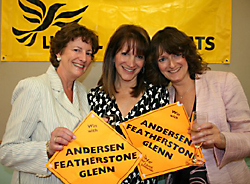
Celebrating ten years of victories

Saturday saw a party to celebrate the tenth anniversary of the very first Liberal Democrats being elected in Haringey – and both June and Julia (who with me became the first ever Liberal Democrat Group on Haringey Council) were there with many old and new faces to celebrate. Really great to see everyone again – even Ross Laird who came in when June had to move and then took over as Leader from me came down from Edinburgh. Really great occasion – much achieved and still the Council to be taken next time!

June Andersen, Lynne Featherstone and Julia Glenn: the original trio of Liberal Democrat councillors from Muswell Hill in 1998

Haringey Council leaves confidential files abandoned – again

Confidential files left insecure by Haringey CouncilThey may say that lightning never strikes twice, but when it comes to Haringey Council and stuffing up – one often wishes they could never make the same mistake twice!

It was bad enough when the news broke that Haringey Council had left files containing personal data on thousands people abandoned in a building (see my blog posting or watch the news report).

And then – after being told about it and saying they’d secured all the files – it turned out there were yet more files still left behind in the building.

After all that, Haringey Council promised that it had re-checked all council property for any other files that might have been abandoned.

Well – clearly they didn’t check very carefully because it’s now turned out that other files containing confidential information about people have been left insecure for over a year in a different building, despite the Labour-run council being repeatedly told about the problem.

It was only when Robert Gorrie (leader of the Liberal Democrats on Haringey Council) personally wrote to the council’s Chief Executive that something was done.

Dreadful, truly dreadful.

It could only happen in Haringey, part 94

More problems with the plans to redevelop / expand Muswell Hill Library as it turns out that the latest plans to sell off land at the back of the site to pay for the work … wouldn’t leave enough land left over for the library to expand after all!

In other words – sell off land to pay for work that they can’t be done because, er… the land has been sold off. So very Labour Haringey!

As my colleague, Cllr Gail Engert (Muswell Hill) put it, “It is ludicrous to think that the very development that was meant to pay for the extension is now the very barrier stopping this happening. Original plans showed the library and the development sharing the land equally – now the development takes nearly all the land, leaving the library with very little.”

MP backs Rokesly 'walk to school' campaign

Lynne Featherstone MP and Mr Croc joined forces at Rokesly Junior School in Hornsey to encourage local children to walk to school.

The local Liberal Democrat MP gave the scheme her full backing because of the huge benefits walking to school has in keeping children healthy, reducing greenhouse gas emissions and reinforcing the road safety message.

Lynne Featherstone MP commented:

“The kids here at Rokesly have been walking to school all week, and they have told me how much fun it’s been. It’s great to come and talk to the kids about road safety, with a little help from my friend Mr Croc.

“Learning road safety is one thing, but putting into practise is another. Encouraging groups to walk to school is a safe way of making exercise a part of everyday routine. A lifetime of healthy living starts literally with the first step.”

Liberal Democrats join fight for safe walk to school

As part of ‘Walk to School Week’ local Liberal Democrat councillors joined pupils of St. Mary’s Junior School in support of their campaign for a safe walk to school.

In September last year Haringey Council confirmed that the dangerous and busy crossing of the High Street outside the school needed a crossing patrol officer to ensure the safety of children. Since then, despite several incidents involving children crossing the street there has been no progress in appointing a crossing patrol officer.

Liberal Democrats are encouraging local residents to apply for this important role and have also urged Haringey Council to do more to fill vacant positions.

Information revealed by the Liberal Democrats shows that this is not an isolated case. Of the 35 school crossing patrol sites in Haringey less than half are staffed.

Cllr Robert Gorrie, Hornsey councillor and Liberal Democrat leader, comments:

“Eight months have passed since Haringey Council confirmed the crossing needed a crossing patrol officer. In that time there have been continued to be incidents involving children crossing the street. The safety of children on the road is an obvious worry for parents. For Haringey Council to simply hang a banner in front of the school asking for applicants is just not good enough.

“I would ask local residents to consider applying for this vital community role and request that the Council do more to identify and support applicants.”

Cllr Gail Engert, Liberal Democrat Children, Schools and Families Spokesperson added:

“A lack of crossing patrol officers is a borough-wide problem. With less than half of the identified crossings staffed, the Council is clearly not doing enough and potentially putting our children’s safety at risk.”

Home Office goes bonkers

So – as the BBC reports – the Home Office wants to put together a mammoth database holding details of every single email sent and phone call made in the UK.

Sometimes you see or hear something – and you just cannot believe where this country of free speech and individual liberty is heading. We all want to defeat terrorism – but expensive, all encompassing monitoring is never going to be the answer – particularly when it will involve such huge databases that it will be vastly expensive (taking money away from other measures), present huge security risks (imagine the scope for wrong doing with people accessing data they shouldn’t) and most likely end up not working anyway (IT projects and the Government don’t exactly have a happy track-record!).

Let’s hope the outcry already makes Labour Ministers see sense.

A quick round-up of press coverage

Hornsey Journal – have picked up the story of Mrs Kelly and the NHS’s failure to properly provide for her health care.

It’s also covered the Crouch End Fun Run and my calls for simpler ticket systems for local train travellers.

York Press – have covered my visit to York last Friday.

The Charities Aid Foundation have picked up on my comments about China’s response to its awful earthquake.

Liberal Democrats celebrate decade of success

Haringey Liberal Democrats are this weekend celebrating a decade of election successes in the borough. On 7th May 1998, Liberal Democrat campaigners June Andersen, Lynne Featherstone and Julia Glenn took three council seats to become the official opposition on the council, altering the course of Haringey politics.

On their way, Haringey Liberal Democrats have worked with local residents to secure some major successes, including the introduction of the 603 bus route, action on school places and the re-opening Muswell Hill Police station front counter.

Over the years, the Lib Dems have gone from strength to strength. Control of the borough is now on a knife-edge, as the party has 26 councillors, and is challenging Labour for office.

Former councillor Julia Glenn, one of the first Muswell Hill councillors, says:

“We really were frontier pioneers and a shock to the Labour strangle-hold on the borough.Haringey was one of the worst performing councils in the country, and the opposition Tories were on the way out. Labour simply weren’t used to any form of democratic scrutiny or anyone challenging the poor performance of the council they ran.

“When I look at our local MP Lynne Featherstone, our 26 councillors and what they have achieved, I am so proud to have been part of the team that lit the fuse, and ended Haringey’s one party state.It has really put the Labour council under pressure. Forty years is far too long to run a council and if they don’t shape up, they’ll be out. That’s how it should be.”

Lynne Featherstone, first elected a councillor in 1998 and now Liberal Democrat MP for Hornsey and Wood Green, adds:

“I learned a huge amount as a Haringey councillor.Standing up in the Haringey council chamber to 54 aggressive and heckling Labour councillors made speaking in the House of Commons seem like a breeze. But the reasons we stood then are just as relevant now.We still face a Labour council incapable of listening to the residents of Haringey.The cherry of the top of the cake will be taking the Council in 2010.”

Scandal as Haringey Council leaves confidential records abandoned for over a year

Labour-run Haringey Council has run into another security scandal after it emerged that highly confidential files were left abandoned in an insecure location for over a year.

The news comes only shortly after it was revealed earlier this year that thousands of housing benefit files has been abandoned and despite promises that after that incident a thorough search had been made of all council property for any other files which needed securing.

Last year, Cllr Lyn Weber requested that the files dumped in a community room in the Colwick Estate were immediately cleared and personal records secured. However, the files were only finally removed a few days ago.

Cllr Lyn Weber (Crouch End) comments:

“I am flabbergasted that no action took place until residents and Liberal Democrats highlighted the issue. Haringey Council seems not to have learnt from their past mistakes.I asked Haringey Council to investigate more than once but still the confidential records were left in the community room.”

Cllr Robert Gorrie, Liberal Democrat Leader, adds:

“Local residents and councillors had been given assurances by Labour Haringey that they took seriously breaches in individuals’ confidentiality. Yet for more than twelve months they did nothing about these files. It has taken a direct approach by Liberal Democrats to the Chief Executive for something to be done and for the files to be taken into proper Council control. How can residents believe what Labour tell them?”