My priorities for tackling violence against girls and women overseas

This week I wrote to all MPs, in my role as Ministerial Champion for tackling violence against girls and women overseas.

Violence against girls and women is one of the most systematic, widespread human rights abuses in the world. One in three women will experience it in their lifetimes. The UK Government believes this can change, that every woman and girl has the right to live free from violence and abuse.

In the letter, I outlined my priorities for this year. In short, they are:

  • Defending/securing the rights of girls and women to live free from violence, through international negotiations such as the Commission on the Status of  Women in March and the ongoing negotiations on the framework which will take us beyond the Millennium Development Goals (MDGs).
  • Eliminating FGM/C within a generation.
  • Sharing what we know works to prevent violence against girls and women, by investing in research and working with others to ensure what we do is based on strong evidence.
  •  Forging strategic partnerships in the international system to ‘lock in’ prevention of violence against girls and women, making sure we get the best outcomes for girls and women by working closely with others over the long term.
  • Linking our international work with domestic, particularly our work on FGM/C and Early and Forced Marriage where there is significant read-across, and through the UK’s National Action Plan on violence against women and girls.

You can read the letter in full here – and find out more about my work at the Department for International Development here.
An African-led movement for change

Here’s my final blog from last week’s visit to Burkina Faso – also available here.

What do you get when you combine a vibrant First Lady, a country in which most women have undergone female genital mutilation and many are facing health problems and complications in pregnancy, and funding from donor countries to support a country’s desire to achieve change?

I discovered that you get an environment in which it’s OK to talk about really difficult subjects like women’s genitalia and FGM/C-related health problems in school.

You get radio shows that allow women who’ve never felt able to speak up about their bodies to call in and ask how they can get help.

And you get the remarkable Suka Clinic, funded by a foundation set up by the First Lady, Chantal Compaoré. The clinic provides free surgery to repair the damage that FGM/C has done to so many women in Burkina Faso.

During my visit I went to the clinic, and saw hope being restored by the dedicated staff who run it.

After showing us the most harrowing video I’ve ever seen – of a baby girl having her clitoris removed – and photographs of some desperate pregnancy complications suffered by women who were sewn up as young girls, it would have been easy to focus only on the horror suffered by millions of women around the world.

But the clinic provides free reconstructive surgery to dozens of Burkinabé women every week – allowing them to have sex, give birth safely, and avoid a multitude of other health risks. All this costs just 6,000 Central African Francs, or $15, but changes lives beyond measure.

I also visited a school, where I saw a class of 15 and 16 year-olds – both boys and girls – engage in a lively debate about the dangers of FGM/C and design slogans to tackle the practice.

And I joined in the radio show in which a woman who hadn’t even known that her body was different to those of other women called in to seek help for the first time in her life.

At the clinic, I met one of the women who had gone through FGM/C as a little girl, had reconstructive surgery a few years ago, and now had a beautiful child of her own. Would she cut her daughter, I asked? “I don’t think so,” she replied with a wry laugh.

That’s the kind of voice, along with those of leaders like the First Lady of Burkina Faso, that can end FGM/C in a generation.

Join my campaign to end FGM in a generation

fgmNo woman or girl should ever have to suffer the horrific practice of Female Genital Mutilation (FGM.) But, in countries like Egypt and Somalia, more than 90% of girls and women over the age of 15 have been cut. Truly shocking statistics.

This has been a taboo for too long – FGM is child abuse and we must help bring the practice to an end.

As a minister for International Development, I have announced a £35million UK Government programme towards this aim, and am doing all I can to raise awareness.

The Department for International Development have launched a Thunderclap in support of ending FGM within a generation.

If over 500 people sign up, the thunderclap app will tweet the same message of support from everyone at the same time. This will get #EndFGM trending, bringing the issue to the attention of millions of twitter users.

Please do sign up and help raise awareness. Together, we can end FGM in a generation.

Positive news from Burkina Faso on the work to end FGM/C

Today I am in Ziniaré, a village that has abandoned female genital mutilation or cutting (FGM/C).

While 76% of girls and women from 15 to 49 years old in Burkina Faso have undergone the practice, only 9% of Burkinabés, men and boys included, think it should continue.

So, what is working here?

Sometimes people see for themselves the terrible harm FGM/C can do. In Ziniaré I met Naba Siguiri, a customary chief who lost his 5 year-old daughter when her cutting went wrong. Siguiri has become an important voice in the fight to eradicate the practice in his village.

But where people don’t have a personal experience of the damage FGM/C can do, including complications in childbirth, other methods are needed to shift people’s opinions.

Here in Burkina Faso the government has an action plan that includes a huge communications and sensitisation effort. Community members are trained to educate their peers and across the village there are posters to remind people of the reasons they have committed to abandon the practice.

In Ziniaré I met Savadogo Jean, Zongo-Savadogo Fati and their daughter Savadogo Awa, they were 1 of the first families in the village to announce that they would not cut their daughter. The community was shocked by the decision at first, but as they learnt about the potential health impacts of FGM/C they began to accept their decision, and in the end congratulated their bravery.

Then there are the prosecutions. Burkina Faso has 1 of the most effective and well enforced laws against FGM/C in the world. 117 cases of excision were reported and 192 people were convicted between 2009 and 2013. Police and magistrates also patrol villages to give help and advice to villages and victims and investigate, prosecute and adjudicate on potential or actual cases. The officers I met are passionate about their work and also staff a hotline that people can call anonymously to report cuttings that are about to happen or have recently taken place. I heard many stories of cuttings the police were able to prevent, or victims they were able to help.

I also met an ex-cutter, Abzeta Kabore, an elder woman who used to perform FGM/C. Traditional practitioners undertake more than 95% of excisions here in Burkina Faso, often with knives or razors and with limited medical supplies. Kabore was prosecuted and spent time in prison, though she says that it was not the punishment alone that made her renounce her former livelihood. In prison she learnt about the negative health impacts of FGM/C and on her return to the village she refused further requests for girls to be cut.

DFID supports all of the people I met today and the Burkinabé government, through the largest ever donor programme on FGM/C which backs the African-led fight to eradicate the practice.

But challenges remain here. The government has so far focused on 2 high-prevalence provinces as they do not have the resources to cover the whole country just yet.

So we need to step up to the challenge. I’m calling on the international community to break the silence on this issue, and to raise their voices against this harmful practice.

I learnt today that we can only do this if everyone – the international community, parliamentarians, customary and religious leaders, communities themselves and even those who perform the practice – work together. Let’s do that, and let’s end FGM/C within a generation.

Voice, choice and control: Tackling FGM in Burkina Faso

Here’s a blog from my visit to Burkina Faso – also available here.

As a woman, a mother, a Member of Parliament and a government minister, I make my voice heard and take significant decisions every day of my life.

But there are millions of women and girls around the world who don’t have the luxury of having their voice heard or making choices about their futures.

One of the clearest examples of women’s lack of choice, voice and control is female genital mutilation or cutting (FGM/C), on which I have launched the world’s biggest programme as part of my cross-government campaign to end FGM/C within a generation.

FGM/C is still practised across a swathe of countries in Africa. In some countries, like Somalia, Guinea, Djibouti and Egypt, more than 90% of girls and women over the age of 15 have undergone FGM/C.

Let me be absolutely clear.  Even if it is practised not as a form of cruelty but because it is an entrenched social norm, FGM/C is child abuse.  It simply has to end.

And there are glimmers of hope. This week, I’m in Burkina Faso to see the efforts of a country that outlawed FGM/C in 1996 and is at the forefront of bringing the numbers of girls who have undergone FGM/C down and who are prosecuting those who continue the practice.

Although 76% of girls and women between the ages of 15 and 49 have undergone FGM/C in Burkina Faso, the prevalence among girls aged 15 to 19 has dropped by 31%.  That’s an impressive shift – but there’s a long way to go.

The Prime Minister, David Cameron, said last week that: “this year, Britain should lead the charge on women’s equality, women’s empowerment, and the empowerment of women and girls, not only because it is a good thing in and of itself, but because if you look at why countries don’t develop or why countries develop slowly, if they exclude women from the work force, if they do not give them equal rights, if there are not proper systems in place for maternal mortality and for safe childbirth, if you don’t have family planning, that country will be held back.”

With that in mind, I’m here in Burkina Faso to find out what we can learn from the African-led movement against harmful practices that damage women and girls. I’ll tell you about what I find in a series of blogs this week, and through a range of activities for the International Day of Zero Tolerance of FGM/C on the 6th February.

I hope you’ll join me here in the fight to help give women around the world the voice, choice and control they deserve, and end FGM/C within a generation.

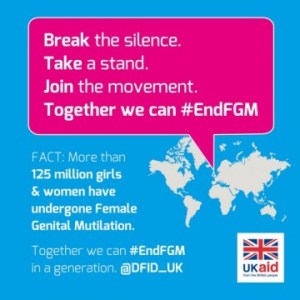
Break the Silence. Take a Stand. Join the Movement. Together we can #EndFGM.


Tory and UKIP MEPs fail to condemn female genital mutilation

Lynne Featherstone, MP for Hornsey & Wood Green, and Liberal Democrat European human rights spokeswoman Sarah Ludford MEP have strongly condemned Conservatives MEPs who voted against or abstained in a European Parliament vote on condemning the disgraceful practice of Female Genital Mutilation (FGM).

Four Conservative MEPs – Marta Andreasen, Nirj Deva, Sajjad Karim and Timothy Kirkhope – voted against the motion to condemn FGM, and several UKIP and Conservative MEPs including UKIP’s London MEP Gerard Batten abstained.

Lynne Featherstone commented:

“It is deeply shocking that so many Tory and UKIP MEPs refused to condemn female genital mutilation.”

“I have made it a priority of this government to end this horrific practice within a generation. That means working through international organisations like the EU to help shape cultural attitudes worldwide.”

“Sending out mixed signals like this completely undermines the global fight against FGM on which Britain is playing a leading role, in support of the many African countries who have already banned the practice.”

Sarah Ludford added:

“Yesterday’s vote was a betrayal of the millions of young girls who have been subjected to genital mutilation the world over.”

“Tory and UKIP MEPs would do better to put their personal attitudes towards the EU aside when it comes to something as important as the fight against FGM. Surely we should be standing united in condemning this barbaric practice and working together to end it.”

Starting small-small

I am currently in Sierra Leone in my role as International Development minister. Here is a blog from the visit, which you can also read on the DFID site.

English may be the official language here in Sierra Leone, but the majority communicate every day in Krio, a mash of English, Portuguese and French with an African grammar. Because there are some English words peppered around in there, you think you can follow along (until you can’t). Today I’ve been hearing about ‘small-small’. DFID runs some big projects which impact on millions, of which I am very proud. But sometimes it is good to be reminded of the small-small.

Take Mama, who I met today in Makeni with Street Child. Supported by DFID, Street Child found 2 of Mama’s children on the street – she did not have the money to feed them. Our project has provided her with a grant of around £30 for a business, promising to match whatever she could save from the business in 10 weeks and mentoring her. Mama says her business, selling firewood, is small-small. But it means all her children eat, and go to school. The business continues without further help.

Take a small DFID pilot project in Makeni, attempting to prove that waste can promise wealth. Among the small recycling projects, I visited a group of women weaving with strands of plastic bags. A woman had been out from Ethiopia with the idea, spent a week teaching the technique and left some knitting needles behind. When I turn up, there are 6 women around the table, some disabled, who are knitting the most beautiful things. That idea, those needles, are small-small. Their impact for those women and the local environment is not.

In Sierra Leone, DFID will ensure that by 2015, 1 million more children will be protected from malaria by sleeping under nets; and we’ll help around 1.4 million people gain access to clean drinking water.

UK aid can be significant sums aimed at tackling major national and international problems. As it approaches the local level, it can be split into small-small packages. But I never cease to be proud of the impact it can have. It can be huge.

Sierra Leone: A helping hand on the road to recovery

I am currently in Sierra Leone in my role as International Development minister. Here is a blog, which you can also read on the DFID site.

To enter Freetown from its airport, boating across the river is your best option. The view of Freetown as the sun sets over the water is breathtaking, but one sadly seldom enjoyed by many from outside the country. Certainly from the UK, Sierra Leone is no tourist hotspot, known best for its recent civil war that ended only 12 years ago. And this is a shame, because the depth of the UK’s relationship with this place is amazing.

Its capital, Freetown, was established by British philanthropists in the 18th century as a settlement for repatriated and rescued slaves. It’s a proud part of the Commonwealth. And more recently, the UK played a pivotal role in ending the civil war.

Importantly, we didn’t then just leave. Because despite its beauty, Sierra Leone is one of the poorest places in the world, with all the problems you might expect as a result. One in 6 children will not see their fifth birthday here. Maybe one tenth of the population have consistent access to electricity.

Yet with the UK’s help, slow but steady progress is being made. Our combined military, diplomatic and development efforts have played a large part in bringing peace and stability, including 3 democratic elections. In a country of around 6 million, DFID’s investment in health and education will (between 2010-2015) put over 200,000 children through primary school, and provide life-saving care to over 800,000 under 5’s.

And Sierra Leone is beginning to find its feet. The economy is stuttering back to life as iron ore exports have come back on line for the first time in 30 years.

After the brutal civil war, there’s a long and bumpy road to recovery ahead for Sierra Leone (a bit like the track to the jetty from the airport). But with the UK’s help, it’s started strong. I hope in time more people will get the chance to see its beautiful scenery and people.

Uganda: Next Paralympic Champions?

I have travelled back to Kampala for the final leg of my trip with Ade Adepitan to investigate what life is like for disabled people in Uganda.

I was very excited about our main event – we were due to meet Uganda’s own wheelchair paralympic hopefuls. I was really interested to hear how their training compares to Ade’s and to see them in action on the court.

We caught up with the team mid-match in a small outdoor court in the city centre. Uganda’s own wheelchair basketball team may lack the latest equipment, high-tech chairs or training centres, but they certainly more than made up for it with their passion and dedication – not least because they’d been training in the sun for several hours before we arrived.

The teams limbered up for a match with Ade (with both sides proudly wearing ‘Team GB’ shirts in honour of their guest) and the rest of us gathered at the side to cheer. They clearly had an instant connection with Ade and everyone was speaking the same language of basketball.

Lynnf Featherstone in Uganda

The match itself was absolutely thrilling. Both sides gave it their all – and while Ade’s team seemed to have a natural advantage and edged the lead – it was heart-warming to see everyone’s differences melt away. The team and the crowd forgot politics and policies and just enjoyed watching the match.

Afterwards, we talked about the reality of trying to become a disabled athlete in Uganda. Their story was a familiar one. A lack of interest, investment and worry about whether they have the training or equipment they need to make the grade.

It was heartening to hear their hopes for the future. I hope they make the grade. After the UK’s own team, I certainly know who I am going to be rooting for.

Lynne Featherstone in Uganda

The match really summed up a lot of our trip. Disabled people across Africa are proving that they have the ability to take on huge challenges and face up to daily discrimination, prejudice and misunderstanding. It is abundantly clear that we will never create a level playing field unless we do more to recognise the tremendous hardship many disabled people are forced to live with – and take action to address it. Recognising disability in the new UN poverty goals will be an important step towards this.

Earlier in the day I gave a speech to an assembled group of charities, disabled lobby groups and Ugandan officials. I’m eager to hear your thoughts on how we can change people’s perception and put an end to the discrimination that prevents so many talented people from reaching their full potential.