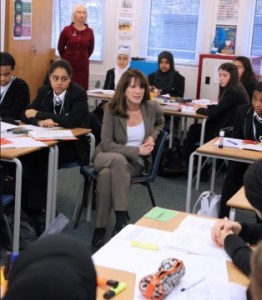
Lynne Featherstone MP visits Hornsey School for Girls on International Women’s Day

Lynne Featherstone MP participating in a group discussion with students from Hornsey School for Girls. Lynne Featherstone MP visited Hornsey School for Girls on International Women’s Day last week, to discuss tackling violence against women and girls in the UK and abroad.

The MP for Hornsey and Wood Green participated in a class of 13 to 14 year old students. Together with representatives from the organisation PLAN, they discussed the causes and consequences of violence against women and girls. They also discussed how empowering women and girls – and protecting them from violence – will be vital for meeting the UN’s Millennium Development Goals by 2015.

The Liberal Democrat MP flew back from New York on Thursday, having represented the UK Government at the 57th annual meeting of the UN Commission on the Status of Women.

At the Commission, Lynne Featherstone MP reiterated that she wants Female Genital Mutilation ended within a generation. In this regard, she announced that the UK is committing up to £35 million to stop this most extreme form of gender-based violence.

Following the visit to the school, Lynne Featherstone MP travelled to Brighton for the Liberal Democrat Spring Conference, where she gave a rally speech on her experiences in tackling violence against women and girls.

Following the visit, Lynne Featherstone MP said:

“It was a delight to visit this school and the bright students on International Women’s Day to talk about violence against women and girls – which I am so passionate about tackling.

“I was so impressed with the students’ understanding and awareness of gender based violence. It is clear that progress is being made in the UK.

“We are making sure that our young girls are made aware of these issues, and given the right support, advice and education. It is, of course, also vital that boys are made aware from an early age that such violence is not acceptable and will not be tolerated.

“I am so proud that Britain is a world leader in international development, respected widely for how effective our work is. We may be two genders, but we only have one future!”

MP offers further support as Connaught House residents face eviction

Lynne Featherstone MP has today offered her continued support to residents of Connaught House in Muswell Hill.

The remaining residents face eviction today. The Metropolitan Police, who own the building, have refused to extend the lease granted to Crown Housing Association. The Association and the residents must therefore vacate the premises.

The Liberal Democrat MP for Hornsey and Wood Green has previously contacted the Commissioner of the Metropolitan Police in an attempt to stop the eviction, and subsequently Crown Housing and Haringey Council, to ensure that appropriate alternative accommodation is found.

Commenting, Lynne Featherstone MP said:

“I have made numerous representations on behalf of my constituents at Connaught House. I have contacted the Commissioner of the Metropolitan Police, Crown Housing and Haringey Council.

“Unfortunately, despite our best efforts, the Met are intent on selling the land. They will not withdraw the instruction to Crown Housing to vacate the property.

“I have urgently contacted Crown Housing and Haringey Council, to gain assurance that all residents of Connaught House would be given appropriate alternative accommodation.

“Haringey Council said that they were advising and offering different housing options to each resident. Crown Housing also said that alternative housing options have been offered.

“I can only imagine what the residents must be going through. If any of them do not feel that Haringey Council or Crown Housing has offered them appropriate alternative accommodation, I urge them to contact me immediately so that I can make further representations on their behalf.”

Two genders – one future

On International Women’s Day (last Friday) I spoke at the Liberal Democrat Spring Conference Rally. Here is the full text of my speech:

Good evening, Conference…

It is a great pleasure to be speaking to you on International Women’s Day…

The day the world celebrates the women and girls who have made great strides on behalf of all of us in overcoming inequality…

Women like Shirley Williams, who is my political heroine and a powerful inspiration for all liberal British women…

Please join me in another round of applause for her…

International Women’s Day is also when we show solidarity with those who continue to suffer discrimination and violence simply because they are women and girls…

Conference, it is shocking and shameful what suffering so many women experience right across the globe…

In the 21st century, it is unbelievable that women aged 15 to 44 are more at risk from rape and domestic violence…than cancer, car crashes and malaria put together…

It is shocking that 15 year old Pakistani schoolgirl Malala was shot simply because she dared to want an education…

And it is horrific that a young Indian woman could be targeted, gang-raped and left for dead – just for being a woman…

Violence against women and girls is the most prevalent abuse of human rights on the planet…

This is not some second tier issue, or a preoccupation only of the privileged…

It is not a women’s only issue…

What affects half of the world’s population, affects all of us…

And frankly, International Women’s Day should not just be once a year – it should be every day, every year…

But, Conference, you already know this…

We are Liberal Democrats…

We know and believe that inequality, wherever it may fester, must be stamped out…

And Liberal Democrats in government are working hard to support women and girls – at home and abroad – and help them live the lives they would choose to live…

I am the UK ministerial champion for tackling violence against women and girls overseas, and in September I became a minister in the Department for International Development…

Jobs that I believe make me the luckiest Lib Dem in government…

In my new role I’ve travelled to African countries, and I’ve seen first-hand the difference we can make…

Conference, I wish I could take everyone in the UK to these places so they could see what I have seen.

In Uganda, I remember seeing a woman with stumps for arms trying to carry a baby. Her husband had cut her arms off to punish her…

In Zambia, I remember meeting a 12 year old girl who had been raped by her uncle…

In South Sudan, I remember seeing hundreds of women, struggling after years of civil war and famine had left their children stunted.  They made stoves out of animal faeces, to try and cook nutritious food and become more sustainable…

This is why I’m proud that Britain is a world leader in international development, respected widely for how effective our work is…

Thanks to this Coalition Government and the Girls’ Education Challenge that Nick Clegg launched in 2011, two and a half million girls across the developing world will get into primary school…

Nearly 250,000 women have their property and land rights secured…

One million more women have access to modern methods of family planning…

And as I announced in New York earlier this week, when I was representing the UK at the 57th session of the UN Commission on the Status of Women…

I want Female Genital Mutilation ended within a generation…

To make this happen, the UK is becoming the world’s biggest investor – committing up to £35 million – to stop this most extreme form of gender-based violence…

But Conference, you already know what a difference UK aid can make…

Liberal Democrats are internationalists, and we understand instinctively why supporting the world’s poorest people is the right and smart thing to do…

I am proud that this year the Coalition Government will deliver our manifesto commitment to spend 0.7 per cent of GNI on overseas development…

I am prouder still that our party continues to stand behind this commitment…

No doubt it is a controversial decision to increase the UK’s aid budget while other domestic spending is being reined in…

But as we have said time and again, we are not going to balance our books on the backs of the world’s poorest…

And – don’t forget – preventing war is cheaper than fighting it!…

Conference, to conclude…

Equal marriage is my proudest achievement in government to date…

But our ambition and dedication should be set just as high to advance gender equality across the globe…

The Liberal Democrat message to those who fight for dignity, respect and equality – wherever in the world it is denied – is we see you, we hear you, we stand with you….

This effort requires all of us – especially brothers, fathers, nephews, uncles, sons, partners and husbands – all who care for the women in their lives…

Good men must not sit back…

Good men like Nick Clegg are helping to lead the charge…

And I am so pleased that Liberal Democrats in government are delivering fairness…

Not just for British women, but for women everywhere…

We may be two genders, but we have only one future…

Thank you…

Push for Change on Women's Rights

Here’s a blog from my last day in New York. Also Available on Huffington Post.

It’s my last day at the 57th session of the Commission on the Status of Women, and I’ve started the day speaking at a breakfast reception for Afghan women.

Under the Taleban, Afghan women suffered some of the worst oppression in the world. To this day the situation remains challenging.

According to the UN’s 2011 Gender Equality Index, Afghan women’s status ranked amongst the worst in the world – rated 141th out of 146. A shocking 87% of Afghan women have experienced at least one form of physical, sexual or psychological violence or forced marriage.

Nevertheless, I am heartened by the progress the international community has made in partnership with Afghanistan in the last decade. Almost 40% of children regularly attending school are girls – up from virtually nil in 2001. Almost one in two pregnant women receives antenatal care now – compared with only one in six in 2003. And women hold over a quarter of seats in the Afghan Parliament.

My colleague Justine Greening made it clear on Monday that we will do whatever the UK can to ensure the gains for girls and women in Afghanistan are not lost. As part of this effort, we are making tackling violence against women and girls in Afghanistan a strategic priority for the Department For International Development’s (DFID) country programmes.

Bringing about change is a long-term task, in which girls’ education, economic opportunities and women’s representation and rights are all key.

This is why the UK’s programmes and the benefits they bring to Afghan women and girls will continue long after British troops come home in 2014.

Ending early marriage

One in nine girls will marry before their 15th birthday. For those girls, their childhood will be cut short and their chances of an education, a job and enjoying the delights of safe motherhood will be dashed. In short, early marriage is bad for girls and bad for development.

2013-03-07-Girlsgembemversion2UK aid is supporting UNICEF to run Girl and Boy Education Movement’s in schools in South Africa to raise awareness about issues affecting young people. Picture: Lindsay Mgbor/DFID
At an event hosted by World Vision, I set out how the Coalition Government is working hard to tackle this issue.

We know that education is the single most important factor in reducing child marriage. That’s why in 2011 the Deputy Prime Minister Nick Clegg launched DFID’s Girls’ Education Challenge, which commits us to help up to 1 million of the world’s poorest girls in 22 focus countries get into school.Nick and I launched two of these country programmes on our recent visit to Mozambique and Ethiopia.

We also know that communities are key to changing attitudes and behaviours towards girls and women, so for example in Ethiopia DFID is working with religious leaders, families, boys, men, the media and schools to change how they view early marriage.

There is no silver bullet for ending early marriage – no complex issue has an easy solution. But all countries have a role to play and we can all work in a direction to build on each other’s successes.

UK commitment to end gender-based violence

My time at this session of the Commission on the Status of Women is drawing to a close. After three packed days of individual meetings with African, Middle Eastern and Asian countries, and speaking at eight panel events on an array of issues, I come away inspired and with renewed hope for tackling violence against women worldwide.

And I’m proud that the UK’s efforts are inspiring others in kind.

I’ve just been at my last panel event and Dutch MP Jet Bussemaker and I presented adverts running in our respective countries, designed to change young people’s perceptions about violence and abuse in their relationships. In the UK our adverts have reached more young people than many expected and I hope these efforts can be replicated with great effect in other countries.

CSW continues for another week and it is vital that by the end of the session a common set of global standards to protect women and girls is agreed. It isn’t easy. Last year, for the first time ever, no Agreed Conclusions emerged.

So I’ve been sending clear signals here in New York that the UK is 100% committed to pushing forward global action to stop gender-based violence. For all our sakes – and for the future of the multilateral system – I hope this year will be a success.

Take a look at this map which shows UK government action to support and empower women across the globe.

Join our Facebook campaign to end violence against girls and women and call on the UN to take action.

Read our feature and stories on how UK aid is working to prevent violence against girls and womenand see our South Africa picture gallery on how we’re working to protect vulnerable children from violence.

Lib Dems call for the Met and Mayor to think again on police closures

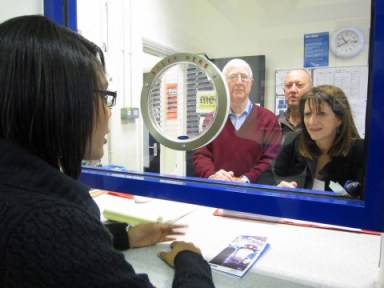
Lynne Featherstone MP and Cllr Martin Newton at Muswell Hill Police front counterHaringey Liberal Democrats are calling on the Metropolitan Police and the Conservative Mayor of London to change their plans for police stations and front counters in Haringey.

The opposition politicians have written to the Conservative Deputy Mayor of London for Policing, Stephen Greenhalgh, objecting to the proposals to close Muswell Hill police station and to reduce the opening hours at Hornsey and Tottenham.

The Lib Dems have been very clear in their letters that they firmly believe that opening hours at Hornsey and Tottenham should not be reduced and that a front counter should be retained in the Muswell Hill area. They have also made it clear that the impact of the proposals on local police Safer Neighbourhood Teams is unacceptable. 

The councillors’ opposition to the borough only having one publicly accessible twenty-four hour police counter echoes the concerns of the Lib Dem MP for Hornsey and Wood Green, Lynne Featherstone, who has also come out against the plans.

Cllr Martin Newton, Lib Dem crime and police spokesperson, comments:

“Haringey Liberal Democrats are opposed to the Met’s and Mayor’s proposals which will make it harder for members of the public to report crimes.

“It is particularly important that here in Haringey, where the London riots began, that the police make more effort to reach out to the community and be as accessible as possible.

“Sadly many people become victims of crime and when that happens they understandably want to be able to report it quickly and locally at any time of the day or night. Unfortunately for the police criminals do not operating during office hours, so the police must be available when the public need them not when it is convenient.

“Local residents in Tottenham and Muswell Hill shouldn’t have to travel miles away to Wood Green in the middle of the night to be able to report a crime, they should be able to do it locally.”

Lynne Featherstone, Liberal Democrat MP for Hornsey and Wood Green, said:

“I am fully behind the Haringey Lib Dems’ calls for the Mayor to change his plans for police stations and front counters in Haringey.

“Since the announcement, we have been calling for assurances that no service is lost without a suitable replacement. We oppose any reduction in hours at Hornsey police station and will be fighting to keep a police base and front counter staffed by the dedicated team of volunteers in Muswell Hill.”

Ending Female Genital Cutting in a Generation

Also available on the Huffington Post

I want to end female genital mutilation (or cutting), I want to see it happen within a generation. I’ve just been with hundreds of people who share this ambition, including the first lady of Burkina Faso and the women’s minister of Niger. The annual meeting of the UN Commission of the Status of Women in New York has brought us together today.

Female genital cutting (FGC) has been neglected by the international community – and international development – for too long. Too little has been invested in stopping this practice – too little money, too little research, too little attention.

The time is ripe for change.

Niger has just seen a reduction of incidents of FGC by 50%. In Senegal, thousands of villages have abandoned the practice entirely. National laws have been put in place making FGC illegal in 25 African countries. And in December last year the UN General Assembly passed a resolution calling for a global ban on FGC – a resolution championed by African countries.

The UK has a duty to get behind this momentum and do all we can to keep it going. We owe it to the millions of girls who are at risk of being cut every year. And this is why the UK, through the Department for International Development, will this year become the largest single investor in ending FGC.

I pay homage to the tireless efforts of NGOs and other governments who have fought FGC for years. Because of them, we’re at a tipping point. And I hope the UK’s new commitment will deliver the final blow.

Find out what the UK is doing to end FGC within a generation.

Take a look at this map which shows UK government action to support and empower women across the globe.

Join our Facebook campaign to end violence against girls and women and call on the UN to take action.

Whittington Hospital suspends reorganisation plans

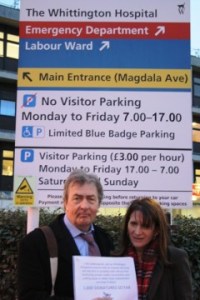
Lynne Featherstone MP and Cllr David Winskill (Haringey Liberal Democrat spokesperson for Health) outside the Whittington hospital with the Liberal Democrat petition. The Whittington Hospital has suspended its reorganisation plan, following a delay to their Foundation Trust application.

The Hospital Board will use the delay to engage the local community, hospital staff and other stakeholders in their strategy.

The announcement follows a public meeting last Friday evening, which was organised by Liberal Democrat MP Lynne Featherstone. During the meeting a number of residents expressed concern at the lack of consultation and engagement with residents prior to the announcement.

Over 2500 residents also signed the Liberal Democrat petition which called for the Board to go back to square one and consult with the public – alongside demanding that no hospital services were lost until equal or better replacement services have been put in place.

Following the meeting, the MP for Hornsey and Wood Green also raised concerns about how integrated care in the community – which will enable a reduction in beds in the main hospital – is implemented and funded.

Commenting, Lynne Featherstone MP said:

“I welcome the Whittington’s decision to engage with the public and to listen to residents’ views on these plans.

“The Hospital is trying to secure a long term future through becoming a Foundation Trust. But public engagement, clarity and confidence are of paramount importance – it is vital that they take this opportunity to listen and adapt their plans as appropriate.”

Councillor David Winskill, Haringey Lib Dem health spokesperson, said:

“The level of debate during the public meeting demonstrated just how much residents value the Whittington, but also how aware they are of the different  factors surrounding any decision about the Hospital’s future.

“Many difficult questions were raised which need clear and thorough responses from the Whittington Board. I’m glad we now have the opportunity for this debate.”

Visit to New York – Day Two

Here’s a blog from the second day of my visit to New York – on Body Confidence and how it links with violence against women:

It’s Day 2 of my visit to the UN for the Commission on the Status of Women, and I’ve just come from a Danish event, where we discussed the links between social controls – like bodily perfection – and violence.

In every society with a mass media, whether in developing or developed countries, women are subject to a daily bombardment of images and messages about what they should look like.

Of course, nothing is wrong with having ideals of beauty and admiring it! We’re only human.

What is different now, however, is the sheer volume of images, the impossibility of escaping them and the rise of a celebrity culture that mercilessly dissects how our idols look – pulling them down to size, while simultaneously telling us we can be like them too, if we just look the part.

But is body confidence a means of violence against women? Undoubtedly yes.

When gender stereotypes restrict and deny individual free will and self-expression, this is violence.

Put another way: If your body must be ‘perfect’ – whether ‘perfect’ means bleached, starved or put through Female Genital Mutilation – before you can expect equality and respect, this is violence.

I have worked on Body Confidence issues for years: inside and outside government, from the Home Office and now in DFID. From each of these perspectives it is clear that this is a universal issue for all women. It’s also clear that progress is possible, particularly when we work across local and national boundaries.

The Coalition Government wants to end violence against women and girls – in all its forms, at home and overseas. We want to value people for who they are and what they can contribute, not for what they look like.

UN Commission on the Status of Women

Here’s a blog about my trip to New York for the annual meeting of the UN Commission on the Status of Women. You can also read the blog on the Huffington Post here.

I’ve finally arrived in New York for the annual meeting of the UN Commission on the Status of Women (CSW) – one of the big annual events in my diary and one that Justine Greening and I have been working hard on for months.

So far I’m overwhelmed by the sheer number of women (and men!) here from across the world, not only representing various countries but countless NGOs as well, all fighting for women’s rights and equality internationally.

This year’s CSW theme is eliminating violence against women: an issue everyone knows I care passionately about – not least because of my ministerial champion role exactly on this topic – and raise at every opportunity.

Britain taking a lead

The UK has a good story to tell.

The Coalition Government has provided nearly £40 million of ring-fenced funding for specialist domestic and sexual violence services, and national helplines.

We’ve invested in changing attitudes and behaviours. You may have seen the UK television adverts we’ve launched to tackle rape and relationship abuse amongst teenagers.

We’ve reformed our legislation, introducing two new stalking offences to better protect victims and better support the police and prosecutors who bring about justice.

And the Coalition Government has also announced plans to criminalise forced marriage.

But we can and must do more. Just last year around 400,000 women were sexually assaulted in the UK. Sharing best practice and learning from other countries’ successes is a great place to start.

Tackling the root causes of violence against women and girls

The root causes of violence against women and girls are gender inequality and related social norms – or, traditional ‘rules’ of societies.

In short, to end violence against women, we have to change minds.

I’ve just been on a discussion panel with Finland, South Africa and the OECD to discuss the best ways to do just this.

The evidence shows, for example, that you cannot change unequal social norms, and gender-based violence, without working with men and boys. This may seem obvious to some, but when it comes to experiences of violence and abuse it’s common for women only to talk to women!

Watch this video showing how UK aid is helping to tackle violence against women and girls in South Africa:

Violence must be seen as a community issue that needs solving at the community level – rather than a private matter or a ‘women’s issue’ only.

DFID is investing £25 million in a new Violence Against Women and Girls Research and Innovation Fund. This ground-breaking work will test new approaches and rigorously evaluate existing programmes, so we can help build up global evidence of what works (and what simply doesn’t).

Ultimately this evidence base will need contributions from across the world and I hope other countries will join in on our efforts. No one country can tackle this alone, but the UK is committed to doing our bit.