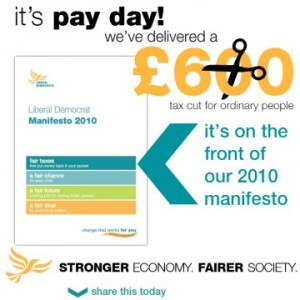
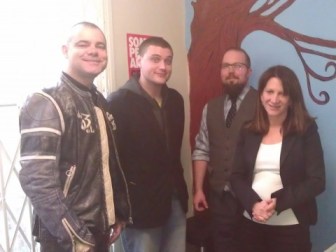
Lynne Featherstone MP holds advice surgery at Wood Green Mosque

Lynne Featherstone MP and Dr Turhan Ozen (Liberal Democrat European Parliamentary Elections Candidate for London) with congregation membersLocal MP Lynne Featherstone last week visited Fatih Mosque, a branch of Suleymaniye, in Wood Green to talk to members of the congregation about local issues.

The Liberal Democrat MP entered the Mosque after prayers and was given a tour of the Women’s area. Following the tour, the MP for Hornsey and Wood Green sat outside the Mosque and met with members of the congregation.

Along with two of her caseworkers, the MP spoke to dozens of people, and offered them assistance with their local issues.

Lynne Featherstone and her team process around 400 pieces of casework on behalf of local residents per week.

The event was organised by Dr Turhan Ozen, the Liberal Democrat European Parliamentary Elections Candidate for London.

Following the surgery, Lynne Featherstone MP commented:

“I would like to thank Turhan for organising this event, and thank the congregation for welcoming me to the Mosque. It was great to take advantage of the nice weather and hold an advice surgery outside.

“My team and I spoke with dozens of people and gave them advice on their local issues. We will be making numerous representations to the Council and other authorities on their behalf this week.

“I hope this will be the first of many advice surgeries at the local Mosques in my constituency.”

Save Muswell Hill Front Counter!

Here’s my most recent Ham and High Column on Policing in Haringey

Policing in Haringey is undergoing major changes. This all started last year, when the Conservative Mayor of London announced that changes would be made to policing in Haringey and across the city.

In the current economic climate, changes have to be made to make policing more efficient and cost effective. But from day one, the Lib Dems were clear that any changes should not have a negative impact on public access to the police.

Police front counters, for instance, are vital local services – allowing victims to go and report crimes face to face, in a safe and secure environment. We all hope that we will never have to visit one, but it is certainly reassuring to know they’re there.

So, when the Mayor mentioned that front counters might be closed and replaced with contact points, we started expressing our concern and asking questions.

Straight away, Lib Dem London Assembly member Caroline Pidgeon asked the Mayor for a guarantee that there would be no time gap between a front counter closing and new contact point opening.

The Mayor gave this guarantee, and went on to say that no front counter would be lost without an ‘equivalent or indeed better’ replacement – open for the same number of hours.

During the consultation period, the Haringey Lib Dems and I called on the Mayor to keep to his word.

You can imagine our disappointment and anger when the Mayor announced his final plans, which include the closure of Muswell Hill volunteer counter. This would leave a huge chunk of the borough without proper access to front counter services.

Yes – changes had to be made, but not like this.

In response, I have launched a petition, calling on the Mayor to retain a local base for the Safer Neighbourhood Team on, or near, Muswell Hill Broadway with an accessible front counter for the public to report crimes.

Hundreds have signed already, and residents can add their names here: http://bit.ly/MuswellHillPolice

After launching the petition, I met with Haringey’s new Borough Commander – Victor Olisa. I was very pleased to hear that he had contacted the volunteers and is keen to keep a police presence in Muswell Hill. But Haringey Police need help finding a new location for the service – as the Met will be selling the building it currently operates from.

So, Haringey Police are willing to keep the volunteer counter service, but only if a suitable location can be found. Please contact me if you have any ideas for a suitable location for a front counter service in or around Muswell Hill.

We also saved this very front counter once before. With enough support from residents and Haringey Police, we can do the same again.

Inspire the House competition

This year, Parliament is hosting the ‘Kids Count Inspiration Awards.’ MPs have been asked to nominate an inspirational young person or community group that deserve to be recognised for their contribution to our communities.

We have some amazing groups and individuals in Haringey, and it will be difficult to pick which one to nominate! I have some ideas in mind, but I would like your views too.

Please don’t hesitate to email me on lynne@lynnefeatherstone.org if you would like to suggest someone to nominate.

The awards will take place on the 24th June in Parliament.  Nominations close of 15th May – so let me know asap!

Here are the two categories in more detail:

1)      Best contribution by a community group

CRITERIA. Recognising a community group who by example, track record and commitment have signalled that responsibility lies within their own community to protect and foster the well-being and development of young people.

2)      Most Inspirational Young Person

CRITERIA. Recognising an individual young person, who has inspired others by their personal dedication, personality, enthusiasm, resilience, flair and commitment to one, or a number of issues affecting the lives of young people.

Labour split on Whittington

After months of opposing any changes at all to the Whittington Hospital, it seems some Labour members have finally realised that campaigning against any changes to the hospital will do more harm than good. See this tweet from Labour Cllr Martin Klute, for instance.

When the Whittington Board announced that it would be making changes to the hospital in January, everyone was shocked. Politicians across the Borough all agreed that the Hospital’s communications strategy had been appalling.

But then, we disagreed. A good summary of the disagreements between the Lib Dem and Labour approach can be found in the news here, with a further explanation below.

From the outset – the local Lib Dems and I knew that, despite their appalling communications, the Whittington Board members were trying to make changes to secure the long term future of the Hospital.

In order for the Whittington to be successful in their Foundation Trust application, the Board needed to make plans for change. They include selling off derelict buildings so that money can be reinvested in A&E and maternity. It also includes reducing beds in non-urgent wards, so that care can be transferred to the community.

Without making these changes, the Board would have been unsuccessful in securing Foundation Trust Status. This would have led to a takeover of the hospital, a loss of services, and loss of local control.

That’s why the Lib Dems and I did not oppose all changes out right. Unlike others, we would not oppose all changes to the Hospital for quick political gain.

Instead, we called for no loss of hospital services as a result of the changes, and for a full public consultation.

We had numerous meetings with the board and called a public meeting so residents could have their say. In response to our 2,700 signature strong petition, we received these assurances.

We continue to ask tough questions about the future of integrated care. We have continued our petition to ensure the Board engages with the public and keeps its word about services.

Labour, however, campaigned against any change or sale of land. They used the opportunity to try and blame the Government for what was happening, and score political points, despite the hospital’s plans having nothing to do with the Government.

During a separate public meeting, David Lammy MP spoke of how any changes would be the death knell for the Whittington. In fact, the opposite is true.

Some Labour politicians, such as Islington Council leader Catherine West, continue to oppose any changes, despite the growing realisation that change is necessary to protect the hospital. However, some Labour councillors have now come out against the Labour position.

I hope in time Labour will see sense and follow our example, fighting to keep local services not derelict buildings.

So, while Labour tries to get its house in order and find a coherent position – the local Lib Dems and I will stick to our original and clear position: That during this period of change, the Whittington should continue to engage with the public, and ensure that no local services are lost.

Check your pay slip!

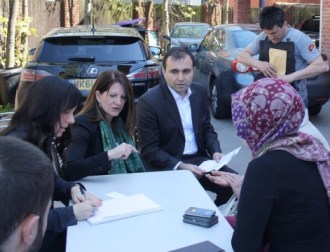
paydaytaxcut(2)Today is pay day for millions of people across Britain. It will be the first pay slip since the Income Tax personal allowance was raised to £9,440.

The personal allowance is the amount you can earn before being taxed. When Liberal Democrats came into power in 2010 this was just £6,475.

Increasing the tax-free personal allowance is the Liberal Democrats’ flagship policy. We have fought hard for this and secured it.

Since we’ve been in Government, millions of low and middle income earners are now paying £600 less tax per year.

The tax-free allowance will rise again next year to £10,000, fulfilling a commitment from the front page of the Liberal Democrats’ 2010 General Election manifesto and resulting in a total tax cut of £700.

By this point, 86,500 ordinary working people in Haringey will have received the £700 a year tax cut, and 7,520 of the Borough’s low or part-time earners will have been lifted out of paying Income Tax altogether.

Earlier, Liberal Democrat Chief Secretary to the Treasury, Danny Alexander summed it up very well:

“If you get paid today, take a moment to compare your pay slip to last month’s. You’ll see that Liberal Democrats have cut your taxes.

“It has taken the Liberal Democrats being in Government to deliver the largest programme of tax cuts for working people for a generation.

“The Liberal Democrats are the only party that will radically cut taxes for people on low and middle incomes to build a stronger economy and a fairer society so that everyone can get on in life.”

Lynne Featherstone MP expresses concern over new measles cases in Haringey

Lynne Featherstone MP has expressed her concern as Department of Health figures revealed that measles cases In London have doubled in the last three months.

The Liberal Democrat MP and the Haringey Lib Dems began making enquiries following the outbreak of measles in South Wales.

In response to questions, Haringey Council stated that there was an adequate supply of the vaccine, and that Haringey had 88-90% vaccination coverage. They also stated that Public Health England was closely monitoring the situation, and that there was no evidence of measles spreading to the wider community in South Wales or in Haringey.

However, figures released by the Department of Health and Public Health England now suggest that Haringey has the fourth highest number of new cases in London, and only an 83% uptake of the MMR vaccine.

The Department of Health has now officially advised parents to get their children vaccinated.

Cllr David Winskill, Haringey Liberal Democrat Spokesperson for Health, comments:

“The public are understandably worried about having a measles outbreak in Haringey because of the recent epidemic in Wales.

“It is very important that vaccination levels don’t drop here and we are calling on the council to carefully monitor the situation here in Haringey and take what steps they can to prevent an outbreak in the borough.

“We have asked for and received assurances from Haringey Public Health that adequate supplies are available to meet demand for vaccinations.”

Hornsey and Wood Green MP Lynne Featherstone commented:

“It is very concerning to hear that cases of measles are on the rise in London, with Haringey Borough in particular experiencing a number of new cases.

“17% of people in Haringey are not immunised against measles, despite their being an adequate supply of the vaccine. We need this percentage to decrease, in order to prevent measles spreading.”

Lynne Featherstone MP visits Stonewall Housing in Highgate

 Lynne Featherstone MP with Stonewall Housing Chief Executive Bob Green, staff member Octavian, and one of the house residents Lynne Featherstone MP last week visited a Stonewall Housing property in Highgate.

Stonewall Housing provide lesbian, gay, bisexual and transgender (LGBT) people with housing advice and support, either in their own homes or in supported housing. They also lobby for LGBT housing rights.

The Liberal Democrat MP met with the Chief Executive, a staff member and some of the residents to discuss the issues affecting both the LGBT community and charities.

After the visit, Lynne Featherstone MP commented:

“It was great to visit the house and hear about Stonewall Housing’s work. They provide an invaluable service to vulnerable LGBT people in my constituency and across the city.

“They would like to do more. It was great to hear about their aims and ambitions to expand their support network, for instance to vulnerable LGBT asylum seekers.

“Charities are having a tough time at the moment, but I am confident Stonewall Housing will get through it and come out stronger. I wish them all the best for the future.”

World Malaria Day

Here’s a blog from me on World Malaria Day. You can also read it on the Huffington Post website.

Malaria affects over half the world’s population, with a child dying every minute from the disease. In the worst-affected countries malaria has a devastating impact on health systems and economies. When faced with these stark facts it can often seem like there’s no hope.

But amongst the gloom there are genuine signs that we may finally be winning the battle against malaria. Across the world malaria is on the decline. Over the past decade governments, NGOs and multilaterals like the UN and World Bank have come together to fight the disease, while national governments in the worst-hit countries made real progress in delivering malaria control programmes. This global coalition had an enormous impact. By 2010, 145 million bed nets – the simple, cheap yet hugely effective defence against malarial mosquitoes – were being delivered to sub-Saharan Africa. The amount of artemisinin-based combination therapies (ACTs) – the most effective pharmaceutical treatment for malaria sufferers – jumped from just 11 million in 2005 to 278 million in 2011. In just one country, Mozambique, DFID’s support for anti-malaria spraying has seen a dramatic reduction in deaths and hospital admissions of at least 40%.

The effect of these efforts can be summarised in just two hugely important statistics. Between 2000 and 2010 global malaria mortality rates dropped by 26%, saving over a million lives. Behind these statistics lies hundreds of thousands of families free from pain and suffering. Free from having to mourn the death of a child. Free to get a job and work themselves out of poverty without having to worry about another bout of fever.

Yet there is a danger that this anti-malaria coalition is fragmenting. Global funding for malaria is levelling off and is in danger of falling in the coming years, threatening the reversal of a decade of progress. The international community needs to sustain its support to make sure the gains made do not go to waste. This must be matched by increased commitments from the governments of high-burden countries.

International Development minister Lynne Featherstone with Félix Kabange Numbi Mukwampa, the minister of Health in DRCInternational Development minister Lynne Featherstone with Félix Kabange Numbi Mukwampa, the minister of Health in the Democratic Republic of Congo. Picture: DFID. 
We are doing our bit. I’m in the Democratic Republic of Congo this week, one of the worst-affected countries in the world. Here malaria is responsible for a third of all deaths and 97% of people live in high risk areas. Children under five experience an average of between six to ten episodes of malaria per year. That’s why today, on World Malaria Day, I am announcing a major new UK anti-malaria programme that will protect around six million people in the DRC from the disease and result in approximately 2.5 million fewer episodes of malaria amongst children under five every year.

The UK will not stand on the sidelines while millions suffer from this entirely preventable and treatable disease. It’s time for the international community to come together yet again and keep up their commitments. We need another decade of action against malaria. The prize could be another million lives saved.

Ministerial visit to the DRC – Kasai Occidental

Here’s my second blog from my ministerial visit to the Democratic Republic of Congo:

Kasai Occidental, a landlocked province in DRC, seems cut off from the world. I flew into Kananga, its capital, this morning on one of the two flights a week. We flew over the railway, but didn’t catch a glimpse of the train that runs once a month, give or take. Potholed road access isn’t an inviting option. It’s little wonder that the business leaders I met with later identified transport as one of their biggest problems. Kananga, a city of around one million people, seems an island.

And this landlocked island has its problems. Conflict in the East of DRC has been making the headlines, but on some measures the situation here is worse. Malnutrition levels are high, in a malnourished country (all the harder to understand when the soil is fertile); conflict has been partly to blame. There is a lack of basic services like electricity and water, gender violence is all too common, the literacy rate for young women is around 35%, and lack of formal employment the norm.

So, where do you start? There is no easy answer, when each problem demands your attention and all are in some way connected. DFID is already investing in health, including the ASSP launched on Monday, which will work in many parts of Kasai Occidental to provide access to much-needed primary healthcare; and in police training, in a country where policing is not adequate to keep people safe.

And DFID is in the early stages of engaging with a new provincial government who appear committed to making things happen. The governor is credited with bringing electricity online – the six hours a day is a massive improvement on the zero hours previously. With the political will here to deliver for the population, perhaps Kasai Occidental can start to move in the right direction.

Lynne Featherstone MP delighted as new W7 bus stop made permanent

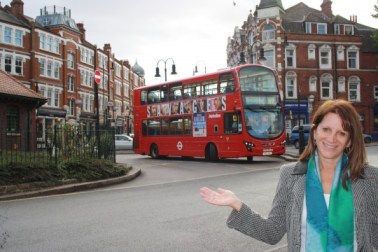
Lynne with approaching W7 busLynne Featherstone MP has today welcomed news that the new W7 bus stop on Muswell Hill Broadway will become permanent, following a six month trial period.

Previously, the only nearby stop was located on the steep Muswell Hill, causing numerous problems for residents who found the stop inaccessible and unsafe to use. Elderly residents, disabled residents and those with young children had particular difficulties waiting for and boarding the bus.

Following a three year Liberal Democrat campaign, an additional W7 bus stop was finally installed by Haringey Council and TFL.  The new, permanent stop is on flat ground outside Boots on Muswell Hill Broadway.

Liberal Democrat Councillor for Muswell Hill Gail Engert said:

“The trial of the new bus stop has been a great success  I am delighted that TfL have decided to make the new W7 bus stop permanent.

“We have campaigned since 2009 to make this happen. The new bus stop is much better for residents, particularly those with mobility difficulties and parents with buggies. We look forward to the trial for the 144 bus to also use the new stop from the autumn. We will continue to press TfL to make other local bus stops more accessible too.”

Lynne Featherstone MP commented:

“I am delighted that this new, safe and accessible bus stop is finally permanent.  This comes after years of local Lib Dem campaigning and demands that Haringey Council take action.

“I’d like to thank all the residents who supported our battle to secure a trial for this additional stop, and to make it permanent. The combination of Lib Dems and people power in Haringey triumphs once again!”