Power to the people

Have you ever felt like screaming ‘it isn’t fair’ when – regardless of the whole neighbourhood being up in arms – the Government runs roughshod over local peoples’ wishes and carry out its own wishes regardless?

Well, although it doesn’t have a sexy title, the Sustainable Communities Bill could help bring about a major change in the way we are governed so that in future local people can more often say, “hang on, you don’t have the power to do that.”

The Bill has been presented to Parliament as Private Members’ Bill (fronted by Nick Hurd, a Conservative, though the Liberal Democrats too are backing it). These types of Bill are hard to get through. In particular, they need a good turnout of MPs to support them on a Friday morning – but that’s a time when many MPs from outside London have already travelled back to their constituencies for a busy and long weekend of meetings and events in their constituency. But on one Friday last month, enough members from all parties came together to try and get it through to the next stages.

There is an overwhelming feeling, whatever the political persuasion of an area, that we are all fighting this dreadful fight against centralist steamrollering of local wishes. The Bill puts forward a proposed mechanism whereby local people can put forward their wishes and so long as it is within reason, the Secretary of State should approve the plan. It’s more complicated than that – but a simplified summary is as follows.

This Bill is primarily about sustainable communities – including making sure our little parades of shops and local village high streets survive. For example – high rents from the big multiple chains could threaten our local shops, driving out our individual shops. Perhaps we locally would want to put particular controls on development in Highgate Village or Archway Road. We might want to say we didn’t want any more estate agents (there are seventeen already) – and that new estate agents wishing to come to the area could only replace existing ones. Or perhaps we locally would want to put particular criteria on development in Muswell Hill to protect its special character. Or over in Wood Green we might want to ensure that new developments which would put too much strain on local public services don’t get the go ahead.

Well, this Bill might allow us to make that local decision. During the debate MPs told of parts of their constituencies where 80% of the homes were second homes – making for virtual ghost towns. Well – of course – there is an argument too that when those homes are filled in the holidays they bring economic benefits – but this Bill would allow local people to argue out which is the best way forward themselves.

Of course, there are lots of other areas where we may well feel that the national Government should keep its nose out and let local people be in charge of the decision making instead. Planning is a classic of the case. So many local residents are only too used to objecting to a planning application, the Planning Committee of the local Authority refusing the application – and then the Government’s Inspector overturns the decision. It doesn’t just make for bad decisions – it also makes for a bad democracy, because you can always vote out of office a council which makes bad planning decisions, but the Planning Inspectors are beyond the reach of the ballot box.

So part of the Bill is about sorting out what can be decided locally and what must remain a central function. It’s a start to giving power back to the people – and having got through its first legislative stage, the Bill now travels on to the Committee Stage in Parliament, hurrah!

Watch short film: My colleague Julia Goldsworthy has been leading campaigner in the Liberal Democrats on this issue and you can watch her talking about it on Google Video.

(c) Lynne Featherstone, 2007
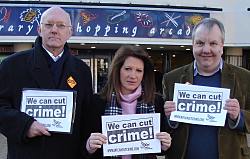
We Can Cut Crime

This Lynne Featherstone MP with Nigel Scott and Cllr Ron Aitkenafternoon it was out campaigning in Wood Green as part of the Liberal Democrats’ We Can Cut Crime campaign.

When you have been in power for ten years like Labour have, you don’t really have much excuse for not getting the capacity of the prisons system worked out properly – nor for having a Home Office that is so badly run. What were all the Labour Home Secretaries doing when they should have been on the job?

With re-offending rates so high we will never make progress until those who are jailed for crimes can be changed from criminals into law-abiding members of society who pay tax, and not cost us our taxes because – remember – nearly everyone will get released from jail at some point or other. But when we do say we’re sending someone away for life it should mean that – no more of this nonsense of calling “life” a sentence that is in reality for only a few years. Life should mean life, with clear and transparent sentences everyone can follow.

More police too – paid for out of the money the Government insists on spending on ineffective ID cards. They should spend the billions chasing the guilty not tagging the innocent. Community punishments also – yes punishments, not soft options – to make sure that the non-dangerous criminal pays their dues – but in a constructive way.

It’s not rocket science!

And the blueprints are in our five-point plan on www.wecancutcrime.com.

Al Gore success!

I Al Gorenote with great pleasure that the Government has announced that they are now going to send the DVD of Al Gore’s ‘An Inconvenient Truth’ to every secondary school.
Given that this was my suggestion in the Climate Change debate on 12th October 2006 (even praised in the debate by the Tory spokesperson in his closing remarks as a jolly good idea) and which I followed up by a letter from me to David Miliband – I am well-chuffed! Of course, I heard it on the news – not in reply to my missive!

You can still watch my own YouTube clip about Al Gore’s film here.

International development

Spent half the day in a seminar about International Development. One of the key challenges is to improve cross-departmental working in government on development issues. The recent debate in Parliament about the export of a (very expensive) air traffic control system to Tanzania clearly indicated the pitfalls of one part of Government working in total contradiction to another part.

So whilst one part was busy with the supply of an over-sophisticated, over-priced military air traffic radar system to one of the very poorest countries in the world at a cost to it of £28 million for an air force of about 10 planes (although estimates varied up to 19), another part was busy saying, “this is a poor country that needs our financial help”. Left hand says: “here’s some money” and right hand says “here’s a big bill”. What we need is rather more coherence in policy making.

There’s a good summary of the current state of play in this scandal on the Guardian’s website.

Postcode lottery for recycling in Stroud Green

Stroud Green Councillor Laura Edge has uncovered a lottery that no local residents would want to enter. Cllr Edge, in questions to Haringey Council’s Urban Environment directorate, has unearthed that many streets in Stroud Green are without a recycling service for plastic bottles or food waste.

The roads affected are Beatrice Road, Carlisle Road, Dagmar Road , Mount Pleasant Crescent, Scarborough Road, Stroud Green Road and The Grove. Haringey Council indicated that they were unsure when this service was to commence for these areas.

Cllr Edge comments,

“It is ridiculous that access to these recycling services depend on your location. All residents in these roads pay Council Tax but do not receive the same level of service.

“If the Labour party in Haringey is committed to providing recycling scheme then these need to be consistent for all residents.”

Lib Dem alarm over health cuts

Liberal Democrats are dismayed at the news that Haringey is facing further cuts in health spending. The Primary Care Trust (PCT) budget issued at the latest Haringey Council Scrutiny Committee meeting showed another 3.6% of funding will be ‘top-sliced’ by the London Strategic Health Authority (SHA) this year – equivalent to £12.5 million.

The Lib Dems believe that Haringey Primary Care Trust (PCT) is determined to avert the financial crisis by using “demand management” to limit bills that they receive from the Acute Trusts – resulting in less people being referred to hospital for treatment and those that are referred being discharged earlier. The PCT will also look towards the private sector to fill gaps in the budget.

Cllr David Winskill (Crouch End) comments:

“We are on the verge of a financial spiral. The London SHA takes cash from the PCTs to bale out the acute sector; PCTs respond by cutting expenditure on acute services and diverting other cash to the private sector. All this adds more pressure on the acute providers – the bits they were trying to save in the first place.”

Liberal Democrat Health Spokesman Cllr Richard Wilson adds:

“This is the second year our local health service has had its budget raided.Over £20m has now been diverted away from frontline health services in our borough to bail out cash strapped hospitals in other parts of London.We have already lost a hospital ward for the elderly and several sexual health clinics as a result.More services now face being squeezed as a result of the continuing financial crisis in the NHS.”

Legislating letterboxes

There’s A letter boxa petition on the Number 10 website that’s been doing the rounds amongst political activists (aka leaflet deliverers) in the last couple of days about the design of letterboxes.

Now if someone has been out delivering leaflets for political parties (or indeed other local community groups) the chances are they have tales of letterboxes that snap on your fingers, letterboxes that don’t protect you from the charging dog, “environmentally friendly” brushes that are meant to keep out draughts but just scrunch up anything stuck through the letterbox, letterboxes that aren’t there, and on and on. (Politics is so exciting and glamorous isn’t it?)

I’ve not signed it myself as being a good liberal (sorry!) I’m not quite convinced this is really a matter of central government legislation – it should more be a matter of Royal Mail and letterbox suppliers / sellers working harder together to raise standards (I mean, how hard is it to design a letterbox that works) and also it is up to us, the purchasers of letterboxes, to pick wisely. Maybe if all these methods are tried harder and fail then legislation could be a matter of last resort … but only last resort.

The serious point behind all this – apart from the one about dogs, fingers, blood and hospital visits that is – is that delivering literature through people’s letterboxes is a key part of political engagement – letting people know what their representatives are up to, soliciting feedback on views and so on. There is another area where current rules and practice really hinder that – and that’s the far too common references in property agreements banning people from displaying posters in their (flat) windows. That seems to me just a straight forward curtailment of freedom of expression at election times – and it’s hard to see why it is justified.

FTSE 100 companies: will they lead the way on carbon footprints?

Having been talking to numerous people as I get myself up to speed and briefed on my new portfolio, it is clear that climate change is on everyone’s agenda.

One of issues at the moment is how many firms will follow the example of those like Marks & Spencer who have been path breakers in terms of taking their environmental impact and carbon footprint seriously.

Talking about these issues has given me an idea: why doesn’t the FT publish the carbon footprint of the companies in the FTSE 100? That would really set an example. Yes – I know most of them won’t have a clue what their footprint is – but that’s just the point. So I’ve punted this idea the FT’s way. I look forward to hearing back from him very soon. In fact – the FT could start a whole campaign on this. Leading the field.

MP story time

Lynne Featherstone, Lib Dem MP for Hornsey & Wood Green, has shown her enthusiastic support for National Story Telling week by telling a short story to a small group of St. Mary’s Junior School Children.

She says:

“As the digital revolution continues relentlessly around us, it’s often forgotten that one of the easiest and cheapest ways of entertaining ourselves is to tell a story.

“Story telling is also such an important way of getting kids into books and reading.

“I read a really ghastly tale of a boy who, to cut a long story short, watched so much television and ate so many crisps he ended up a crisp. And there was no happy ending!

“Thank you very much to the school and I hope the pupils at St. Mary’s enjoyed it as much as I did!”

Tanzania: another case of BAe corruption allegations

Corruption is major news today. No – not (just) the second arrest of Lord Levy, but the opposition debate on the stinking deal involving BAe (the alleged ‘briber’); the Government (who issued an export license for a military air traffic radar control system for Tanzania) and Barclays Bank who loaned Tanzania the money.

Basic story – BAe sell Tanzania this radar system which is far too expensive and sophisticated for Tanzania’s real needs, and yet only covers one third of the country. Price tag: a hefty £28 million.

Tanzania is one of the poorest countries in the world and a country to whom we are pouring in aid. So is this a sensible deal?

Barclays Bank appears to give them a loan on concessionary rates – as a commercial one would have too high interest and break the criteria imposed by the Government on granting export licenses for arms and military radar etc.

This all broke wide-open when two middle-men owed up to having been bribed $12 million in a Swiss Bank to see this deal through. Clearly this all stinks and that was my first debate leading on International Development for the Liberal Democrats. My colleague Norman Lamb had done a lot of work on this in 2002, so good steps to follow in! You can read my speech in Hansard.

This was a Tory Opposition Day motion, very narrowly defined so as not to stray into even more murky territory of the Al Yamamah arms deal with Saudi Arabia on which the Labour Government intervened to stop the Serious Fraud Office investigating corruption. The Tories did not want this mentioned as they were hopelessly compromised as the deal was struck when they were in power – and there is also the matter of the financial relationship between one of the middlemen on the deal and the Conservative party.

Of course Labour said it was right to have granted the license to export the traffic control system – but it is quite clear that this was not a kosher deal. So – we wait for the Serious Fraud Office to pursue its investigation all the way.