Why does it matter how many women are in politics?

Downing Street road signLast weekend I talked at a conference about empowering women to play more active roles in different countries to help bring peace and to take part in democratic processes. There’s no doubt that we’re relatively lucky in the UK compared with many – in fact most – other countries around the world in terms of how women are treated by men and by society’s structures.

There is though work to be done, and as one of the thoughts I think lurking at the back of the minds of some people I talk to is “women have equal rights in the UK, so why bother with all this stuff about gender balance here?” I thought I’d expand on what I said on that topic at the conference.

I was listening to the radio a little while back and Bob Geldof was on. Bob apparently believes that it is wonderful to come home to his wife in the kitchen doing womanly things probably with food or curtains – so feminine, so warm!

It’s the sort of view that makes me want to throw up usually – but then I thought about it. What he was extemporising was actually not that different from my view – because I think women make the world a better place too – it’s the place we differ on.

I think women’s virtual absence from high level decision making both in politics and in business has meant that the world we live in has been skewed to one gender’s bias. And we know that diversity is what gives life its richness and its balance and for too long it has been out of kilter.

Most of the decisions that affect women’s lives have been made by men – not just in politics but in the wider world of business too.

Now I love men. I value their input. I’ve even consorted with them on occasion – but the paucity of women in politics has a real and detrimental effect on the quality of decision making and policy.

It is 90 years since women were given the vote in the U.K. and 80 years since female voters were granted exactly the same rights as men. But the U.K. still has a long way to go to ensure that women have equal status in the political process.

Currently only one in five MPs are women, and in 2007 we were joint fifty-first internationally on the number of women in Parliament. Beaten by Iraq, Afghanistan and Pakistan as well as some of our European partners such as Sweden, Germany, and Finland.

Even our devolved governments of Scotland and Wales fare better on representation: a third of the Scottish Parliament and just under half of the Welsh assembly are women.

Women have to be properly represented in Parliament to ensure that they have a say on issues that affect them. When Parliament voted a few weeks ago on whether or not the abortion limit should be reduced, 80% of those voting were men. Whilst the limit was not reduced, it is a measure of how far we still have to go that the vast majority of the chamber which is able to restrict a woman’s right to choose is populated by men.

Women have an important and positive role to play in politics. Having more women involved in politics inevitably ensures that issues faced by and relevant to women, take a prominent place on the political agenda and can be dealt with more effectively due to the positive input of women. If you look at some of our European counterparts, you will see the impact that the involvement of women has made – the way that, for example, in Finland far more attention and resources is given to childcare issues than in countries where it is the males who dominated such political decision making.

These days just about everyone talks about how consultation and involvement and other such phrases are important. But whilst we’d be up in arms if – say – a bus route was determined with only a tiny say being given to the users of the bus route, far too often there is a little burst of blindness that says it’s ok for issues that hugely effect women to be overwhelmingly decided by men.

Now, as to why there aren’t more women elected as MPs and to other political posts … that will have to keep for another day!
The role of a church in our community

I’ve already blogged briefly about attending a 100th anniversary event – to celebrate the ‘birthday’ of the Moravian Church in Hornsey.

I want to return to that topic – to say a little about why I think that church, and others like it, bring something special to our community – even to those of us who don’t go to worship there.

The church’s history itself shows how our capital and society have been changing over the years. The church was founded in 1908 as the “daughter-congregation” of the Moravian Church in Fetter Lane (today in Chelsea).

Many members of Fetter Lane had moved to the northern outskirts of London and decided to build a new church in Hornsey. It used to be a predominantly “white English” church but over the years, especially between the early ’50s and the mid ’70s, its congregation changed as London’s population changed and it is now predominantly a “black Caribbean” church – complementing the historic roots of the Moravian Church, which was carrying out missionary work was in the Caribbean in the early eighteenth century.

Thus in this institution we see a microcosm of how our society and institutions can – and do – successfully change over time, bringing together people as our population changes. Its role is greater though than simply what it does for its worshippers – it is part of our wider community.

And so even though I am not part of the congregation, the church has regularly featured in my life. So many community events happen there. During my eight years as a councillor (Muswell Hill ward), I regularly held surgeries there. I’ve been to many flower shows there. I’ve often spent election day in and around the church – it being one of the regular polling stations. And so on.

Our community – whether we are Christian, Muslim, Jew, other faith or no faith – would be the poorer without it. And community is vital. One of the real issues we are all facing as a community is the change in the institutions and structures of our lives as there used to be.

The old structures that held our society safely in place – be that marriage, the law, class or a virtual, unwritten but universal understanding of acceptable behaviour – are far less certain, uniform or permanent than used to be the case. Consumerism seems to rule OK.

But the periods of relief from ‘quick fix’ solutions or momentary glow from ‘retail therapy’ is getting shorter and shorter. We seem to see our welfare in terms of our purchasing power. We value appearance rather than substance.

So how – in this world that has moved on from those ‘old-fashioned’ values – can we create structures or environment that value our human good qualities more and place less importance on wealth or status?

Well – here we are with one part of the answer. A church that works and seeks to support and help and be part of that community. And further – a church that is aware of their responsibility as stewards for our world. This is why they are interested in social and environmental aspects. (And it is interesting to see how in the USA, increasing support for action against global warming is coming from the religious right – driven by a similar believe in the responsibilities of stewardship.)

Part of the Moravian Church’s plans for the centenary year is the installation of solar panels on the roof of our community hall in August 2008. At the end of last year and the beginning of this year they have done extensive building work (refurbishment of the south elevation and of the steeple) – about £80,000. They will continue with the other elevations and the community hall as they raise further funds – preserving and improving not just their own building, but a building that is part of the wider community.

So – it was a delight to help celebrate 100 years of our Hornsey Moravian Church – and I’m looking forward to the next 100.

Liberal Democrat concern over crucial Archway Road site

Two Highgate Liberal Democrat councillors have expressed concern over Haringey Council’s plans to sell off a crucial site – and are calling for a full planning brief to be prepared to protect development in the Archway Road site in the Highgate Conservation Area.

Secret papers to go before Haringey’s Cabinet on Thursday will propose the sale of the site at 505-511 Archway Road, which lies next to the Wellington Gyratory at the top of the Archway Road.Lib Dem councillors say that Haringey Council must ensure that every opportunity is made to improve the site, and that the future of the whole area needs to be considered – including discussions with Transport For London over the future of the gyratory system.

Local councillor Rachel Allison comments:

“This is a crucial gateway site in an area that has been the victim of terrible planning decisions by Haringey Council in the recent past.We need to ensure that the Council looks at the whole picture, as I would like to see a review of the gyratory system. We also need a bus stand in the area, so the loss of this site could be crucial to any future improvements.”

Fellow Highgate councillor Neil Williams adds:

“We will be pressing to ensure that local people are consulted about the future of this site. It mustn’t be about whatever cash Labour-run Haringey Council can trouser on a sale. The wider benefits to this part of Highgate, and the Conservation Area,must be considered. We must have a full planning brief.”

Worries over Highgate Hill embankment

Liberal Democrat councillors in Highgate have expressed concern at the slippage of land on an embankment at a prestigious stretch of Highgate Hill, and have called for immediate action from Haringey Council.

Cllr Bob Hare says he is worried about the potential collapse of The Bank, which runs parallel to Highgate Hill. He says the rate of movement in the past week, and large cracks opening, indicates the high section has become unstable, and fears pedestrians could be at risk on the well-used pavement on Highgate Hill underneath.

On this stretch, there is a bus stop used by large numbers of children from nearby Channing School. This means that people, including many children are not just passing by, but kept in the danger zone under the wall and road, which are some seven feet above.

Cllr Bob Hare comments:

“It is very unfortunate, but in my view, the pavement needs to be closed, and the bus stop moved, at least on a temporary basis while a solution is properly looked at. Whether heavy, or even any, vehicles can continue to use The Bank needs to be considered.

“I have asked Haringey Council to keep the school and local residents fully informed, and given as much notice as possible of any road closures. It will be a real nuisance, but safety must come before convenience.”

New dentist practice in Haringey

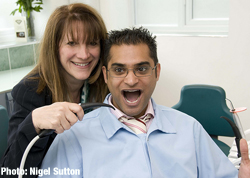
Lynne Featherstone and some dentistry equipment!Yesterday saw the opening of a new dental practice – Crystal Dentist Practice – in Durnsford Road. Hurrah! We need more dentists – and yes – it took them two years but they managed to get funding for some NHS work as well as private.

Having consulted with local residents – they realised that there was a huge demand for an NHS dentist locally and decided that they would wait to get the NHS contract and not just go ahead as a private dentist. So – well done!

Dr Ali sat bravely in the very state of the art chair – while I grabbed an instrument! I’m not really a dentist – bet you couldn’t tell.

I’m a great believer in the importance of good design – and the pleasant atmosphere that flows from it. The whole surgery is absolutely beautifully designed with state of the art equipment. So – double well done!

The Moravian Church, Hornsey

Last stop on Friday was the 100th Anniversary of the Moravian Church in Hornsey. They have a wonderful priest in the form of Joachim who makes sure that not only is the Church vibrant for its members but reaches out into the community. The Church has a number of events this year – this was to launch an exhibition of the history of both the church itself and also the Moravians history worldwide. Such a lot of work goes into these events – well done to all who spent the last three days in non-stop activity to make this happen.

Getting the wheelchair you need

After several hours of angst at Friday surgery – it is pretty draining sometimes – I go off to the Bernie Grant Centre to give a speech on Primary Health Care in the borough. This event is hosted by Camidoc – who are the current providers of Out of Hours Service (OOHS) in ours and three other boroughs.

Their contract has just been extended to September ’09 – but this service will be up for tender at that point. My fear is that Haringey Primary Care Trust will use a private provider – perhaps some big company – that has no local base and no local experience. I can’t endorse any provider myself – obviously – but I will say that I have used Camidoc extensively (given my children seemingly only ever tell me they are ill as the doctor’s surgery closes on a Friday night!) and found their service very, very good and very professional.

Anyway – most of my speech was about the proposed polyclinic scheme and how we, the human beings, want our local GP to remain our local GP. The clinics may be super duper – so long as they provide extra services and in consultation (real consultation) with us provide what we want in accessible form.

Then on to see a lady whose daughter was perfectly normal until the age of 13. She loves music, films, drama, clothes, shopping and spending her parents’ money (so her mother told me). She was bright, did very well at school and was very active at sport. She then developed Rasmussen’s Encephalitis, a rare neurological condition which presents as intractable seizures, and loss of function on the affected side. She had a hemispherecomy operation in April ’06 which left her paralysed on her left side with significant cognitive and visual difficulties. She is gradually regaining some mobility but will never recover the use of her left arm and hand, her fully cognitive functions or visual field.

Anyway – the point of my visit was to highlight the appalling provision of wheelchairs. You can have the basic model – which means you have to be pushed by someone else – but you can’t have a powered chair unless you fit very, very strict criteria. The daughter has already lost a lot of confidence. Being able to move yourself is all the difference in the world in terms of independence. Otherwise you kind of become someone who waits – waits for someone to push you. You have no power over your own life. No independence. I think this is vital. As if it’s not bad enough to have a disability which means you need a wheelchair for all or some of the time.

(There have also been some health and safety arguments wheeled out as to why a powered chair won’t suit in this case, but they don’t stand up to close scrutiny.)

We shouldn’t have a health care system that says you have this basic chair which will condemn you to always need someone around to push you – will give you no independence – and which is cheap (basically).

Crouch End CPZ and road safety measures

Thursday saw the AGM of the Haslemere, Waverley and Christchurch Road Residents Association, which was in Sue Hessel’s garden. And how lovely it was as she provides refreshments so it is social as well as business.

My Liberal Democrat colleague Cllr Lyn Weber was there too – as was Sergeant McGrath from the local Neighbourhood Team. So – after drinks etc – the three of us sat to take questions.

The big issue was the CPZ. What shocked me was that many people there had not received either the consultation on the proposed CPZ nor the consultation on Coleridge School Safety Scheme. The latter is about the road traffic and safety schemes needed to deal with Coleridge School’s expansion from two to four form entry and which will mean that the school is divided by a very, very busy road.

The school will be up and running this autumn – but the CPZ and the safety scheme (or rather, whatever emerges after the consultations) won’t be there in time for its opening. That has to be a concern both in safety terms for the kids but also in terms of the residents who will have extra pressure on parking from the school in their roads (the triangle of roads around the new building) – where parking is already under stress.

There seemed to be also quite a lot of concern that Haringey Council would provide parking permits for teachers of infinite number. Whilst everyone was quite happy for a few permits to be issued on the basis of need – there was a view that simply being a teacher at the school should not be the qualifying criteria for any such permits. If that were the only criteria – then the number of permits would make parking impossible for the residents who are already going to experience the extra weight of traffic in their roads.

So – we will see what Haringey Council is going to do to both ensure safety and deal properly with the parking stress. It simply cannot be right for the school to open without any measures in place.