Launch of the Haringey Somali Forum

Went Lynne Featherstone MP with Mohamed Dirshe at the launch of the Haringey Somali Forumto the launch of Haringey Somali Forum. Greeted by Mohamed Dirshe. There are seventeen different Somali groups in Haringey supporting the community in various ways – but this is a coming together of those voices, often marginalised and often virtually invisible. It was clear that everyone had worked hard to make this happen.

To be part of a diaspora torn from your homeland is tough enough. But the Somali community have to struggle to get decent housing, to access social and health services. They have often been demonised in the media and in neighbourhoods and had issues with other communities – and if we are honest – there have been inter-clan clashes within the Somali community. And that is why today is so important as this forum brings all sides together in unity to raise the Somali voice.

This is not a grassroots delivery agency – but a campaigning, voice raising, issue raising forum so that the Somali Community can take its place at the democratic and campaigning table!

Campaigning with Neil Morrissey

Joined Lynne Featherstone MP campaigning with Neil Morrissey and others against an inappropriate mobile phone masta protest against a new mobile phone mast on Crouch End Reservoir, which is on Mount View Road. Once more the Goliath of the mobile phone mast people (this time Hutchison 3G) is crushing the David of local residents and campaigners against its siting.

And the siting is wrong. It is within 20 metres of bedroom windows, within 200 metres of nursery school and its ugly and 30 metre being is to be placed ruining a lovely view out across London (currently unobstructed). Oh and it is in a conservation area.

Now yes, we (nearly) all use mobiles. But this is about both the location – in appropriate – and about the precautionary principle. This mast would both ruin a lovely view and site and also would be very close to young children at school.

So – Haringey Council did turn it down. But the big boys appealed and won – as they do. And this application will beget other applications. The local campaign group led by Robin Derham and with huge local support – including Men Behaving Badly star Neil Morrissey – has done everything they can. But one last ditch attempt to get Hutchison to see reason (or the law) is the submission of an appeal for a judicial review. The case has been filed and put together – and they await (legal) Counsel’s opinion as to chance of winning. It will cost the earth – and it isn’t right that local residents should have to fight these Goliaths, whose pockets are so deep and who act like steamrollers over local people’s wishes.

The planning system isn’t right. It has a presumption in favour of the developer and even if the developer loses then the developer can appeal. But if the developer wins, then the objectors don’t get to appeal (except in extreme and expensive cases of judicial review). (I’ve written in more detail about this topic before).

So – I am also going to try and get the Chief Executive of Hutchisons to meet with me and the key campaigners to see if persuasion (even compassion) might beat in the chest of the mighty mobile magnate.

How to take care of older people

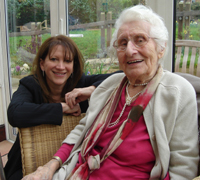
Lynne Featherstone with Dorothy ScalesVisited the coffee morning at Abbeyfield. Abbeyfield is a sheltered housing complex – but really tries and succeeds to feel like home. It has a lovely atmosphere and many of the residents have their family living very nearby.

The thing that strikes me always, when I visit older residents, is that boredom is the real enemy. Here they have a beautiful lounge area looking out on beautiful gardens from a warm conservatory – and that is a communal area. Many of them go to a Monday club for bingo at a nearby location and Age Concern collects some residents to take them to lunch and activities – and of course families visit often.

So – it brings it home how vital these services are and why we kicked up such a furore when Haringey were considering closing luncheon clubs. Getting out and socialising makes it a proper life.

I talked to lots of the helpers and residents and some ladies who come into the weekly mobility class. In the picture you can see Dorothy K Scales who was born in 1907 – yes she will be 100 on September 18th and she was completely on the ball – beautifully turned out – and very charming (as you can see). Her son kindly invited me to her birthday party!

Boxing Dinner in Haringey

Tonight was the Haringey Police Community Amateur Boxing Dinner. The club does phenomenal work taking young people off the street and out of trouble and giving them a real avenue to achieve. Shock horror – two of the bouts were girls! And they really, really fight. Tonight’s matches were between Haringey Select and Norway Select. The evening – which comprises a black tie dinner, auction of special items like Mohammed Ali’s boxing shorts signed by Ali and of course the boxing itself – raises a lot of money to support the club.

A great event, started by Haringey’s local police commander (the one before the one before this one – Stephen James). Tonight’s host was the current Commander, Simon O’Brien – and hats off to Haringey Police for the good work they do.

Bafflement and anger over school places

Nearly all the morning was surgery (i.e. meeting succession of constituents who have individual cases they want to raise with me face-to-face). This is the time of year when a trail of virtually suicidal parents come to see me because their children have not got not only their first or second choice schools – but as of today – not even their sixth choice.

It is a woeful process and totally baffling at times. Whilst not every child can get in exactly where their parents want, there are some examples that are quite extraordinary when several children from different families all living close to each other get into a school – but another child also living right next to them all doesn’t (and none of them have siblings at the school, so it’s not the siblings rule at work). So how can parents believe it is fair? Perhaps it is time that Haringey was forced to publish who gets in from where and why!

Can a two-state solution work in the Middle East?

Finishing off my thoughts from my visit – cut short by the Trident vote – to the Middle East – it was pretty clear that the Road Map was now becoming a virtually impossible route to follow.

The good news, I guess, was that all the parties we met in Israel were now in favour of the two-state solution – as apparently are around 70% of the population. Ten years ago that wasn’t the case – so that’s progress.

How to get there without the Road Map? Well, there were a couple of theses around. There was one idea which was for a trusteeship for the area to be held by the EU – much like in Bosnia, the EU could provide a political incubator to Palestine preparing it for full independence. That theory being based on the need for a central authority in Palestine that would make it possible for Israel to withdraw without prejudice to its security and that Europe would be far better a trustee than America.

Then there was the Geneva Accord. Without going into long explanations – a group of Israeli and Palestinian politicians agreed a set of aims, principles and methodology for moving forward to a two-state solution. Not given huge credit at the time – now perhaps back in play as another possibility. The Accord: reaffirms the determination of both sides to put an end to decades of confrontation and conflict, and to live in peaceful coexistence, mutual dignity and security based on a just, lasting, and comprehensive peace and achieving historic reconciliation; recognizes that peace requires the transition from the logic of war and confrontation to the logic of peace and cooperation, and that acts and words characteristic of the state of war are neither appropriate nor acceptable in the era of peace; affirms their deep belief that the logic of peace requires compromise, and that the only viable solution is a two-state solution based on United National Security Council Resolution 242 and 338.

The problem with moving forward on the two-state solution (amongst others) is the seemingly relentless increase in settlements in and around Jerusalem and the West Bank on the ‘Israeli’ side of the wall. The Palestinian areas are now to an extent isolated and to be connected by a different road system. Palestinians now worry that they would end up with no viable state. So, whilst Israelis seem to be shifting to a two-state position (at least verbally) the Palestinians seemed less convinced. Whilst they verbally often referred to a two-state solution, there were also voices raised to say that this would never be viable and therefore they should be going for a one-state solution. I don’t believe that would or could ever happen – but the continual building on the Israeli side of the wall removes their ability to believe that they will ever get a viable state.

And then there are the residual views – polarised on each side. If we talked about the wall (or fence for most its length) – the Israelis say since its erection suicide bombings have virtually stopped. The Palestinians say that the suicide bombings have stopped because Hamas declared a ceasefire – and that it would be simple to tunnel under the wall or fence – i.e. the fence is no defence.

The Israeli who took us out to the fence near Qalkila (right wing by his own admission and a settler moved from Gaza when Israel unilaterally left) explained the positioning of the barrier. For most of us (including me) it is hard to argue against Israel defending itself from suicide bombers by erecting a barrier. The argument is why they did so on what was Palestinian side of the Green Line. Palestinians regard this as a land grab. Israel says it is for security.

Whilst I can see that it might not be the best line to follow and there should and could be variance to the Green Line – it isn’t right at the moment. I don’t see why you can’t have an independent United Nations special judge and court and experts to adjudicate on the line that would be respected by both sides as a judgement. Security for Israel and as near to the ’67 borders as the Court judged viable.

As for the retention of taxes (and to my surprise I found out that the Palestinian Authority wanted the Israelis to collect the tax – although not obviously hold on to it) but that they did not want it put through the Temporary International Mechanism. Their argument was that when it was released it was needed to pay the debts on wages etc and therefore if it was put through the TIM it would not be there to pay those debts. Many different tales of money coming into the PA in suitcases and used for nefarious purposes. Meanwhile, as I said before, it is the ordinary people who are suffering most.

And lastly – the Quartet Principles. These say basically that the world won’t deal with the elected government as long as it is Hamas – unless they recognise Israel, renounce violence and agree to previous peace deals. This is a high bar – but perhaps with the coming of a unity government they will under the radar work out a triple-lock process where by the end of x period, a number of significant steps will have been taken that will allow the Quartet Principles to be agreed to – so that then publicly the process can move forward.

So – whilst I have only skimmed the surface of what I heard and saw – I hope that gives a flavour of my three days in the Middle East.

Focusing on education in conflict zones

Following up on my earlier blog posting on my Teachers Without Borders policy consultation, you can now read my newspaper column on the subject on my website.

As I wrote:

Focusing on education in a conflict zone is vital in order to establish a future for that region. War only teaches war. Children need not only the therapeutic medicine of learning itself but also – as they emerge from the carnage – children need to be given the skills and capacity to become anything from farmers to pharmacists.

Moreover, the relationship between education and community and political participation is well established. Participation in education contributes to community action and national political life. Teachers can also help children to develop new skills and knowledge necessary for survival and coping in a post-conflict environment, including landmine awareness and safety, negotiation and problem solving, and information about HIV/AIDS and other health issues.

You can read the full newspaper column on my website.

Sunday's radio appearance

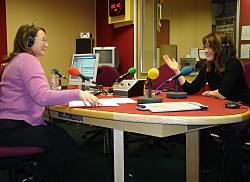
Appearing on Radio 4's The Westminster Hour with Carolyn QuinnThis Sunday I’ll be appearing again on The Westminster Hour: Radio 4, 10pm.

If you want to get advanced notice of my media appearances like this one, you can use the RSS feed from Flock Together.

Party members can also register and login at login.libdems.org.uk – and you get automatic information on the right about forthcoming media appearances by all the Liberal Democrat MPs.

A double dose of speaking in Parliament

Managed on Thursday to get called (after an hour of bobbing up and down) in Business Questions and asked the Leader of the House (Jack Straw) to give time for a debate – a proper debate – on gang culture, the problems of which have recently been highlighted in Haringey with 60 – 80 youths rampaging down Lordship Lane. Jack Straw agreed – but that doesn’t mean we will get the debate.

In the afternoon I led for the Liberal Democrats in a three hour debate on the sixth report from the International Development Select Committee which is on ‘Conflict and Development: Peacebuilding and Post-conflict Reconstruction‘. The Select Committee was and is chaired by my Liberal Democrat colleague Malcolm Bruce who presented the Committee’s report. It is a substantive piece of work on an area – conflict resolution – that is tough to address.

The key issues I raised were around the abuse and rape of the natural resources which conflict states are often so blessed and therefore cursed with – and trying to ensure that our UK companies are behaving properly. I also raised education in conflict states and the issue of the Department for International Development right hand not knowing what the Department for Trade and Industry left one is doing. Cross-departmental goals might be helpful and selling sophisticated and very expensive radar air control units to countries that don’t need them but to whom we are giving aid is just stupid and counter-productive.

Gordon Brown: too little, too late

And I know – I haven’t mentioned the budget – but there is much coverage in the news today. I always find it interesting the day after when we have all had time to read the small print. In short though – nothing to narrow the widening equality gap between rich and poor and little on climate change action – the two great challenges we face. Perhaps that heralds the Brown style of leadership – too little and too late!