Check your pay slip!

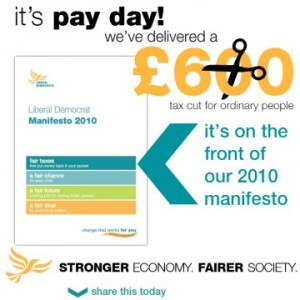
paydaytaxcut(2)Today is pay day for millions of people across Britain. It will be the first pay slip since the Income Tax personal allowance was raised to £9,440.

The personal allowance is the amount you can earn before being taxed. When Liberal Democrats came into power in 2010 this was just £6,475.

Increasing the tax-free personal allowance is the Liberal Democrats’ flagship policy. We have fought hard for this and secured it.

Since we’ve been in Government, millions of low and middle income earners are now paying £600 less tax per year.

The tax-free allowance will rise again next year to £10,000, fulfilling a commitment from the front page of the Liberal Democrats’ 2010 General Election manifesto and resulting in a total tax cut of £700.

By this point, 86,500 ordinary working people in Haringey will have received the £700 a year tax cut, and 7,520 of the Borough’s low or part-time earners will have been lifted out of paying Income Tax altogether.

Earlier, Liberal Democrat Chief Secretary to the Treasury, Danny Alexander summed it up very well:

“If you get paid today, take a moment to compare your pay slip to last month’s. You’ll see that Liberal Democrats have cut your taxes.

“It has taken the Liberal Democrats being in Government to deliver the largest programme of tax cuts for working people for a generation.

“The Liberal Democrats are the only party that will radically cut taxes for people on low and middle incomes to build a stronger economy and a fairer society so that everyone can get on in life.”

World Malaria Day

Here’s a blog from me on World Malaria Day. You can also read it on the Huffington Post website.

Malaria affects over half the world’s population, with a child dying every minute from the disease. In the worst-affected countries malaria has a devastating impact on health systems and economies. When faced with these stark facts it can often seem like there’s no hope.

But amongst the gloom there are genuine signs that we may finally be winning the battle against malaria. Across the world malaria is on the decline. Over the past decade governments, NGOs and multilaterals like the UN and World Bank have come together to fight the disease, while national governments in the worst-hit countries made real progress in delivering malaria control programmes. This global coalition had an enormous impact. By 2010, 145 million bed nets – the simple, cheap yet hugely effective defence against malarial mosquitoes – were being delivered to sub-Saharan Africa. The amount of artemisinin-based combination therapies (ACTs) – the most effective pharmaceutical treatment for malaria sufferers – jumped from just 11 million in 2005 to 278 million in 2011. In just one country, Mozambique, DFID’s support for anti-malaria spraying has seen a dramatic reduction in deaths and hospital admissions of at least 40%.

The effect of these efforts can be summarised in just two hugely important statistics. Between 2000 and 2010 global malaria mortality rates dropped by 26%, saving over a million lives. Behind these statistics lies hundreds of thousands of families free from pain and suffering. Free from having to mourn the death of a child. Free to get a job and work themselves out of poverty without having to worry about another bout of fever.

Yet there is a danger that this anti-malaria coalition is fragmenting. Global funding for malaria is levelling off and is in danger of falling in the coming years, threatening the reversal of a decade of progress. The international community needs to sustain its support to make sure the gains made do not go to waste. This must be matched by increased commitments from the governments of high-burden countries.

International Development minister Lynne Featherstone with Félix Kabange Numbi Mukwampa, the minister of Health in DRCInternational Development minister Lynne Featherstone with Félix Kabange Numbi Mukwampa, the minister of Health in the Democratic Republic of Congo. Picture: DFID. 

We are doing our bit. I’m in the Democratic Republic of Congo this week, one of the worst-affected countries in the world. Here malaria is responsible for a third of all deaths and 97% of people live in high risk areas. Children under five experience an average of between six to ten episodes of malaria per year. That’s why today, on World Malaria Day, I am announcing a major new UK anti-malaria programme that will protect around six million people in the DRC from the disease and result in approximately 2.5 million fewer episodes of malaria amongst children under five every year.

The UK will not stand on the sidelines while millions suffer from this entirely preventable and treatable disease. It’s time for the international community to come together yet again and keep up their commitments. We need another decade of action against malaria. The prize could be another million lives saved.

Ministerial visit to the DRC – Kasai Occidental

Here’s my second blog from my ministerial visit to the Democratic Republic of Congo:

Kasai Occidental, a landlocked province in DRC, seems cut off from the world. I flew into Kananga, its capital, this morning on one of the two flights a week. We flew over the railway, but didn’t catch a glimpse of the train that runs once a month, give or take. Potholed road access isn’t an inviting option. It’s little wonder that the business leaders I met with later identified transport as one of their biggest problems. Kananga, a city of around one million people, seems an island.

And this landlocked island has its problems. Conflict in the East of DRC has been making the headlines, but on some measures the situation here is worse. Malnutrition levels are high, in a malnourished country (all the harder to understand when the soil is fertile); conflict has been partly to blame. There is a lack of basic services like electricity and water, gender violence is all too common, the literacy rate for young women is around 35%, and lack of formal employment the norm.

So, where do you start? There is no easy answer, when each problem demands your attention and all are in some way connected. DFID is already investing in health, including the ASSP launched on Monday, which will work in many parts of Kasai Occidental to provide access to much-needed primary healthcare; and in police training, in a country where policing is not adequate to keep people safe.

And DFID is in the early stages of engaging with a new provincial government who appear committed to making things happen. The governor is credited with bringing electricity online – the six hours a day is a massive improvement on the zero hours previously. With the political will here to deliver for the population, perhaps Kasai Occidental can start to move in the right direction.

Ministerial visit to the Democratic Republic of Congo

I’m currently in the DRC in my capacity as Parliamentary Under Secretary of State for International Development. Here is a blog following my meetings yesterday:

It is sometimes hard to comprehend the health statistics in the Democratic Republic of Congo. This is a country where one fifth of children born do not reach their first birthday. And part of the story is that only one in four people have access to basic healthcare.

Here in Kinshasa yesterday, I sat alongside the DRC Minister of Health and formally launched DFID’s access to primary healthcare programme, “Accès aux Soins de Santé Primaires” (ASSP).

This major £182.9 million investment will improve access to primary healthcare for millions of Congolese. It will build clinics, provide equipment and medicines, improve management systems and train healthcare workers. For example, between now and 2015, it will ensure over 300,000 women give birth with the help of a trained attendant, and will provide 64,000 vaccinations a year to children. Importantly, it will work in close partnership with the government.

For these improvements to last, the government needs our help to take on more and more of the provision of healthcare. So I was heartened to hear the DRC Health Minister’s commitment to the ASSP programme and beyond. He faces huge challenges in building a healthy DRC. He will not face them alone.

Outbreak of measles in South Wales

I’m sure you have seen the news about the outbreak of measles in Wales. Though it’s many miles away, we know from past experience that these outbreaks can spread. And there’s certainly no harm in being prepared.

That’s why my Haringey Lib Dem colleague, Cllr David Winskill, started asking Haringey Council a few questions. David is the Haringey Lib Dem lead on Health – so was well placed to ask.

We asked the Council if they thought that the historic vaccination rate in Haringey has been adequate to prevent an outbreak in the borough. The Council said that Vaccination rates in Haringey have improved significantly in recent years reaching population coverage of 88-90% for MMR.

We asked if the situation in Haringey was monitored, and if is there are adequate supplies of vaccine if it is decided to offer them to the public. They Council said that all vaccines are now being procured centrally and there is an adequate supply of MMR vaccine.

The Council also said that Public Health England are closely monitoring the situation, though there is currently no evidence of measles spreading to the wider community in South Wales or indeed here.

So, we have asked for reassurance and have found out that vaccine stocks are adequate and that the situation is being monitored.

In the meantime – it seems sensible to remind people that the MMR vaccine is free on the NHS and is internationally recognised as the best and safest way to protect against measles, mumps and rubella.

You can read more information about measles and the vaccination here.

Margaret Thatcher

It was good to have a woman Prime Minister and Margaret Thatcher demonstrated conclusively that women are more than capable of doing the job.

Whatever people think of her policies – today is simply a day for respect. I wish her family strength and peace.

Fairer tax for low earners and part time workers

Here’s my latest Ham and High column. Also available in full on Lib Dem Voice.

Week after week, I meet local residents at my constituency advice surgeries. Many are working hard in full or part time jobs, but still struggling to make ends meet due to the current economic climate.

The unemployed and part timers often tell me they want to work more but also keep more of the money they earn.

The Lib Dems have known this for a long time. And from now, the amount you can earn before being taxed has risen to £9,440. That’s £600 less tax to pay for working people, since the Liberal Democrats entered Government in 2010.

Even better news – next year it will rise to £10,000 – meaning 25 million people across the UK will pay a total of £700 less Income Tax.

This announcement was made in the recent budget, one year sooner than had been expected.

In Haringey alone, an estimated 86,500 working people will benefit from the £700 tax reduction, and 7,520 local low and part-time earners will be lifted out of paying Income Tax all together.

Make no mistake; this would not be happening if it were not for the Liberal Democrats. This was so important to us we put it on the front page of our manifesto, argued for it in the coalition negotiations and are now delivering it in Government.

Labour failed to deliver this in 13 years in office, instead hitting low income workers by scrapping the 10p rate and pandering to bankers in the City of London. The Conservatives would not have delivered this on their own. Their priority at the last election was an inheritance tax cut for millionaires.

Low earners and part time workers keeping more of the money they earn is a key part of our plan to build a stronger economy in a fairer society, enabling everyone to get on in life. That’s why securing these vital tax reductions for ordinary workers is so important.

In other news, families in Haringey – and across the UK – are to get greater financial support for childcare, thanks to a major new Government initiative.

The Deputy Prime Minister Nick Clegg has announced a £1bn boost to help parents with childcare costs. This could benefit around 10,972 families in Haringey – saving them £1,200 per child, per year.

Almost a quarter of employed mothers say they would like to work longer hours but can’t do so because of the cost of childcare.

Making sure all families – and mothers in particular – can afford to work has been an absolute priority for Nick Clegg and the Liberal Democrats and I am delighted we are able to give parents this much needed help.

I know that these measures will not solve all the problems we face, but I hope these Lib Dem led initiatives go some way to helping individuals and families in Haringey and across the UK.

How would you use an extra £600?

Yes – it is tough out there! But without the Liberal Democrats’  delivering our front page manifesto commitment to raise the tax threshold – we wouldn’t even have that £600. And next year the threshold will rise to £10,000 of earnings before any tax is payable. So how would you use an extra £600?

http://www.youtube-nocookie.com/embed/VGQahXAnOn8?rel=0

(You can also watch the film directly on YouTube.)

Haringey – a Council in Crisis

I’ve just read an article by Haringey Liberal Democrat leader Richard Wilson, which details the many failings of Labour-run Haringey Council over the last month. Unfortunately the failings are all to familiar – they’ve been at this for the best part of 40 years.

The article is a must read for all local residents – who deserve much better!

Full link here: http://www.libdemvoice.org/opinion-haringey-a-council-in-crisis-33896.html


Seeing is believing – abandonment of FGC in Senegal

A fortnight ago I announced that the UK, through the Department for International Development, would throw its weight behind the global movement to finally bring an end Female Genital Cutting (FGC). Momentum is building and I firmly believe we have a chance to end the practice within a generation, stopping the untold physical and psychological damage it is bringing upon millions of girls across the world every year. Our children’s children will be able to look back on FGC as we do foot binding today.

But with this goal comes a whole host of questions – how do we reverse a practice that has been so deeply ingrained in many cultures for thousands of years? How can we address the issue without just driving the practice underground? What approaches work?

Last Thursday I was in Senegal to find some answers. The West African nation has led the world in efforts to end FGC since the Government outlawed the practice in 1999. By the end of last year nearly 6,000 communities had declared they were abandoning FGC and the Government has a target to end it entirely by 2015.

Among the inspirational NGOs helping to make this happen is Tostan. Founded in 1991 by Molly Melching, Tostan has a completely unique approach to working with communities. When invited into a village a Tostan facilitator, who will often be from a neighbouring village, will move into the community and become part of its daily life. He or she will then host regular classes with both adults and children, focusing on democracy, human rights, hygiene and health, as well as basic literacy and numeracy. By empowering the community and informing them of their rights and responsibilities, Tostan enables them to make their own collective decision to abandon FGC.

The process seems to work – more than 6,500 communities in Senegal, Guinea, Guinea-Bissau, the Gambia, Djibouti, Mauritania, Mali, Burkina Faso and Somalia have made public declarations for abandonment of harmful traditional practices following the Tostan programme. A UNICEF-funded evaluation found that FGC prevalence in young girls dropped by 77% in the decade following these declarations.

On Thursday Molly invited me to visit Keur Simbara, a tiny village near Thies – Senegal’s second city – to see what Tostan’s programme can achieve. Home to just 300 people, Keur Simbara formally and collectively abandoned FGC in 1998 after following Tostan’s programme. After a wonderful welcome, when this isolated, sandy village became filled with music and dancing, the villagers told me how they came to this hugely impressive decision.

Demba Diawara, Imam and village chief, told of how he dedicated himself to building a consensus for ending FGC in his community – a vital intervention as many falsely link this harmful traditional practice with religious obligation. There is no passage in the Qu’ran nor the Bible that recommends female circumcision. By making a stand, Demba was able to help break the taboo around FGC and make the first steps towards abandonment.

One of the most powerful testemonies was from Oureye Sall. Married by her parents at the age of 14 to a man 41 years her senior, Oureye was also put through FGC as a child. Instead of being given the opportunity to learn how to read and write, Oureye was then was taught how to practice FGC. For years she was the local FGC practitioner, before Tostan’s programme made her aware of the consequences of FGC (terrible health consequences for women) and the Imam confirmed it was not a religious obligation. She is now a pioneer in the movement to end the practice and has travelled to over 100 villages across Senegal to spread awareness of the harm it causes.

Molly Melching, my guide throughout the visit, makes for a truly formidable ally in the movement to end FGC. This was only one village, in one country in a continent which still has a long road ahead of it but this approach – of working alongside and within communities to help them come to their own conclusions about the harm and trauma caused by FGC and change social norms – offers hope that the successes in Senegal can be replicated across Africa. There are countries where this harmful traditional practice is far more deeply ingrained in culture, society and even politics than it is in Senegal, but it’s clear that attempting to dictate to people what is right and wrong when it comes to a 2000 year-old tradition just won’t work.

And given that we have upwards of 20,000 girls at risk of FGC in the UK – the ties between mother countries and diasporas are intrinsically linked – and I am convinced that the answer to our diasporas lies partly – if not mostly – in the behaviour change models bringing such success in Africa.

To find out more about the UK’s fund to help end FGC within a generation, go to http://www.dfid.gov.uk/News/Latest-news/2013/FGM-UK-to-help-end-female-genital-mutilation/
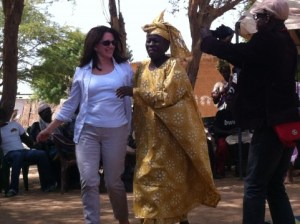
Dancing - well trying!

Dancing – well trying!