Our sexist monarchy

Well – I’ve referred to the Equality Commission the demotion in the line of succession to our throne of Lady Louise (daughter to Prince Edward) in favour of her newborn brother. It may not be the nuts and bolts of discrimination against women in terms of equal pay (appalling – 144,000 cases waiting for tribunal), rape conviction rates, funding for carers and so on – but it is completely unacceptable. In this day and age that a female can simply be pushed out of line by a later male addition to the Royal Family belongs in the Ark.

In fact – if I was Princess Anne – I would be mightly cheesed off at being shoved out of line by Edward and Andrew. She may not have been – who knows – but the legislation wasn’t in place then and there wasn’t an Equalities Commission to refer such a thing to. Now there is – and as this has long been on my agenda – and Nick Clegg has given me the locus to do it – I have.

Whatever one thinks of the monarchy – and this is not that debate – this is wrong and needs correction. Tackling sexism in the monarchy would send a strong symbolic message to the rest of society. And this is a good time to do it – as ridding the system of sexism now won’t immediately alter who gets on the throne – so it isn’t about the personal merits of person A versus person B. But William has a 50% chance of having a girl child first – and we don’t want to be discussing it then!

Let’s see what the Commission makes of it.

Here’s the news release:

Legality of Lady Louise Royal demotion referred to equality watchdog

James Windsor, Prince Edward’s first son, overtaking of his sister, Lady Louise, as eighth in line to the throne has today been referred to the Equality and Human Rights Commission by newly appointed Lib Dem Youth & Equalities Spokesperson Lynne Featherstone MP.

Following the common law practice of male-preference primogeniture that sees male heirs take preference over their female siblings in the line of succession, James Windsor (Viscount Severn) who was born in December now comes before his 4 year old sister in succession to the throne.

Ms. Featherstone has written to the chair of the Commission requesting an urgent investigation into the legality of displacement in the light of recent equality legislation.

Lady Louise’s displacement in favour of a male is the first amongst Queen Elizabeth II’s direct successors since the advent of laws on sexual discrimination.

Commenting, Lynne Featherstone MP:

“This is an arcane practice that might have suited the grey bearded king makers of old, but it is completely at odds with how a head of state should be selected in modern Britain.

“Of course who is eighth in line to the throne is slightly academic, but there is a 50/50 chance Prince William’s heir will be a woman and what then?

“More importantly, there is little hope of bringing full equality to the workplace if we can’t bring equality to the highest office in the land. Any practice that is based on the idea of making do with a woman until a man comes along must be consigned to the history books.”
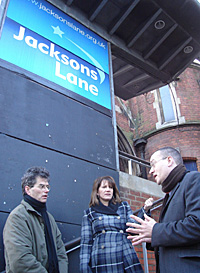
Jacksons Lane Community Centre: action needed to secure its future

I’ve Lynne Featherstone MP with Cllr Bob Hare and Cllr Neil Williams at Jacksons Lane Community Centrejust demanded a meeting with Arts Council London to try to secure the future of Jacksons Lane Community Centre – one of our much-loved local resources that has provided so much to residents of Highgate, Archway and beyond.

Organisers at the centre were told in December that its £125,000 annual grant may be cut this year. And without that grant the centre, which has already endured nearly a year of closure, may have to close permanently. Not good!

The problem is that Arts Council London has questioned the commitment of Haringey Council to the centre – not surprising given the delays in funding repairs after roof damage in January 2006 and also Haringey Council’s failure to provide a long lease – which meant the centre missed out on applying for a £1 million grant.

But the annual grant is absolutely vital to the future of the centre and I will not see it disappear without a fight.

Clegg's first Prime Minister's Questions

Well – Nick did well! As readers will know, I think too much attention is given to PMQs, but given that it is – certainly better to do well than not, and Nick did well.

He played it straight with a question about the sort of real issue that hits so many people – home fuel costs – rather than going for a Westminster hothouse story. Keeping your home warm, and being able to afford it, is a big issue for many of my constituents – so good on Nick for picking that topic.

He moved a few places in from where Lib Dem leaders usually sit / stand. I’ve not seen how this came over on the TV, but it seemed to work well in Parliament – as he was surrounded by Lib Dem MPs, rather than having opposition MPs heckling straight into his right ear.

New Hampshire score: polls 0, public 1

Hillary pulls it off! I thought she might lose New Hampshire. Well – so did the polls. But that’s what makes politics so exciting – for all the polling predictions and pundit pontification, in the end – it’s the public who get their say.

I came across a conversation last night in Central Lobby (in Parliament) between three men – all from ethnic minorities. Two were for Clinton and one for Obama. The conversation was interesting in that there clearly was a feeling (not hugely strong – but enough to make this discussion happen) about being black and not supporting Obama because they were Clinton fans. In the end, for these two, supporting the candidate they thought would make the better President of the United States won out over supporting a black candidate because of the good that too would do. In the end, we will really have made it when it’s not even an issue for discussion. Equality really has a long way still to go.

A postscript about Iowa: those scenes of hundreds of people turning up to squeeze into venues to do politics for several hours were really impressive, but once the immediate impact of those pictures fade I’m left with the more sobering thought that for all the effort, money, hype, enthusiasm and choice of different candidates – turnout in the Democrat caucuses was only a bit over 10%. And that was with turnout at record high levels! So – although as I said, the public do get the final say in politics, it’s a good reminder of how much work there is to do on both sides of the Atlantic to persuade people that say is real and worthwhile.

Petitioning: the good, the bad and the ugly

I’ve Lynne Featherstone, Susan Oatway and Neil Williams running a petition about Haringey's policingseen (as a possible signer, actual signer, recipient or even organiser) more than a few petitions in my time. Some are great – a really effective way to help bring about change. And some go wrong in all sorts of ways – too few signatures, unrealistic or confused objectives, aimed at completely the wrong target or just a mess – a few barely legible lines on a rather tatty single piece of paper.

The House of Commons is currently running a consultation on introducing an e-petitions option, so that in future people could run online petitions to Parliament – a bit like the way you can run an e-petition on the Downing Street website.

So how might a Parliamentary e-petitioning system be done? There’s a whole host of questions behind the concept. Are there more than enough petitions already – and should we worry about generating too many new ones? Or should everyone have as many opportunities to express their views as possible? Is this just a duplication of the Downing Street petition system – and so we should try hard to avoid duplication? Or is it a welcome move and reminder that Parliament matters – not just the occupant of Downing Street?

All these lead to the basic point: how could a success be made of such a system, and how would it really serve the interests of the public best?

There’s an online consultation you can take part in on the Parliament website. I hope lots of people will take part – because I’ll certainly be having a look closely at the views to help me decide which way to argue and vote when it comes to decision time.

What do you think when you see Barack Obama on the TV?

I’ve expressed my doubts about Barack Obama previously, but – whether or not it helps propel him to victory in the Democrat selection contest – his victory in the Iowa caucuses (an overwhelmingly white state) comes with huge symbolic resonance in a country where race relations are so often strained and racial divides are so often so very stark.

This post seems to capture the raw emotion of what his victory meant to many American blacks – it’s a bit long, but well worth reading to the end – especially for its account of what went through the author’s mind whilst watching Obama speak on TV.

Janet Street Porter gets it wrong on blogging

Well – Janet doesn’t like us bloggers! Now – normally I’m a big fan of hers (sorry Iain!) but today she’s got it wrong in her attack on blogging in The Independent.

My main point of disagreement is that she points out that a lot of blogs are – not to put too fine a point on it – crap. Well, that’s true. But then the same is true of published books: an awful lot of published books aren’t that good and are read by hardly anyone.

Of the 86,000 books published in 2007, the majority only sell trivial numbers – but you wouldn’t judge the idea of a book by saying, “oh, they’re a waste of time, there’s so much vanity publishing, loads are awful and read by hardly anyone”.

What’s great about blogging is that it is easy for anyone to get into and give a try – and, yes, that means you get a lot of dross – but it also means that everyone gets the chance to make their mark and build up a wide readership if they are of good quality. (And of course, there’s nothing wrong with someone running a blog that’s aimed at just close friends and family. So what if your readership is only just into double figures if that’s who you are writing for? And so what if you are writing just about the details of your own life for that sort of audience? It’s what people used to do in letters to friends and family, and I don’t recall too many people declaiming, “It’s awful! I’ve just got another letter from my brother. And he tells me what’s he’s been doing. What a waste of time!”)

I do like the irony though with the Independent ending her piece saying:

To have your say on this or any other issue visit www.independent.co.uk/IoSblogs

Ah, that would be a blog then… (and you can read the comments from readers here).

Where have Labour supporters gone online?

Interesting (and good!) to see that my piece about Prime Minister’s Questions over on Liberal Democrat Voice has generated quite a lot of comments – and, despite my general scepticism about the quality of comments on many political blogs, a good quality debate too.

Several Tories – hello Justin! hello Roger! – have joined in too, but no-one it seems from Labour. Curious that. I could understand only getting comments from Lib Dems on a Lib Dem site, but getting comments from Lib Dems, Tories and those of no apparent political party – but no obviously Labour comments – seems a bit odd. Any thoughts why?

Identity cards: another good reason to oppose them

Today’s news that the Government lost a record number of pieces of personal data in 2007 is another good reason to oppose their plans for identity cards. (The Telegraph has more details on these figures, released today by Nick Clegg.)

There are many problems with Labour’s scheme (such as the huge cost – the money would be far better spent on other ways of fighting crime which we know would work, unlike a huge new IT project – which may well fail!) – but one of them is the risk to our own privacy and safety from the identity database the scheme requires.

It will hold tens of millions of records of personal information – just the sort of thing that people who want to swindle us, pry on us or otherwise misbehave can exploit. And on last year’s form – we really can’t expect the Government to keep this data safe! And that would apply to other Governments too – putting all that sensitive and valuable data into one place is just too risky.

You can help stop them by signing the Liberal Democrat petition against ID cards here.

What should we do with Prime Minister's Questions?

As you may just have guessed from some of my previous blog postings about Prime Minister’s Questions (PMQs), I’m not exactly a fan. As I’ve written on Liberal Democrat Voice today:

But the point at which I draw the line in defending my profession [politics] is Prime Minister’s Questions. What an awful testosterone-fuelled bear pit of badly behaved boys (and it is overwhelmingly boys!) that is!

In the absence of a few ASBOs being dished out to the serial hecklers and shouters, what then is to be done?

For my suggestions – you’ll have to go and read the article!