If I could commission one government IT project

That’s the topic of my (first!) posting today over at Liberal Conspiracy:

I’ve been pretty critical of two massive government IT projects – the existing plans to introduce mandatory identity cards with a huge database behind them and also the Home Office talk of a database of all phone calls and emails made anywhere in the country.

My criticisms in both cases are three-fold: the money involved could be better spent on other projects (such as giving us more police rather than keeping huge databases of the activities of innocent people), they involve a huge infringement of our liberties and privacy, and – thirdly – big IT projects like this are likely to go wrong and to be vulnerable to misuse.

But I’m not a Luddite. Over time I’ve found embracing IT innovations has made my life easier and made me more efficient – whether it was years ago buying a laser printer to speed up production of casework letters or more recently starting to use the text-messaging based blogging service Twitter to help keep residents informed of what I’m up to as an MP.

Indeed, the idea of organising information in an efficient way so that it helps people make decisions and find out what’s going on is fundamentally a very liberal approach – getting computer code to do the heavy lifting so that individuals can find out and act.

So this has got me thinking – if I could commission just one IT project from government, what would it be?

You can read the rest of the piece here and there’s an interesting response over at Puffbox.

Hillfield Park 2008 Olympics

Well – it’s the Hillfield Park 2008 Olympics! Hillfield Park’s annual street party is the daddy of street parties. I’ve been going there for – I don’t even know how many years. Such a lot of organisation goes into this event with three teams (red, white and blue) representing the three streets or part streets involved.

Loads and loads of events – from skipping, to a dog obstacle course, to a bike race up Hillfield (and that’s one hell of a hill) to a major tug of war. The children adore it and everyone gets to know their neighbours. In the evening – although I left at around 5.30 they go on to party ’til late. Congrats again to the A team from Hillfield Park.

I am pictured firstly with Harry. Harry lives at No 43 and did not win the dog obstacle course.

But I have seen Harry (not the youngest of dogs) take part every year and in the spirit of the taking part being the important bit (as opposed to winning) I asked to have my photo with him!

Then I met up with Peter Thompson – one of the key organisers and local saint for all he does in Muswell Hill and elsewhere.

I had to unveil a plaque. In reality the wind unveiled it – but it was to remember Viv Stanshall, late of Bonzo Dog Doo-Dah Band.

Musician, broadcaster, wit and raconteur and troubled genius, Viv was the main singer in the band. The hit most people would remember (if they are my age) is I’m the Urban Spaceman. He lived at No. 21 – but I never knew that until today. Nice to have him remembered!

Why I cried yesterday

Yesterday went to launch the sports day for the Hornsey Trust for Children with Cerebral Palsy. This is one of the only places in the whole of London where from the age of six months parents can take their child to a conductive education school. This is the method that started in the Petto Institute – at the time highly controversial, but which delivers results.

And you know – can you imagine what it is like? You give birth – with all the hope in your heart that nothing is wrong – and then you are told that your child has cerebral palsy. A new world that you never wanted to take part in lies in front of you. What does it mean? Where can I get help? What will my child be capable of? So many questions and so many battles ahead.

When you become the parent of a child with disabilities – you will spend so much of your time researching and fighting to get what your child needs. Of course – it should be there – but it it often isn’t.

Many parents come to me because they cannot get Haringey (or whatever local authority) to fund their child’s education or care. And when the policy is mainstreaming – there is a great resistance to special facilities.

That is now beginning to change – as the consequences of the policy have become clear – that in some cases mainstreaming is appropriate; in some cases it isn’t and in some cases half the week in each is the best solution.

Anyway – back to sports day. Three groups of children up to the age of seven with about six or seven children in each group were doing races. The first group were mobile with a variety of help – of walking frames or without – and they went around a simple obstacle course. The conductive method seems to work off intense one to one encouragement and help to urge the child to take the next move. It is a kind of patterning – but I am no expert. At the finish lines, siblings, parents and relatives rejoice – and the little ones faces full of beams. The point is that they have achieved!

The next group less mobile – but in a short distance to a finishing tape – they crawled using their elbows or whatever – each with a helper urging them on each and every step. And the last group even less mobile – literally encouraged to roll to the finish line.

It is intense and it must be exhausting for the trainers – but the children from all the groups absolutely loved it. And the effort and the love in that room meant that tears rolled down my face continually. Don’t get me wrong – no-one else cried – they were all happy. But I cried because the achievement was huge and the road so hard and the bravery and the love so strong.

And I spoke to quite a few of the parents – and the struggle they have had to get the funding to have their child here rather than where their local authority wanted the child to go. For parents here – they have seen what this method can achieve. The normal method puts them in a wheelchair and the parents feel condemns them to a very limited life. I met one parent of a girl who had not been able to walk – now she walks. For some the improvements are small by ‘normal’ standards – but they are all about improving quality of life and maximising what each child can do – and as a parent that is what you want.

It isn’t just cerebral palsy. Readers of my blog will see only a week or so ago I visited the mother of a young girl who couldn’t get a power wheelchair from Haringey who seem to operate a one chair fits all policy.

And there are many others – but I don’t want to post here as they are private matters brought to me – but they are on the same line. The parent fights and the authorities (whether medical, council or other) all seem to make the already horrendously difficult road more difficult, more bleak and more hopeless.

Three cheers for all the parents at Hornsey Trust and all the children – and the wonderful staff!

Then it was Highgate Fair – happily the horrible rain and drizzle of the morning has dried up for this Highgate celebration. Lots of stalls and people and children all milling around and seeing what’s to eat, what’s to buy and what’s to join. My Lib Dem councillor colleagues – Neil Williams, Rachel Alison and Bob Hare have a stall too. The big event for me here is the launch of the Highgate Shopping Bag! I purchase one immediately. My only problem now is that I have the Crouch End Shopping Bag and the Highgate Shopping bag (and I have a designer given to me by my daughter last Christmas) and Marks bags that you buy to shop there. So two things – is it de trop to use the wrong bag in the wrong area? (Jokes!) And come on Muswell Hill – you can’t be left behind! Join in and soon!

The Westminster Hour: Sunday 10pm

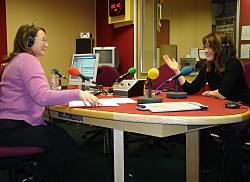
Appearing on Radio 4's The Westminster Hour with Carolyn QuinnI’m back on The Westminster Hour this Sunday: Radio 4, 10pm.

If you miss the show you’ll be able to listen again on their website.

If you want to get advanced notice of my media appearances like this one, you can use the media events service at Flock Together. You’ve got three choices:

  1. Using this feed: http://feeds.feedburner.com/LiberalDemocratsMediaAppearances, or
  2. By email: register at FlockTogether and pick “Media appearances” as one of the categories of events you want to be emailed about. (If you are an existing Flock Together user you can also change your preferences – login and then click “Edit your preferences” in the left-hand menu; you need to tick “Media Appearances” under “Email options”), or
  3. On the web: take a look at the dedicated Flock Together page.

What does an MP do when they are not in Parliament?

Sometimes people think that being in Parliament was the only part of being an MP. I wish – the job would be much easier if that was all there is to it!

So as an example – this is what Friday was like for me. Started with a few hours of surgery (residents coming to meet me face-to-face to raise issues) – with at least four people bursting into tears. No – not ‘cos I am mean to them – but because I am sympathetic – and so many of those who come to me at surgery have been through so much with nobody listening. And when someone sits you down and says now what’s wrong and how can I help – it is obviously a release. I may not always be able to solve the problem – but I do listen properly. It’s pretty dreadful when the first person who will listen non-judgementally is your MP! And it is very, very emotionally draining.

Next port of call – to see the finished works at Bounds Green station. Cllr John Oakes, my local Lib Dem colleague and councillor for the ward was also in attendance. I went to see the works in progress some while back – hundreds of fluorescent orange jackets deep underground, dozens of different trades busying away at 2am. They have very limited time to work – so literally an anthill of activity.

Today I am met by Mike Challis, who is the General Manager of the Piccadilly line. The station really does look marvellous. And the very beautiful lights at the bottom of the escalators now look splendid in their setting. So much better!

The only flaw was the backing to the posters you stare at inanely whilst you are going up and down the escalators. This area wasn’t renewed (they can’t do everything – too much money) but it was a shame as they detracted a bit from the rest of the work that made the station look so much better.
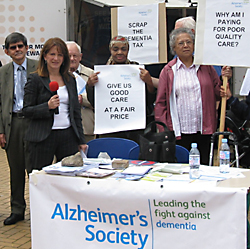
Lynne Featherstone with Alzheimer's Society, Wood GreenThen back to Wood Green to support the Alzheimer’s Society day of protest about the appalling way those with dementia or caring for those with the dementia are treated compared to other illnesses. It is that they are charged for help with washing, eating and using the toilet. One in three people over 65 are affected. And it could be you!

The cost is heavy. The quality of care often poor. Dementia sufferers are hardest hit by such costs as they need so much care over so many years. And the means test for what help there is penalises those who have saved a little bit for their old age with the threshold at £21,000.

The Government is to launch a consultation in 2009 and what the Alzheimer’s Society is saying is that for dementia they need a funding system that is fair, sustainable, transparent, simple to understand and will deliver good quality care. The solution the Government eventually puts forward must meet the needs of people with dementia – not just the convenience of the Government.

Then on to the FAITH Plant Centre which is in Wolves Lane right on the edge of my constituency boundary with Tottenham. Cllr Richard Wilson, my Lib Dem colleague and spokesperson for Social Services and Health in Haringey, was there too.
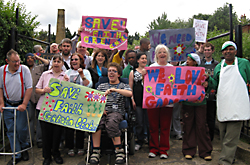
Lynne Featherstone at the FAITH garden centre, with protestorsHere they have the most remarkable jungle area, desert area and rain forest area – as well as a garden centre – and also training and work for volunteers with a variety of disabilities.

About 50 volunteers come here to train and work in horticulture. This perfectly fits the bill of helping people to find routes to occupations for those who simply cannot work in the normal way. Additionally – local children come here to experience the different climate areas, to learn about some of the creatures that live in them too.

The problems are thus. This wonderful scheme has been funded through a national charity, Livability, to the tune of roughly £300,000 a year. It will end its funding at the end of August, because they say they can’t afford to continue this any more without support from Haringey Council and others.

This would end all the educational work with primary schools, all the work with adults with learning disabilities and force the place to close unless Haringey Council steps in to find other sources of funding.

The site is owned by Haringey Parks (it’s their old nursery) who give it rent free to the organisation that run it. The (only) funding Haringey Council gives is for the three staff who run the cafe (a council funded project that was moved to the centre when it had to leave its previous location), and they pay for the plants that are grown there for the parks. But Haringey Council do not pay towards the maintenance of the site. In addition to the funding needed to keep the service open, it is in need of investment – it needs £300,000 to replace the electrics very soon.

A lot of volunteers, their families and local users of the centre turned up to tell me how much the centre means to them. To most of the volunteers closure will result in the end of their outside independence. Many of the volunteers will simply be left to vegetate at home if the scheme closes – so it’s battle stations for a really worthwhile cause. Watch this space!

Whoosh back to get to Greig City Academy to meet with the students and staff who tell me what they plan to do as part of the B & Q @One Planet Living Award scheme. Greig has been awarded £2,400 based on a natural pond they have created. They will use it to establish plants and to purchase special tools to construct and maintain the area. Two B & Q staff came for the photo op – and together with four students there are now photos in existence of me and them in wellies in the middle of the pond. It’s not dull – being the MP! Well done Greig and B & Q for the scheme itself.
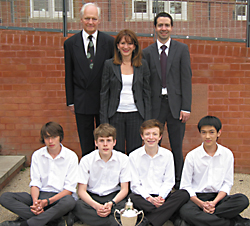
Lynne Featherstone at Highgate SchoolThen off to to Highgate School for two very good reasons. Meet the science teachers and the four boys who have won the 2008 Top of the Bench competition. Twice before they have got close – but this time they have done it. It is a wonderful tribute to the science teaching at Highgate and to celebrate I have tabled an Early Day Motion in Parliament to congratulate them!

But the main event I am at Highgate School for is to launch the Chrysallis Partnership. Basically Highgate School is using its very best skills to advantage all the bright children from other schools in Haringey and Camden. This part is about offering subject-specific teaching to bright pupils and about offering specialist advice and assistance in applying to top universities.

I think this is fantastic. For far too long Highgate School has been regarded as separate from the community of schools in Haringey. What I saw was the beginning of a reaching out and bringing all our schools together to develop and use skills to help all our children. I think there is a passion and a hunger there which will spread benefits widely.

And – as the Head himself said – the ultra bright pupils who are coming from other schools are teaching the Highgate pupils a thing or two themselves. Adam hopes in years to come to extend the scheme so all the schools can offer any specialist skill they may have to pupils from the other schools – not just Highgate. Anyway – too much to put in a blog posting!

Campaigning in Henley

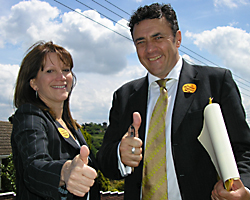
Lynne Featherstone and Stephen KearneyWas campaigning in Henley with Stephen Kearney this week.

Well impressed with our candidate – a wow on the doorstep!

Love by-elections – especially seeing very different constituencies are from each other.

Polling day is Thursday (June 26th), so if you’re thinking of going to help Stephen’s campaign (again) – time to get a move on!

42 days, David Davis and Nick Clegg

I am truly sick of the Westminster Village sneering attitude to David Davis. Quite frankly – I don’t care if David Davis is doing this for truth, justice and liberty or because he was never going to get Home Secretary, is a loner, egomaniac or because he hates David Cameron – all doing the rounds as explanations.

What I do care about is the issue – and if his actions help secure the same outcome that I want, then good for him – and I don’t see why I should have to pretend that I don’t really agree with him – or have to pretend that him helping to achieve what I want too isn’t a good thing – just because we are in different parties or disagree about 1,001 other issues.

Why does the issue of 42 days detention without trial matter so much? Quite simply – because locking an innocent person up for a month and a half is an awful, ghastly thing to do. Imagine it happening to yourself. How it can wreck jobs, pull apart relationship and leave a deep and abiding sense of anger and hostility.

And we know that when the police and other authorities think they know that someone is guilty – they ain’t always right. That’s why people get acquitted. Even with the best will in the world, mistakes are made. And we know too – the best will often is missing. We’ve seen in the fight against Irish terrorism how some police were so convinced they knew who was guilty that evidence was forged – to frame people for crimes they didn’t commit. We know we can’t just assume that all involved in security matters follow the rules and do their job properly – look at the repeated incidents of secret documents being lost!

So locking anyone up for any protracted period of time without a trial should only be a matter of very last resort. That’s not the situation we’re in. The government has left a whole host of other approaches untouched – such as changing the rules on what can happen pre and post charge. Or indeed taking the obvious step to deal with the extra complexities of terrorism investigations these days (involving many computers and many countries and so on) – that of giving extra resources to the police and security services.

If the problem is investigations taking too long – put more resources in I say. Double win if that’s done – not only are you able to keep to the current timescales – but if you’re investigating an outrage or would-be outrage, the quicker you do it the more chance there is of stopping other outrages too through what you discover in the investigation. Let’s not forget, Labour managed to whip up some extra billions just before a by-election polling day to attempt to deal with the political fallout from their 10p tax policies. So do we really think they’ve exhausted every avenue to fund quicker investigations into terrorism?

Go back to imaging your life. If you’ve got a diary for the next month or two take a look at it. And then imagine being locked up for 42days without being told why you’re being held. And think of the impact it would have on you. And then remember how very many of the people held at the moment end up being released without charge or being acquitted in court.

That’s why this issue cuts to the very core of the point of having elections and Parliament in the first place. If MPs aren’t there to protect people from the almost inevitable demands for greater and greater powers over them from all parts of the state, what is the point of much of what we do?

That’s why I agree with David Davis on the issue, and why I have a sneaking admiration for the insight or bravery or zaniness or call it whatever you will that he showed in forcing the 42 days issue to stay at the centre of political debate by forcing a by-election.

I don’t envy Nick Clegg and others having to make the quick judgement about how to react to his resignation. I think Nick and they got it right – there really are some issues which are more important the inter-party disagreements. And events so far have shown his judgement to be much surer than that of many of the critics.

No, Davis’s resignation on the issue didn’t hand Cameron a media bonanza – just look at all the coverage of splits in the Conservatives.

No, it wasn’t a pointless resignation – just look at the way those in the Conservative Party who wanted to back down over 42 days have instead themselves been backed into a corner.

No – it wasn’t a one-day wonder – just look at the continuing attention being given to the issue.

And above all – yes, it has been possible for David Davis to keep this attention on the civil liberties grounds on which we agree with him. (Imagine if there were a Liberal Democrat candidate against him – by necessity they would be having to campaign on a whole range of other issues in order to give people a reason to vote for them rather than for Davis – and that would have taken the attention away from that very civil liberties issue).

On each of these points, Nick and other’s judgement so far has been proved right – and events are offering us the opportunity to make a major step forward in the fight for our civil liberties. Real protection for our civil liberties doesn’t just come from electing Liberal Democrats – it comes from moving the terms of debate for all political parties. Civil liberties are part of the very Liberal Democrat DNA and to me helping make that happen matters far more than the usual instinct of”must fight every election, must fight every election, must fight every election.”

Earlham Primary School visits Parliament

Earlham Primary School visit to ParliamentThe past two Mondays – I have taken young people from Earlham Primary School on a tour of the House of Commons – or rather Ed (my Head of Office) has been the tour guide and I have accompanied them.

It’s followed by an hour of questions to me by the kids. I love it when my schools come up. Usually they join an official tour – but this time they left it too late so they got the DIY version from me!

Polyclinics: panacea or plague?

Polyclinics are turning out to be one of those slow-burning political issues which, although getting the occasional piece of news coverage, have really been bubbling away in the public’s mind and concerns for a long time before really grabbing the forefront of political attention.

The possible introduction of polyclinics has been an issue in Haringey for some time now, and it’s a topic I’ve blogged about moderately regularly – but nearly each time I’ve been struck when going to research further information on the topic or to see what other people have been saying, how little attention overall the issue has been getting. Yes, there’s been the occasional news story and occasional reference in Parliament, but for an issue that could massively alter the way tens of millions of people get their health care via the NHS, it’s really been pretty low key.

The recent news that over 1 million people have signed a petition on the issue – along with the major Kings Fund report into the topic – may well change that now!

I certainly hope so, because the introduction of Polyclinics, or Neighbourhood Health Centres, or whatever the government has tried to re-brand them as this week is the biggest health issue facing my constituency – and many others – at the moment.

The idea behind these centres has some attractions – bring different health services together on one site so that you can move quickly and easily between those services without the usual delays (go to one place, get referred to another, wait for appointment) or the extra travel.

Haringey’s Primary Care Trust has chosen to be a trail blazer for Polyclinics and has enthusiastically adopted the idea. The current proposal is to close a number of local GP’s surgeries and consolidate them into four or five Polyclinics.

And that’s where the concerns start. Will these become large impersonal services where we are no longer able to see our own local doctor? We need guarantees that the relationship with your doctor will continue. Any severing the doctor/patient relationship would be a travesty. Hardly anyone wants to explain a deeply personal medical problem to a complete stranger.

Consolidation of GP’s will undoubtedly increase journey times for many people wishing to see their GP, and force them to take either public transport or their car. The heaviest users of primary care have low levels of car ownership (senior citizens 69% no car; lone parents 42%).

It’s easy for those of us who have no trouble getting around to under-estimate just what a burden it can be to extend someone’s 10 minute journey into a 30 minute with two bus changes journey.

The site of the old Hornsey Hospital is where one of the proposed polyclinics is to be built. This site is currently served by only one bus route and it takes Transport for London anything from two years to establish a bus route. This means that those with the most need would most likely have the least access to the service. I met with TfL and raised the issue of public transport provision to this site several years ago and recently raised it with Peter Hendy – the Transport Commissioner for London. But as yet – no firm plans.

Sorting out adequate access to the services should be central to any polyclinics plan – not an afterthought to play around with after the service is in place and people are already suffering from poor transport links.

The recent report by the Kings Fund concluded that there were “serious risks to access to care” posed by consolidation of primary health care and that “it is unlikely that the gains in access to some services currently provided in hospitals are worth the losses for primary care patients.”
Accessibility of service, both in terms of getting an appointment and getting to the appointment, is vital – especially as 90% of access to the NHS is via the primary care route.

And then there is the question of whether polyclinics will really add to our services and facilities? Or will consolidation mean – as it has in so many other areas – cuts?

That brings me to the problems over how the policy is being pushed through – without proper consultation or information. It’s a central imposition of Labour’s ideas on to local communities. Local health bodies have been instructed by central government that they must have polyclinics in every community. This is a classic top-down, Whitehall imposed centralising solution to local problems.

As with our post offices, we were promised that local opinion would be taken account of through consultation. Yet so far we have not been told precisely which services will be provided by polyclinics. This renders the consultation process pretty meaningless as we cannot make an informed choice about what we will gain. And so we are marching on blind – not knowing and having to keep our fingers crossed.

Bringing understanding between those of different faiths

I haven’t blogged about being a “parliamentor” to three young women from the Three Faiths Forum. It was born to work at friendship and understanding between Jew, Christian and Muslim.

For a year nine groups of three young people (one from each of those faiths) has been mentored by one of nine parliamentors as they developed a project – and at the same time learned about each other.

Amina, Eva and Michele were assigned me as their mentor. Each month they have come to spend time with me at Parliament or in Hornsey & Wood Green. What a bright and talented trio my girls are!

Yesterday was the end of the year presentations with each group presenting their project to the assembled guests at Parliament. My group, in the end, chose to make their project about asylum seekers.

They gave wonderful examples of what people coming here have brought to our country (including Marks & Spencer) and went on to explore the work they had done with the Refugee Council and the difficulties of being without state support, without medical care, without anything – held in limbo (or worse) whilst the appalling Home Office fiddles for years before delivering an outcome.

So well done! Daniella (a saint herself and responsible for running the whole caboodle) told me that my three had started barely being able to talk to each other – and now were inseparable friends. That’s the real value – that understanding that we all as humans have far more in common then we have in differences will stay with them all their lives and colour their understanding of the religious divides – and never let them be human divides.

Just a word to say thank you to the Sternberg Foundation who part-funded this project. It is hugely worthwhile work – and none of it could happen without funding.