FGM

I gave an exclusive interview to Marie Woolf of the Sunday Times about an announcement I would be making about Female Genital Mutilation (FGM) at the 57th Session of the UN Commission on the Status of Women in March 2013.

However, I wouldn’t give her the figure.

I kept that for the moment when I actually announced the UK new anti FGM funding from the platform at the UN to a hall full of hundreds of people. Campaigners and leaders from around the world on the issue of FGM had gathered to discuss this most extreme form of violence against women and this, I decided, was the right time and right place.

It’s over a year now since I made that announcement and launched a £35million fund to support the anti FGM African-led movement.

Twenty-five countries in Africa have now made it illegal. The African Union took a resolution to the UN just before December 2012 – and the UN resolution passed banning it world wide.

It had  the desired effect. I remember well waking up the morning after I had made the announcement to a text from the Evening Standard saying could I do an interview on FGM. So I phoned them, did the interview and  they did the rest. It is the publicity that has been our major partner in raising this issue.

I am very optimistic now that we are on our way now – joining hands with all the countries of the world – including in the UK – to end this harmful practise.

With the announcement from the Crown Prosecution Service this week that two men have been charged with FGM  and with the Prime Minister’s announcement that FGM and EFM (early and forced marriage) will be the subject of a huge world summit – The Girl Summit in July – all the tireless work of the campaigners who have worked away at this for years is now bearing fruit.

And these women – Nimko Ali and Efua Dorkeeno just two among them – have worked for years to bring us to this point. I remember Nimko coming to see me at the Home Office where I was before I moved to DFID. She was full of anger at the lack of prosecutions and the lack of action on this extreme form of violence against women – mutilation of women’s external sexual parts. I often now say (as there is absolutely no equivalence with male circumcision) that if this had been little boys having all or part of their penis cut off the practise wouldn’t have lasted four minutes let alone four thousand years!

And that meeting left its mark.

David Cameron appointed me as Ministerial Champion for tackling Violence Against Women and Girls overseas when I went to the Home Office in 2010 and I took this title with me when I moved to DFID (Department for International Development). I said almost the minute I arrived at DFID  – we are going to tackle FGM. It is my priority. It was always my view – with 20,000 girls at risk in the UK – that with the mother countries and our UK diaspora intrinsically linked – we would have to end it in Africa in order to end it here.

A huge amount is now going on in the UK as well as our international program. The Home Office with my colleague Liberal Democrat Norman Baker, is doing a prevalence study and has also won funding for our own community groups to apply for. The Department of Health, with Conservative Minister Jane Ellison has now announced that FGM will be coded. It didn’t exist in data previously. And that information will be collated at the Department. We have a number of FGM clinics. The Secretary of State for Education is writing to all schools and will also be issuing statutory guidelines on safeguarding and giving schools the tools and information they need. The Ministry of Justice is looking to see if we need any new legislation. And the Director of Public Prosecutions, Alison Saunders, was saying that they were near to a prosecution – and now one is happening. And Norman Baker and I have met with faith leaders and David Laws (Schools Minister) and I have met with the teaching unions.

If I have learned anything over my time campaigning on FGM – it is that it takes everyone working together to address this.

But I want to pay tribute particularly to the media and encourage their continued support on this issue. Without them – we wouldn’t be at this point. So – huge thanks go to the Evening Standard for their massive campaign almost on a daily basis that has raised everyone’s in London’s awareness and then some; to the Sunday Times who carried the first and exclusive interview on what I was going to do in New York; to the Times who sent a reporter and photographer with me to Senegal, to Chanel 4, to the Guardian and most recently to congratulate BBC Radio London who spent a whole day practically on FGM.

I did an interview with them in the breakfast slot – but was then listening to the Vanessa Feltz program on my way to work where women (survivors) were phoning in with their own most personal and harrowing tales. I was crying. I suspect Vanessa was crying. Such brave women to tell their stories so that we might learn intimately of the abuse they have suffered.

There is an NSPCC FGM helpline if you know anybody who might be at risk or who has been affected and needs support. You can telephone 0800 028 3550 or email fgmhelp@nspcc.org.uk.
Calling a roundtable to fight FGM in Haringey

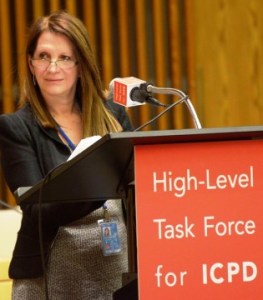
Lynne Featherstone MP, Parliamentary Under Secretary of State for International Development, speaking at the United Nations Commission on the Status of WomenLynne Featherstone MP has called a roundtable of key figures in Haringey, to discuss fighting and preventing Female Genital Mutilation (FGM) in the borough.

Representatives from Haringey Council, Police, and health services have been called on by the local MP to discuss an integrated strategy to protect local girls from FGM.

The practice is prevalent in countries like Somalia and Egypt, but also affects girls in the UK.  Most commonly, young girls are sent abroad to be ‘cut.’  It has been estimated that over 20,000 girls under the age of 15 are at risk of FGM in the UK each year, and that 66,000 women in the UK are living with the consequences of FGM.

It is illegal to arrange for a child to be taken abroad for FGM. If caught, offenders face a prison sentence of up to 14 years.

The Liberal Democrat MP is also a minister in the Department for International Development, and the ministerial champion for tackling violence against women and girls overseas. Ending FGM within a generation is one of her top priorities.

Lynne Featherstone MP commented

“Over the last few months I have met with Haringey Council, the Borough Commander and local health representatives. All have shown a great willingness to fight FGM in Haringey.  Now, I want to bring everyone together to discuss a truly integrated strategy. That’s why I have called this roundtable meeting.

“Late April to July is usually the time when girls are sent abroad to be cut – so there really is no time to lose. FGM is a crime and it is child abuse – and everyone needs to work together to tackle the problem.

“As minister for International Development, I have made ending this awful practice within a generation one of my top priorities. We will not see an end to FGM in the UK unless the practice is eliminated worldwide – but we need to tackle it on the ground here, too.”


Ending violence against women and girls – the missing target in the MDGs

Here’s my final blog from New York, where I represented the UK at the UN Commission on the Status of Women. Also available here.

As I’m sure you know by now, I am passionately committed to tackling violence against women and girls wherever it occurs, and this issue was the theme of my last speaking event at CSW before heading back home.

The Millennium Development Goals have led to remarkable achievements in poverty alleviation over the last 15 years. But for all their good, the MDGs omitted a crucial element – a target for ending gender-based violence.

I’m proud that the Coalition Government is absolutely committed to the principle that every woman and girl has the right to live free from violence or the threat of violence. And that every women and girl should be empowered to take control over her own life.

So in the post-2015 international development framework discussions, we are focused on pushing for a stand-alone goal to empower girls and women and achieve gender equality, and mainstream gender across the whole framework. Within this, we are pushing for a target on eliminating all forms of violence against women and girls.

Over the last year, I have spearheaded a new multi-million pound programme to tackle one of the most extreme manifestations of gender-based violence – Female Genital Mutilation. And because of this solid foundation of work and momentum, this July the Prime Minister will host a major summit to tackle FGM as well as early and forced marriage – both domestically and internationally. Our aim is to galvanise political and popular support to end early and forced marriage and FGM within a generation. An ambitious goal, but women’s rights campaigners have always been ambitious! And I believe this goal is achievable – but only if we work together and ramp up our efforts to support this African-led movement.

Ending gender-based violence has been and will continue to be a long-fought struggle. And research shows we need to use a whole range of approaches and work across multiple sectors.  This includes addressing the entrenched social norms and gender inequalities that drive violence against women and girls.

There is a great need for more robust evaluations of initiatives that engage men and boys as partners and that create new social norms. Men and boys are crucial – we’ll get nowhere if women continue just to talk amongst ourselves.

So we need to invest in evidence to understand the causes of violence against women and girls, so that it can be effectively prevented.

That is why I was delighted to announce today that DFID is investing £25m in a new research and innovation programme called What Works to Prevent Violence led by the South African Medical Research Council. This flagship programme will support national governments and the international community to understand better what works in preventing violence against women and girls. It will also fund innovation grants for new interventions that have the potential to be taken to scale.

This research will take time. And we’ve got a long road ahead. But I believe if we all, men and women, work hard enough together we really can create a world where women and girls no longer live in fear of violence.


FGM event at the UN Commission on the Status of Women

If I needed any reminder of the degree to which female genital mutilation (FGM) has shot up the international agenda in the last couple of years, the scrum to attend this morning’s FGM event at the UN Commission on the Status of Women did the job. I was speaking alongside the First Lady of Burkina Faso, who I met on my recent visit there, ministers from Italy and Somalia, the head of UNESCO, NGOs and, most importantly, young people from across the world to discuss how to empower youths to end FGM. The energy in the room was palpable, and the panel represented some of the strongest commitment in the world to ending FGM.

FGM is one of the most extreme manifestations of discrimination against women and girls. It is violence against women and girls. I am very sure if we were talking cutting off men’s penises, this issue would be a priority – and it would have ended centuries ago! But FGM has carried on for thousands of years, and still goes on today.

That is why, as a DFID minister, I began my campaign to end FGM – a mission that fits well with my role as ministerial champion for tackling violence against women overseas. I have learnt from some of the most inspirational women – campaigners, activists, leaders – many of whom were in the room today. Bold, ambitious women who believed that change could happen. And I was told by African women and leaders that they wanted support. Now, I have heard some amazing young people add their voices to that call – including a young brother and sister duo who both spoke passionately about ridding the world of this abuse.

The young people who spoke today told us that they have been desperately trying to get leaders to listen to their calls to tackle FGM for years – and that finally they are in the room, and telling us not to ignore them any longer. They have felt the fear as they or their friends or sisters have been carried away to be cut. They know the feelings of sadness and shame and fury that their bodies no longer belong to them. They asked for our support to help them end this violence.

I will rise to that challenge and support these brilliant young people, who are the agents of change. I hope you will join me to end FGM in a generation.


Clean energy access for women and girls

Here’s my fifth blog from New York – this time on clean energy access for women and girls. Also available here.

There’s a key ingredient to women’s equality that just hasn’t made it far enough up the agenda, yet could literally power development: energy access for women and girls.

So, this morning, I spoke at a meeting hosted by the Global Alliance of Clean Cookstoves, of which I am a leadership council member, and Energia. I was also joined by Cathy Russell, US Ambassador for Global Women’s Issues. We were there to work out how to get clean energy access for women and girls firmly on the development agenda.

Women and girls’ limited access to clean energy has extremely negative consequences on their quality of life, as I’ve written before.  Put simply, without energy access, women and girls in the developing world are even more time-poor – time spent collecting fuel and water is time not spent on education or on paid work. They are least safe when they are out collecting fuel and water. And smoke-related illnesses are one of the greatest causes of ill-health for women and children.

That is why I have launched a DFID campaign to improve the economic opportunities, safety and health of girls and women through clean and affordable energy. I am working closely with the UN’s Sustainable Energy for All initiative – which took up my suggestion to focus the first two years of the Decade of Sustainable Energy for All on women and girls. And I am working to raise the profile of the women and girls’ limited access to clean energy, and to advocate for the international community to do more.

Research is an important first step to demonstrating the extent of the issue and developing and scaling up practical solutions. In May, DFID will be co-hosting a conference in London with the World Health Organisation and the Global Alliance of Clean Cookstoves to bring together research on clean cooking. Just last week, research that DFID and the Alliance jointly conducted was commended by the UK Climate Week awards. This research supports the Alliance’s target to enable 100 million households to adopt clean and efficient cooking practices by 2020.

The energy and development communities are finally beginning to understand and respond to the gravity of this issue and the need for action. But there is a need to improve awareness and action more broadly, and to push the international community to recognise that energy is a critical element in building gender equality and improving women’s health and economic opportunities – one that really can power progress on development.

UN Commission on the Status of Women – part 4

Here’s my fourth blog from my recent visit to New York for the UN Commission on the Status of Women. Also available here.

As long as there is gender-based violence, we will never achieve gender equality.  The Prime Minister appointed me as Ministerial Champion for Tackling Violence against Women and Girls Overseas in 2010 for exactly that reason.  And today Poland organised their first ever high-level conference on women’s equality, which I have just attended and which focused on this issue.

67% of women will experience gender-based violence at least once in their lives.  This doesn’t just cause short-term damage.  It can silence women’s voices, stop them from accessing work and economic opportunities, and prevent them from making choices about their lives.  It closes down women’s freedom and opportunities, but it also has a knock-on impact on families, societies and countries as a whole.  This makes combating gender-based violence a prerequisite for achieving gender equality and reducing poverty.

This afternoon I had the chance to share the UK’s experience on tackling gender-based violence.

In 2010 the Coalition Government published its Call to End Violence against Women and Girls strategy.  This strategy is a public declaration by the government that violence against women and girls is unacceptable and is an issue that we are committed to tackling together – in the UK and overseas.  We launched our latest National Action Plan to deliver this strategy on 8March to mark International Women’s Day.

The UK government announced this weekend that we will hold a summit this year on FGM and early and forced marriage – two examples of gender-based violence that we are committed to eradicating, and that link the domestic picture in the UK with our work in developing countries.

In the UK, our Forced Marriage Unit provides assistance to victims as well as reaching out to practitioners and communities to ensure that people working with victims are fully informed of how they can help.  Overseas, the unit provides consular assistance to victims prior to or after a forced marriage to secure their return to the UK.

In 2012, the Prime Minister announced that the Government will make forcing someone to marry a criminal offence.  In doing so, we are sending out a clear message that this brutal practice is totally unacceptable and will not be tolerated in the UK.  That legislation is currently being progressed.

Internationally, the UK government is driving change throughout the humanitarian system to ensure that girls and women are protected from violence during an emergency; leading the way on tackling sexual violence in conflict through our Preventing Sexual Violence Initiative; leading a flagship programme on female genital mutilation (FGM) at ending the practice within a generation; and investing in evidence of what works to prevent violence against women and girls in the first place. DFID supports programmes to address violence against girls and women in over 20 countries.

We believe that our approach and actions in the UK are making a difference, as well as making a strong contribution to our international work – and in turn our international work is intrinsically linked to how we make progress here in the UK.  But we are not complacent – there is much more to be done.  We will never stop our efforts to tackle violence against women and girls until we have achieved our ambition that women across the world can live productive and happy lives, safe from violence and abuse.

UN Commission on the Status of Women – girls and disability

Here’s my second blog from the UN Commission on the Status of Women, where I am representing the UK as International Development minister. Also available here.

The world has been guilty of turning a blind eye to the challenges, discrimination and abuse people with disabilities – especially women and girls – can face every day. They are disproportionately some of the poorest and most marginalised in the world, meaning there is a direct link between gender, disability and poverty.

This was the theme of the first event I participated in just now at the annual UN Commission on the Status of Women.

Being a woman or girl with a disability often also brings the risk of violence and abuse – anecdotal evidence suggests even twice as much. And this abuse comes even, sometimes especially, from their closest family members.

As the DFID minister responsible for disability and as the UK’s ministerial champion for tackling violence against women overseas, I have made it my mission to ensure both disability and violence against women become key priorities in international development.

Although DFID is already doing some great work on disability – particularly around inclusive education, water and sanitation, and social protection – I felt this work was not mainstreamed enough. That’s why I announced new DFID commitments last year: that all schools directly funded by DFID will be fully accessible and to improve the data on disability which is so essential to understanding where and what the exact challenges are. And I’m working on more new commitments, so watch this space over the coming months!

But this is a global challenge and it needs a global effort to tackle it.

We now have a once-in-a-generation chance to finally put disability high up on the global agenda. Over the next 18 months the world’s leaders will negotiate the post-2015 development framework, and I’m going to be doing everything I can to make sure that no one is left behind.

UN Commission on the Status of Women

I am currently in New York representing the UK at the annual UN Commission on the Status of Women. Here’s a short blog from day 1 – also available here.

I’ve always said that, as great as ‘international days’ are at galvanising action on an issue, when it comes to women and girls we need to take action on the other 364 days too.

That’s why I’m so pleased that the Prime Minister will host a summit in July to tackle Female Genital Mutilation (FGM) and Early and Forced Marriage (EFM).  I’ve been spearheading the Coalition Government’s work on tackling FGM at home and abroad over the last year and the Prime Minister’s summit will send a clear signal of just how seriously we take this issue.

And that’s why, hot on the heels of attending the brilliant Women of the World event at the Southbank Centre for International Women’s Day on Saturday, I’m here in New York for the annual UN Commission on the Status of Women (CSW).

I’ll be attending a whole load of events as well as talking to my counterparts from around the world to ensure the CSW negotiations lead to a commitment to finish the job of the Millennium Development Goals (MDGs) and to support the inclusion of a stand-alone goal on women and girls in the development framework that replaces the MDGs when they finish in 2015.

I’ll be posting short blogs over the two days I’ll be here on a range of themes – and I invite you all to join the conversation on women and girls that the UK government is leading in 2014.

Uganda – A great leap backwards for gay rights

Here’s a copy of a recent post by me – also available on Lib Dem Voice.

Uganda’s new anti-homosexuality legislation is abhorrent. It imposes draconian penalties for repeat offences of homosexuality, so-called ‘aggravated’ homosexuality, same-sex marriage, attempting to commit homosexuality and for the loosely defined ‘promotion’ of homosexuality. This is nothing short of a great leap backward – not just for Uganda but for gay rights across Africa. I believe it marks a growing state-backed homophobic trend across the continent, one we cannot and should not ignore.

From Day 1 in my role as Africa minister at the Department for International Development (DFID), strengthening the department’s LGBT rights strategy has been one of my top priorities. I instructed every DFID country office in Africa to report back to me with details of their respective LGBT rights strategies, with proposals for doing more. The approach DFID has taken has been led by local gay campaigners in each country and, up until recently, they have asked that we take a subtle approach, raising our concerns only in private with their respective politicians. So, respecting their wishes, that is what I have done in African counties I’ve visited – raised my concerns behind closed doors with the Governments and privately met with local LGBT groups.

But this approach clearly didn’t work in Uganda. It failed to prevent new anti-gay legislation, and I fear it won’t deter similar legislation in other parts of Africa.

I will continue to do everything in my power to promote gay rights and equality – both at home and abroad. I’ve also invited Stonewall and the Kaleidoscope Trust to meet with me early next week to discuss how they and their international networks can help. We need to work closely together, jointly where possible, in defending and promoting human rights everywhere.

Because that is what this debate is about – not Western imperialism or Western impositions on African cultures, but the universal values of tolerance, love and mutual respect.

In Praise of Civil Servants

When I first became a minister at the Home Office in 2010 we newbie ministers were invited by the Institute for Government to an induction. It’s a great idea to give new ministers some external, impartial advice on how to make the most of the job – and the advice I got that day stood me in better stead than any before or since.

Essentially there were two pieces of advice that I took to heart. Giving that advice were Michael Heseltine and Andrew Adonis – and whilst I know they are nothing alike, it’s the very fact that two such different people politically (from each other and from me!) had useful advice to give which shows there are common challenges ministers of all parties face.

The first piece of advice was to prioritise ruthlessly. We would find ourselves hit by a tsunami of work – a never-ending juggernaut all through our time in office – that was simply the business of government. If we weren’t careful we would do all our work, read all our submissions, make all our speeches, attend all our government meetings, take debates in Parliament and more – and we would exit our ministerships as good little ministers. Yes we would have done our work well but not used the extraordinary opportunity of our positions to deliver something we wanted to deliver during our time in the sun.

The second piece of advice was to trust our civil servants. They would, we were told, strain every muscle to enable us to deliver our mission if we made it clear what we wanted. They were not the satirical stuff of which ‘Yes Minister’ or ‘The Thick of It’ was made (although there have been some recognisable moments during my time in government!). We were told how civil servants are hard-working and noble in their efforts to make their new minister’s missions come true.

So I went back to my office, then at the Home Office as Equalities Minister, and set out my priority: introducing same-sex marriage. It was liberal. It righted a wrong and it would mean a huge amount to those it gave the freedom to choose to marry. I believed it was possible. Thus I decided and set my course.

The civil servants then got to work. Always willing to raise decent questions about how and when, but always willing to stick to the priority and find a way to make the details work. From a standing start they guided me through all the many many hoops, pitfalls and dangers that I had to get through. I had nothing but support, advice, energy and dedication to my mission.

And now it is the law.

And then I went to the Department for International Development (DFID) and did the same thing. I prioritised Female Genital Mutilation (FGM). I said to my civil servants I want to campaign in government on FGM (campaigning in government was a bit of a new concept for them at that point). And as I hope you have noticed – it is now in the media on virtually a daily basis. In fact – the media deserve plaudits for their coverage on this too – particularly the Evening Standard.

I have instigated a £35million program to end FGM in a generation, working with the many opponents of FGM in the communities where it happens. The diaspora in our own country who practise FGM and their mother countries where this terrible practise has gone on for 4,000 years are inextricably linked. We won’t stop it here if we don’t end it there.

That is why we are supporting the African-led movement to end Female Genital mutilation and the UN resolution banning it worldwide.

And now my campaign stretches right across Whitehall – into the Department of Health, the Home Office, the Ministry of Justice and the Department for Education. I’ve had the privilege of working with phenomenal campaigners like Nimko Ali and Efua Dorkenoo, who for years have been so instrumental and inspiring with their work on FGM.

Without such dedicated civil servants understanding what I was trying to do and helping me do it – I could not have been so successful.

And not to forget that there is even more praise due to the DFID civil servants around the world in the most dangerous of locations – providing our programs to end extreme world poverty by delivering on health, education, water and sanitation and much more to the poorest and most marginalised people in the world.

A big thank you to all my civil servants!