MP checks-up on police progress at Bow command centre

After demanding drastic improvement on how quickly the Met answer non-emergency calls, following a damning survey in 2002 that showed 40% of London’s police stations not picking up the phone within 6 minutes, Lynne Featherstone MP has this week been to see how the Met have stepped up to the challenge at its new centralised command centre in Bow.

The Bow centre, along with two others in London, now takes all emergency and non-emergency calls from the public. Last year they recorded a new response rate of 30 seconds for 90% of all non-emergency calls. The Met have also recently launched a pan-London non-emergency number (0300 123 1212), and can now also connect you to interpreters in 150 different languages within 30 seconds.

The police pledge, launched this week, will further allow the public for the first time to check-up on police progress against pre-defined targets.Amongst other things, this means that all non-emergency calls should be taken within 30 seconds, and emergency calls within 10 seconds.

Lynne Featherstone comments:

“When I carried out my response survey in 2002 I was shocked to see the poor response rate, and pushed hard for the Met to deliver a system that worked for 21st Century London.

“I’m really chuffed to see that the Met have stepped up to the challenge here at Bow and delivered.With response rates down from 6 minutes to 30 seconds, the proof certainly is in the pudding!

“The new police pledge for the first time allows us to check how well Haringey Police are doing in relation to their own targets. I would therefore be really keen to hear from any local residents who might have had a bad or good experience with a police response. Only through continual challenge can we ensure the service local residents deserve.”

Howard Dean to meet Technology Advisory Board volunteers on Saturday

Looking forward to heading off to Harrogate this weekend for the spring Liberal Democrat conference – though not quite sure when I’ll have time to finish preparing!

We’ve got a special meeting with Howard Dean on the Saturday for everyone who responded for my call for volunteers to help with software coding etc. If you haven’t had an invite by email and think you should have, drop a line to ecampaignteam@libdems.org.uk.

Opposition reaction to Haringey Council's one star rating

Commenting on Haringey Council’s fall to a one star council, Lynne Featherstone, Liberal Democrat MP for Hornsey & Wood Green, says:

“We can only regret that the Audit Commission did not reach these conclusions sooner.Early indications of the failings in Children’s Services might have helped prevent the well-publicised tragedy that followed.

“Questions still remain unanswered how three stars were previously awarded to a service that has so publicly proved not to have deserved it.

“Up to now the Audit Commission has been complicit in the tick box culture that lulled all into a sense of security. I hope this marks a new chapter shedding a welcome eye on key services.”

Councillor Robert Gorrie, Liberal Democrat opposition leader on Haringey Council, adds:

“We have continually challenged the Labour Council’s leadership on sleep-like affliction to tick the right boxes and their neglect of their key responsibility – to deliver for the people of Haringey.

“Local residents and scrutineers rely on the supposedly expert assessment of service performance.Recent experience has shown how badly we have been let down.

“I very much hope this new assessment marks a watershed in this failed regime.”

Having traction on foreign affairs

Managed to get to the All Party Parliamentary Group (APPG) on Cyprus chaired by Peter Droussiotis – my former colleague (albeit Labour) on Haringey Council. MPs turned up to say their few words to the assembled audience – and it is great to have the opportunity to show those who care so passionately about Cyprus and its prospects for prosperity and re-unification that as an MP with lots of Greek and Turkish Cypriots that it matters.

What I tried to put across in my few words is the frustration when the motions which are part of the democratic process (lobbying your MP, raising matters in the House, writing to Ministers, attending events etc) don’t seem to lead anywhere. For me the question then is what is it that I can do to find the right angle, the right moment to make change and progress more likely?

It is the frustration I often feel about foreign affairs – about situations like the Middle East or Cyprus or Afghanistan – where the democratic process is all we have – but it sometimes just doesn’t seem to have the traction to make those with the power to effect change.

Women and the recession

Yesterday Harriet Harman invited me and women from all over the country in key positions to 11 Downing Street for a session on ‘Women and the Recession’. My table, led by Tessa Jowell, were just fantastic – and we examined and tested and trailed ideas on what and how to help women as the recession bears down on their lives. So many good and wise voices contributing to the body of knowledge on what might be the differential impact on women; what support and information might they need and where and what the future would look like.

Tomorrow to mark International Women’s Day we have a debate on women and the recession in the House – and I will lead for the Lib Dems.

Problem is – that all the need, angst and wringing of hands which Harriet wants to be heard by the G20 (and full marks to her for that) will be as nothing if all the measures in the Equalities Bill are watered down as I fear they may be. Battle will commence in April finally – when I hope and hear that the Bill for which there has been no White Paper or Green Paper and is shrouded in secrecy (except from the media) will come forth.

How quickly will the police respond if you call?

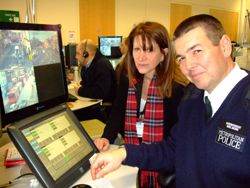
Lynne Featherstone at police control centreOn Monday I went to visit the new, wham bam, all singing all dancing communications centre for the Met Police.

Having spent much of my time when on the Metropolitan Police Authority (MPA) banging on about the appalling lack of response when people tried to ring their local police stations – today was pretty satisfying.

About five years ago or so I carried out a survey of police stations with front counters across London. We rang them all – allowing up to 100 rings (6 minutes +) – for them to answer. The results were a damning report to the MPA showing that something like 60% were not answered within that time.

I then wrote to all the Borough Commanders in London with their results. No – it didn’t win me a popularity contest – but it sure made the point!

Anyway – the centre is meant to be the answer to all those unanswered or late-answered calls. The new centre along with the new policing pledge means that you will have your 999 call answered within 10 seconds and the police will aim to attend within 12 minutes. Your call to the non urgent number 0300 123 1212 will be answered within 30 seconds and the police aim to be with you within an hour.

Given how much of the dissatisfaction about the police is around their non-answering and their non-turning up in timely fashion – this is definitely the way to go. And the new centre and the enthusiasm of the lead and staff in this state of the art centre is pretty impressive.

So now they have the building, they have the system and they’ve made the pledge. Proof and pudding we look forward to!

Cambridge University pay continued…

I see the news of the Cambridge University unequal pay issue also reached the student press.

My efforts on this issue have reached Cambridge’s ears and the Director of External Affairs is seeking a meeting with me. So full marks to him for a quick approach. We will meet in a week or so. I have no doubt there are rafts of ‘reasons’ as to why there is a gender pay gap (and Cambridge is not alone in this regard). The even more depressing aspect though, is Cambridge’s response to the figures – which is basically that women are on the lower paid rungs of the greasy pole – as if that was OK!

Anyway – point is – I am not an investigator – which is why I have asked the Equalities Commission to investigate the situation. That, after all, is their job!

Over on the Spectator, Martin Bright, in his blog calls me redoubtable (love it) for unearthing this report – but ‘unearthing’ is not really how it happened. The report, as I understand it, was completed last year but only saw light of day on 18th February when the Council at Cambridge discussed its findings. Whether it was sat on until then or simply that is the way things are done at Cambridge – I have no idea. What I will say for Cambridge however, at least they have produced a document voluntarily which does look at the pay – which is more than can be said for many.

One of the underlying issues equally damaging to sorting out pay issues is the habit of gagging staff. Gagging clauses have themselves been severely criticised within the university – see the debate on the web here, especially in the speech of Dr Cowley (near the end). This is the most relevant bit:

To finish I would like to make a suggestion. While the white paper makes a great deal of academic freedom, it’s not clear that the HR Division itself is really in favour of freedom of speech. As part of my concerns over the white paper I have tried to talk to members of staff, here and elsewhere, who have been dismissed, or ‘persuaded’ to take severance or early retirement. I have found it difficult to find out what happened because of gagging clauses. In a University that believes in freedom of speech they are an affront. Even the HEFCE does not seem too keen on them, at least in the case of Senior Staff earning more than £70,000.

Institutions must not agree to confidentiality clauses within any severance agreements except where it is necessary to protect commercially sensitive information. Commercially sensitive information does not include information on the details of the severance package itself, nor generalised clauses whereby individuals undertake not to make statements that might damage the reputation of an institution. However, there may be exceptional cases not covered by commercial considerations, where it is in the public interest to include a confidentiality clause. In these circumstances the institution must consult with me as HEFCE chief executive, in my capacity as Accounting Officer, before agreeing to such a clause.

The University should have similar restrictions on confidentiality clauses, but for all staff.

Anyway – as I said – will see what the Director of External Affairs says when we meet. And then I should hear back from the Equalities Commission as to their take on this. They are already investigating the financial sector – so don’t see why they shouldn’t put our Ivy League universities on their list too.

However, when the Equalities Bill hits the Commons (predicted April-ish) the nation will find that the Government is still clinging to a voluntary code for pay audits. That will so not work. Pay audits must be mandatory. Whilst Cambridge has at least produced this document voluntarily, on the whole we have seen how well voluntary codes usually work – for example in the banking sector – not! Whenever I tackle Harriet Harman on this issue – she says basically if companies don’t improve in five years then the Government will look again at making pay audits mandatory. Always jam tomorrow for us girls – 30 years since the Equal Pay Act and we are still waiting – and it is an inequality that is totally unacceptable and compounds with many other inequalities that women still face.

I fear that much in the Bill is going to be watered down anyway. There were lots of ominous bits and pieces in the papers last week saying that any policy elements that cost will have to go! Denied of course by She Who Would be Prime Minister!

Is there too much news?

The Guardian’s Charles Arthur has an interesting post about the financial pressures on news outlets. Traditional media has been under pressure from online for some time, and both are now under pressure from sagging advertising revenues courtesy of the recession.

The third problem is that, as he puts it, “There’s a huge oversupply of news, and the internet is making it trivial for people to read content that has been produced anywhere.”

He quotes good evidence to backup this oversupply thesis, but what’s interesting – to me – is that whilst part of my media consumption experiences would agree with that view, the other part wouldn’t. Yes, there’s a huge excess of political commentary, for example, and you can read an awful lot of high quality – and not so high quality! – commentary for free online.

But then there’s a whole host of areas where there is very little reporting or commentary. Local councils are the classic example – frequently the local media barely report them, and even in those areas blessed with both high readership local newspapers and newspapers which cover the council in some detail, it’s often only one title – and so the coverage is very much in the whim of the editor or owner. It may mean they are always anti one particular party, or it may be that they are always anti the council. But whatever – the point is that you get a very skewed sort of news because there’s no rival and just one editorial/owner direction imposed. (See Mark Pack’s piece on Lib Dem Voice for the example of the Evening Standard changing its coverage of London Mayor Boris Johnson when the editor changed.)

If you take my own home patch of Haringey – it’s been a council with more than its fair share of scandals and tragedies over the years, but it’s also been exceptionally rare for any of the local newspapers to have broken news based on investigative reporting. I don’t blame the journalists generally – I know how many words have to be written in how few hours – but in the case of Baby P it was largely only when the case went national, bringing in national news organisations, that journalists started shedding the light on all sorts of things. Or look at my old stomping ground of the London Assembly – and look at the huge budgets and responsibilities of the London Mayor, and then how few journalists cover it in any detail (Tim Donovan, Dave Hill, Hélène Mulholland, and … not many others).

So – yes, there is a news glut. But also – there is a real paucity of much news too. Now if someone can make a business model out of that local reporting…