The future of Wood Green police station

There has been a flutter of speculation about the future of Wood Green police station. I have asked our local commander – Dave Grant – to give a horse’s mouth briefing of what he understands to be the case. Rumours have included the police station not being rebuilt; the front counter moving down the road; no police station there, etc etc.

This is what Dave Grant says is the case following enquiries he has made. He has asked the Metropolitan Police Service (MPS) about what steps are being taken. The only activity at the moment is between Local Authority officers and MPS staff from Property Services Department about the format of the plans. Commander Grant says he knows that nothing has been agreed and that there are meetings scheduled to discuss the content of the plan.

The MPS uses a company to undertake the formal public consultation process and Mr Grant knows that they are drawing up a list of individuals and groups, with the help of his staff, who must be consulted. This would include me and councillors amongst others. He says he is more than happy to share that list with me when it is complete – and of course I will be checking to see that local people are the key consultees.

At some stage in the autumn a formal planning application will be made, which will then trigger the consultation process. As soon as the process begins, Commander Grant will be personally involved and intends to help with the key briefings.

So – as ever – it is down to whether this will be a real consultation – i.e. whether our responses to the consultation can affect outcome. I will post any news I get as this proceeds.

Crouch End lap-dancing application rejected

Thank goodness! Councillors turned down the lap-dancing club application in Crouch End. It’s been a very long and hard fought campaign – so congratulations to Alison Lillystone and all of the local people who worked so hard to present such a brilliant case. My LibDem colleague Cllr Dave Winskill has been working with the campaign group every step of the way – and I have done whatever whenever I could to help.

The report says the applicants may go to the courts and appeal the decision – but I hope they don’t. The new laws coming into effect soon change the status of the license that lap-dancing clubs need. Currently they only need the same license as a club or pub – but under the new laws they are classified as ‘sex-encounter establishments’ and will need a different license – one in which the location plays an even stronger determinant than currently.

So – as they have lost at this point, the chances of them getting a license under the new laws are even less. And they may be considering trying to get in before the law change – but in the Commons I pushed the Minister to state quite clearly that even if they were to succeed and get a license now – they would still have to apply for a new license as soon as the laws come in.

In the end – this is about location. That has always been the point and the reason for upset for local people. This was just the wrong place.

Getting ready to be the bridesmaid again…

News reaches me that I have been nominated for one of the Stonewall Annual Awards – obviously the political one. Nominated politicians include new Speaker John Bercow, secretary of state for culture, media and sport Ben Bradshaw, Labour MP Chris Bryant and me!

Since becoming an MP. I have been nominated and shortlisted for quite a lot of public awards: blogging, female politician of the year, New Statesman website of the year etc etc. So far – always the bridesmaid. I suspect, somehow, my unbroken record will continue.

Our new community health centre gets its official opening

Hornsey HospitalSecond happy occasion of the day – the official opening of Hornsey Central Community Health Centre!

Given it must be about ten years since the local LibDems joined local residents campaigning against the closure of the old hospital – and campaigned continually for a new health facility on this site – today was a very special and happy day.

The new centre is fantastic – and whilst there are still issues about transport to and from – this is the state of the art sort of community health facility that we so badly need in the west of the borough.

Health Link – which works to link the health services in the borough and the community and give a proper voice to local people in all of this – had asked local children to design posters for the opening about what the new health centre represented to them. The posters were fantastic – and I happily had the best job of the day giving out the prizes. The three winning designs will be exhibited at the new centre.

So – congratulations to everyone who over the years has worked, fought, campaigned and lobbied for this to happen. And a special word of thanks to Richard Sumray – chair of the local Primary Care Trust (PCT). Despite all the obstacles and years of frustration – Richard promised me a long time ago that he was absolutely committed to seeing through onto this old hospital site the new health facility we needed. I believed him then – and he has been true to his word – down the years.

Today – is just the beginning!

Waxing a man's legs

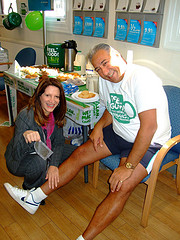
Lynne Featherstone waxing Steve Kalli's legs at Barclays Muswell HillHilarious! And for a good cause. Pitched up to Barclays in Muswell Hill to wax the well-tanned and pretty hairy legs of Steve Kalli, Area Director for Barclays North London.

This is all in aid of the World’s Biggest Coffee Morning in support of Macmillan Nurses. And that is a cause that is so worthwhile. Macmillan nurses came to my sister’s house for the last two days of our mother’s life – and like everyone who has the benefit of their presence – I am indebted and a complete fan as a result.

Last year Barclays raised £140,000 to pay for a Macmillan Nurse to based in a local hospital. This year they hope to do the same and pay for a senior specialist dietitian at University College Hospital who will directly support local people referred there suffering from cancer.

Fantastic effort!

And as for Steve’s leg waxing, he didn’t scream – and actually I think he rather liked the look of the smooth version!

Equalities: my keynote conference speech

Here’s my keynote speech to the Liberal Democrat Bournemouth conference:

My fellow Liberal Democrats – what a moment in world history for equality.

When we were last here in Bournemouth, the Presidential Campaign in the US was drawing to a close. I don’t know about you, but I can still hardly believe it. Who would have thought it possible … there is now a black man who is president of the United States of America.

The message of hope and optimism, and the potential for change could not be clearer. On that historic day when he made his inauguration speech, the words of our own party constitution kept repeating through my mind: “That no-one shall be enslaved by poverty, ignorance or conformity.”

So conference let’s today be ambitious as Liberal Democrats.

Let’s agree right here and right now that anything is possible whether by small practical steps or by great leaps of inspired Obama-like faith.

Because if a black kid in America can rise above the noise, the prejudice and the class divides to become the President of the United States – then anything is possible.

But as all Liberal Democrats know, and as President Obama himself said, idle aspiration alone is not enough. On Monday morning I went to Moordown St John’s Primary School – here in Bournemouth – with Trevor Phillips from the Equality Commission.

Now the children had been asked to draw pictures of politicians – needless to say – the pictures were almost all male and almost all pale – just like the House of Commons! These children captured Parliament perfectly with the skills of the best sketch writers.

One comment on one drawing said: ‘I have drawn a man because I think that men can stand up and talk better to a crowd than a woman can’. Another had written: ‘I have chosen a male MP because I have never seen a woman MP’. He has now! And I’ve had a word with him.

That’s the power of the role model, the power to challenge our preconceptions and to bring hope alive.

In my constituency I see kindness and cruelty; fierce intelligence and shocking ignorance; the struggles and successes; the love; the bitterness and the bias that make up the sum of all our experience.

But in small corners of that experience I have seen a shift.

Children for whom the halls of Harvard Law School, or for that matter Oxford or Cambridge, have seemed no closer than the moon can see the possibility.

This new generation pregnant with that possibility should not – cannot be let down.

And for many, far too many, President Obama’s triumph remains as irrelevant as the more distant figures in our history books.

That’s why we need action – the practical steps – because education and opportunity are the ways to blast away the old order.

The Liberal Democrats offer the bold approach to tackling inequality. Our pupil premium delivers a life-changing opportunity at school by injecting funds where they are most needed. Our name blank job application policy will open doors previously closed for that young boy – or girl – when they come out of education and apply for a job.

Name blank job applications is a simple idea. Just as we give a number for children to write on their exam papers so there can be no bias in the marking – so job applicants can use their National Insurance number. It costs nothing – and by removing the name from job application forms – we remove from that very first sift the unconscious prejudice that sadly can lurk in all of us. And I am proud of our party passing this on Saturday.

Now, you probably already know that 80% of MPs in the House of Commons are male. Lord knows – I’ve mentioned it often enough!

Even more shockingly, of the FTSE100 companies 88% of the directors are male. That’s right – take the 100 biggest listed companies in Britain, and you’ll find only one in ten directors, here in 2009 – are female.

Do we really think that if we trawled through to find the best people for the job of running our top companies, we’d find nearly nine in ten are male? Or if we hunted out the very best people to be our MPs, that eight in ten would be male?

Friends, I want to set you a task today.

I want you all to conduct some detailed research. Extensive research. Perhaps at the Highcliff Hotel. Perhaps this lunchtime – perhaps in the bar – perhaps at a fringe.

I suggest that you look at all the representatives there and you ask yourselves this simple question: if you hunt out the best people to be MPs – will 4 out of every 5 of them end up being men?

I think not.

Now don’t get me wrong. I love men. I’ve consulted with them – consorted with them – and even – on occasion – cavorted with them. But they are not the only answer – nor necessarily the right answer – and they are certainly not the right answer 88 times out of every 100.

I sometimes wonder if we really understand the scale of the inequality that women suffer financially?

The Equal Pay Act was sparked by the gender pay gap. For every pound that men were paid at the Ford Dagenham car plant the women earned only 85 pence. So on June 7th 1968 the women went on strike – and when they were joined by the women and men of the Ford car plant in Liverpool the company caved in and the Equal Pay act was spawned.

But the law has not been effective. And at the high end of the pay spectrum – it’s no different.

We see the highest paid female director of a FTSE 100 company took home £3.8m last year – but it is a figure dwarfed by the highest paid man – who took home £36.8m – almost ten times as much.

In case you are in any doubt – I think pay levels like that are insane and obscene.

But the issue is – from the highest earners to the lowest earners – women get the raw deal. It is as tragic as it is shameful that these gaps remain 40 years after the Equal Pay Act.

And it happens – and can happen – because that differential is hidden from public or indeed, the employees’ gaze.

Liberal Democrats would introduce mandatory pay audits. We would expose a company’s overall pattern of pay – not individual salaries – but enough information to show quite clearly where the pay gap lies.

That would put power into the hands of an individual to see for themselves whether they were being discriminated against – enabling them to take forward a case of discrimination -b e that man, woman, someone from an ethnic minority or a person with disabilities.

When it comes to pay, everyone is entitled to greater transparency.

And there are wider inequalities we must tackle.

A primary school child in an inner city constituency is not judged by the content of his or her character or the passion of his ambition. He is judged by the invisible barriers he or she will face because of both the colour of his skin but also his class and family income.

Poverty reinforces class barriers. That’s why in difficult times for the taxpayer Liberal Democrats make our priorities clear.

We will cut taxes for those who are on middle and low incomes – so that no one pays a penny on income tax on the first 10 thousand pounds they earn.

And then there’s religion. In recent years, sadly the spectre of religious discrimination has arisen again. A party born of revulsion at the treatment of Catholics and Non-conformists stands four square behind all those who seek to practice their faith.

9/11 and the subsequent Iraq war has fostered increasing ignorance and prejudice – on all sides. And it deepens apace – as we saw with the fascist demonstrations against the Harrow Mosque on the anniversary of 9/11.

And there has been so much damage done to the image of Muslims with the reporting of news from overseas and here, where so-called Islamic terrorists often feature – but when those fighting the terrorists, or the victims of terrorism, are also Muslim – this often goes unmentioned.

The drip-drip effect of linking the word ‘Muslim’ and the word ‘terrorism’ – but not linking “victim” and “Muslim” in the same way – is pernicious.

And at the same time we have seen a rising tide of attacks on Jewish people too.

It is better to confront and address these challenges before we are at real risk from violent internecine strife or the hideous bile of the far right – especially as there is no doubt that with an economic downturn the far right will be looking to turn the screw on peoples’ fears.

Liberal Democrats believe in cohesion – not separation.

Friends, there is not enough time to talk in one brief speech about all the inequalities that exist today. I would love to have the time to tell you exactly what I think of BBC’s sacking of Arlene Phillips from Strictly.

What on earth are we doing when we throw someone of Ms Phillips experience – one of the world’s foremost choreographers – on the scrap heap in favour of someone young and pretty? No offence to Alesha and I’m sorry she had such a rough ride on her first outing. It’s not her fault – it’s the BBC bosses.

What message do we send out – other that we don’t value what is important but we pay homage to the fleeting, the superficial and the desperate quest for youth?

We believe there should be no mandatory retirement age – something Labour refuses to support.

And I’d love to have time to talk about the severe prejudice encountered by our young people and the many barriers that remain for those with disabilities, I’d like to talk about caste discrimination, and gender identity issues.

So – let’s not kid ourselves that there isn’t discrimination out there – whether it is on the basis of gender, race, class, sexuality, religion, age or disability.

Discrimination is still rife. After hundreds of years of fighting against it.

But what I do have a moment for – is to persuade you, to continue your fight against prejudice, to use your powers in local authorities and devolved bodies throughout the land to use your powers as the great campaigners that I know you are. To fight and continue to fight until issues of equality no longer need to be on the agenda.

We are called on, as a party, by our history to fulfill our creed and fight for equal rights.

This is not the politics of single issues that should remain in the province of women, or minority groups.
It is a cause to which all those who hold a liberal world view are drawn.

In facing the scale of that challenge – and the urgency of that need – we have to persuade people that doing nothing is letting entrenched discrimination win.

I want to turn on its head the way we approach campaigning on this issue – I want to reframe the debate – so that we don’t just present issues in a way that appeals to those who already agree – like us – but which takes the argument to those who don’t.

Tackling discrimination helps all of us.

Because when a company discriminates in its choice of senior staff – and ends up predominantly male – it’s not just the woman who gets overlooked for promotion who loses out – it’s all those who lose their jobs, men and women because the management of the company itself is not up to scratch.

Tackling discrimination helps all of us.

Because when the police carry out stop and search on black and ethnic minorities. Searches which are out of all proportion to the numbers in the population and crime figures – it isn’t just those who are stopped who lose out, it’s all of us who lose out – from the police wasting time on the innocent rather than catching the guilty.

Tackling discrimination helps all of us.

Because when so many schools assume that information about children of separated parents should be given to their mothers – it isn’t just the fathers who lose out, it’s all of us who lose out from the damage to our next generation.

Whoever the discrimination is against – even when it is against the less talked about groups such as men – no I hadn’t forgotten you – we all suffer.

On many of these issues there is progress.

Not that long ago it was against the law to be openly gay. Now it is against the law to refuse to register a civil partnership

Conference, this is a call to arms. For each and every generation has the opportunity to shape our society and our communities. In this year, an election year, we accept that challenge.

Liberal Democrats are different – we are the real alternative to failed red-blue/blue-red stale old politics. Liberal Democrats are straight talking – we are prepared to stand up for what is right for people – not what is popular with the tabloids.

Liberal Democrats are ambitious – for change – for every woman who is underpaid, for every child who is denied life opportunities, for every person who suffers the insult and injury of discrimination.

The battle lines are drawn at our childrens’ feet.

Against us – those who can live with – racial hatred, gender discrimination, and homophobia. Those who point fingers but don’t point out solutions. And those who just can’t be bothered.

Ladies and gentlemen: be bold, be brave, be active. History will judge us on our action and our purpose.

The Liberal Democrat purpose is to set our nation free.

Child protection: my conference speech

Here’s my speech in the child protection debate at the Lib Dem conference in Bournemouth:

I was leader of the opposition on Haringey Council when Victoria Climbie died.

We were promised that lessons would be learned. That it would never happen again.

But lessons were not learned.

And it did happen again – with the tragic death of Baby Peter.

And it happened because the rotten culture of Haringey didn’t change, the secrecy didn’t change, the unwillingness to listen to outsiders didn’t change, the instinct to close ranks and turn backs on warnings of problems didn’t change and key senior people didn’t change.

After Victoria Climbie’s death, the only person who had to carry the can for all the failings right up and down the management chain was Lisa Artherworry – the most junior social worker at the end of the food chain. She took all the blame – and it’s the memory of that buck-shifting and failure to change that drove me and my colleagues to campaign so hard to say that this time, after the death of Baby Peter, there had to be a real clearout of those who had failed – however senior.

But my deep-seated fear is that it was only the outpouring of public grief and anger , the focus of national media coverage and – yes, to his credit – the intervention of Ed Balls – that forced change – and so when that attention moves on, will the old ways return once more to Haringey?

That is why we need to attract the brightest and the best social workers and managers to Haringey and give them the support and the resources they need to do the job.

We need to get rid of the tick box culture that takes away all personal responsibility. We need to enable professionals to use their brains and their instincts and their critical faculties. We need a performance regime that doesn’t give gold stars based on rubbish inspections which, the moment things go wrong, turn out to have failed to spot a myriad of problems. We need whistleblowers to be listened to and followed up on.

And, above all, we need to ensure that all those running similar services in future know the full lessons of what went wrong and why and how – so that they can do their level best to ensure such mistakes do not happen again.

But there are still too many unanswered questions.

Why did all four senior consultant paediatricians in the children’s health team resign, go off sick or go on special leave? That’s why there was a locum –the locum who unbelievably didn’t recognise Baby Peter’s broken back and broken ribs. Has whatever caused that health team to descend into such chaos really been sorted?

And what about the inspection regime that gave three stars when only weeks later Haringey Children’s Services was damned to hell by that same inspection authority – Ofsted? What value in the next inspection – whichever council it may be – saying all is good?

What about, what about, what about?

Too many questions to fit into this one speech are still unanswered – and that is why we still need a public inquiry and we need to publish the Serious Case Review.

We cannot stop innocent children being born into families where – instead of love and comfort – they get cruelty and misery – but we can and must do better than we have.

That must be our commitment. That must be our mission.

Support the motion.

Trust in politics: how we lost it and how to get it back

Here’s my speech to the Total Politics fringe meeting in Bournemouth about trust in politics:

If I wasn’t a politician, and given the theme of trust tonight, I would talk about the world we now live in where trust has virtually disappeared, a world where we have to be vetted to drive kids to school and a world where ticking boxes has replaced personal responsibility and standards.

But I am a politician – and I expect Iain invited me here tonight to talk about the trust that we politicians have lost.

The atmosphere in Parliament during the weeks of the exposure of the corrupt and greedy goings on of elected, ‘honourable’ members was horrible – no quarter given out there for those who deserved everything they got.

But absurd and wrong though duck houses were – it’s worth pausing a moment to reflect on how they caught not just the public’s eye but stoked the public’s anger – far more, it seems, than far bigger sums in the world of bankers’ bonus and salaries.

In part, perhaps, that is because the banking sums are so astronomical as to be beyond imagination – but a duck house (once you’ve discovered what one is) is all too palpable.

Moreover, MPs are in a holier than thou position – or meant to be. When you make laws for others, you bloody well should follow them yourselves. People need to be able to trust those in a position of authority – and we betrayed, comprehensibly.

So our fall was pretty spectacular.

However, it was not unprecedented.

Remember when Blair came in on a non-spin, whiter than white ticket? Those hopes and dreams were dashed very quickly by that litany of Iraq, dodgy dossiers, turning a blind eye to corruption in arms deals and extraordinary rendition.

He was in many ways simply following in the footsteps of each political generation. Each has its own story of high hopes that end up mired in controversy, sleaze and broken trust.

In the Major years we had the Iraqi supergun. The Thatcher years gave us Westland, Bernard Ingham’s briefings, battles against freedom of information and so on. In the 1970s it was Poulson, Stonehouse, Thorpe. And so on back through each inglorious episode.

All through those episode, democracy has survived. We’re still here. So I combine my anger with what I’ve discovered fellow MPs were up to with hope that our political system can survive once more.

The danger this time is greater – for the anger and disgust is not at a handful of people, or even a whole political party – this time the scandal sweeps up all of Parliament, across party lines.

So it will be a long hard slog, requiring solutions that change the system, not just a few faces – or the governing party. And here are my ten starters to get us on that road. They are all doable. They are all either free or cheap. They could all be done within months – if there is the will.

First, transparency on expenses: we have seen what an effective disinfectant publicity has been. There are rules that still need changing – but there’s no doubt that it is the glare of publicity that has changed Parliamentarians’ behaviour far more than alternations to the rulebook.

Second, end comfy deals for MPs and Lords employing their relatives. I don’t believe in a blanket ban for an area that involves such a myriad of different individual arrangements, including the happy ones where the MP marries a member of their staff – but local government shows how it can be done properly. Use the same rules as used for employing political assistants in councils around the country – clear, above the board employment rules, but with those for whom the staff end up working closely involved in the process.

Third, just as Parliament should learn from local government, so too it should learn from commercial companies. It’s normal practice to have contracts to ensure senior staff can’t leave and then immediately start using the knowledge they’ve gain to earn money for someone else. Same rules should apply to MPs – and most especially, but not only ministers – with a proper gap between ending your time in Parliament and starting your job if it is a clear case of poacher turned game keeper.

Fourth, remove the near monopoly of the Cabinet on deciding what legislation goes before Parliament. Instead of shunting away backbenchers’ bills into time slots that are too short and out of the way, give them prime place in the legislative agenda. And as an added bonus – that may well focus the minds of the Cabinet rather better than they are at the moment, with the endless going back year after year after year to the same topics to legislate again and again and again.

Fifth, recognise the changing media world and let bloggers into the Lobby. The more channels of communication the better – and the blogosphere has as much right as any to be admitted to the lobby – especially if you start comparing actual readership figures, not just of blog versus newspaper but of blog post versus newspaper story on page 12.

Sixth, ensure ministers give their statements first to Parliament. This isn’t about Parliament for Parliament’s sake – but about ensuring that when statements made, they don’t get the cosy free ride of a minister leaking it to a favour journalist who in return runs the story uncritically, giving the minister a free pass. No – it makes for better government and cuts away some of the grandstanding for the tabloid headlines if statements have to stand up to immediate scrutiny.

In order to enforce this there has to be a real punishment for ministers who err – perhaps by giving the opposition a free extra debate on any topic they wish in the minister’s area – so cancelling out, and more, any media benefit from breaking the rules.

Seventh, increase the number of cameras in the Commons – and let all the angles be broadcast, online and on TV. This isn’t just about the irony that whilst Parliament merrily overseas the spread of cameras pointing at everyone else, Parliament retains tight rules on what cameras can be shone on its members in the Chamber. It’s about taming the awful herd mentality of bad behaviour that so often grips the Commons.

Exhortations to be nice won’t stop MPs from behaving like the sort of rude rabble that would get you sacked in another job. So instead catch it on camera, stick it up on YouTube – and let the media, their political opponents and the satirists have a field day. Still think the job of an MP involves sitting there mouthing sexist comments at female MPs? Fine – let’s see what the public thinks where the compilation of your greatest moments hits YouTube.

Eighth, introduce a TV debate between party leaders at general election time – with questions asked by the public and with each questioner getting a follow up. There’s no better way to make politicians answer the question than the knowledge that if they don’t, it won’t trigger just another sneer from Jeremy Paxman or interruption from John Humphreys – but it’ll give all the TV cameras a shot of an angry member of the public.

Ninth, make Tom Steinberg the Parliamentary webmaster. I don’t know if Tom would wish or accept that job (though the threat of imprisonment in the Tower should be quite persuasive!) but quite simply he and his colleagues in MySociety have consistently shown-up Parliament and central government when it comes to understanding how to use data and the internet to give the public sight over what is done in their name.

And tenth – give the public a referendum on introducing multimember Parliamentary constituencies – so you no longer have people feeling they are forced to vote for mediocre or worse candidates because they are from the party they want to support overall. Give a choice between candidates of the same party and then the bad and the lazy really need fear losing their seats.

Then and only then will we begin to regain the trust of the people.

The Equality Bill – will it deliver for women?

Here’s my speech to a Lib Dem conference fringe meeting organised by the Fawcett Society and Unison:

Will it deliver for woman? No! Not on your nelly! Women are the losers from the lost opportunity of the Equality Bill.

This was literally a once in a lifetime chance to make a step change in women’s lives – but instead of taking the opportunity – perhaps the last opportunity a whole generation of Labour politicians will have to wield Parliamentary power – they’ve run scared of anyone who says “boo”, condemning women to hideously unequal pay for another generation.

A small, very, very, small bit of good crept through on women’s pay – stopping employers from banning staff from talking about their pay – ending finally those bans that let discriminatory pay, wasteful pay be hidden away under clauses of legal secrecy.

But that only frees up the hardiest and doughtiest of campaigners to fight that little bit more for more equal pay.

There were three key amendments put forward by the Liberal Democrats, one jointly with two Labour back benchers on equal pay for the Bill – each on of which would have ensured that the move towards equal pay would come quicker and more widely and for everyone.

Firstly we argued for mandatory pay audits – exposing the overall patterns of pay (though not individual salaries) to public scrutiny.

It’s ironic that opponents of equal pay measures often argue that in the market place there can’t be discrimination – because those firms discriminating would be worse off.

Yet when here was the opportunity to strengthen those market pressures – to give the market more information just as free market theorists tell us the markets need – where were those people? They made themselves very, very scarce from the debates!

The Government’s proposal only suggests that the information be published voluntarily until at least the year 2013. As the Equal Pay Act was passed 39 years ago and women are still – on the latest Office of National Statistics figures – paid 17% less then men – we are sick of waiting – always jam .

So instead of this weak measure, I and my colleagues argued that for reasonable sized firms and up – 100 employees would be a good cut-off – there should be mandatory audits with public results so women – or indeed men – could bring claims and avoid companies as they see fit.

The Equality Commission has most recently been making some bullish noises about the size of the pay gap in the City – warning that if it doesn’t get its act together the Commission will have to use its statutory powers.

And yet – the Commission flunked the test when the Bill was going through Parliament – for where was its lobbying and campaigning for effective equal pay measures in the Bill?

The second key area which we argued for during the Bill’s passage – in addition to mandatory pay audits – was on loosening some of the ridiculously tight restrictions on legal action over equal pay.

For women wanting to prove sexual discrimination in pay they have to be able to give a concrete example of someone else in a comparable job, being paid more. Now –often that exact comparator doesn’t exist. Many people do jobs where there isn’t someone else in a comparable role – and of the opposite gender.

But no – Labour dug its heels in and insisted there must always be a direct comparator that you can use.

And thirdly – there was the issue of allowing ‘representative action’. Currently, if a woman believes she has been discriminated against in terms of pay she can take the claim to an employment tribunal.

But you have to be quite brave and assertive to take a claim forward – and the resources for tribunals etc are so inadequate that there is currently a backlog of women waiting – and waiting – and waiting.

Thousands and thousands of women are held in this backlog – and women have actually died waiting for justice.
The answer to this is simple – allow representative actions, which means one action can cover and so settle many situations – speeding up justice, taking the pressure off each individual and saving the system from breakdown.

With representative action people such as a trade union or indeed the Equality Commission would be able to take action on behalf of a group of people in the same situation. But again the Government resisted this most obvious of moves forward.

Three opportunities – three fails – from the Government – and the price paid in more years of unequal pay.