Costly mistakes of a Council in crisis…

The Ham and High got it spot on this week, reporting on the costly mistakes of a ‘Council in crisis.’

Haringey Council have always been prone to bad press and terrible errors, but last week this intensified, as the Council quickly lurched from one scandal to another.

The front page article specifically refers to a court case against the Council. A High Court Judge ruled that that the Council acted indefensibly and unlawfully on an anonymous complaint against two parents.

Not only did Haringey Council act unlawfully throughout the investigation, they were also ruled to have also breached the Human Rights Act and will have to pay compensation accordingly.

Compensation following a Judicial Review is very rare,  and  indicates  that  the  judge  feels  a  real  abuse  of power  has  occurred.

This really was a damning verdict against Haringey children’s services, who have again failed the people in this borough.

It’s truly shocking that even after Baby P, they still have not managed to get the department in order.

Haringey Labour have proved themselves incapable of turning around the department. They are truly living up to their reputation as ‘the worst in England.’

Haringey Children, parents and residents deserve better.

Today's Whittington March

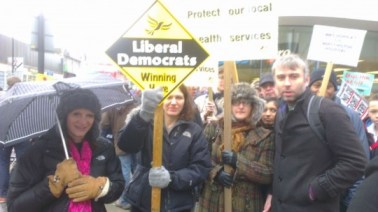
Lynne Featherstone MP and the Haringey Lib Dems at the Whittington MarchTogether with the Haringey Lib Dems, I joined the Whittington march today. We repeated our call for local health services to be protected.

The Whittington Board recently announced its intentions to sell off a third of the Hospital site and reduce the number of and staff at the hospital. It came as a shock to politicians, residents and staff alike and caused a great deal of concern.

It was, of course, only three years ago that we took to the streets to march, petition and fight against the Labour Government’s proposed closure of the Whittington A&E. We were successful then, as the community made it clear how important the hospital is to them.

Now the Hospital faces another challenge. But this is not the same as three years ago. The A&E is not under threat. And also – this time it is nothing to do with the Government (although many on the march with a purely political agenda would tell you otherwise.)

The Whittington Board have said that they are making these changes in order to improve their chances of becoming a Foundation Trust, which would secure a long term future for the Hospital.

We want the Hospital to be successful – and to be clear, we do not oppose selling off derelict buildings and using the money to improve maternity, for instance. Some changes could be positive and better for patients.

But we do have serious concerns about other parts of the plans, and we have some demands.

The Haringey Lib Dems and I are running a campaign to reflect these concerns. We don’t want any service lost without an equal or better replacement in place. We have serious concerns about how moving care into the community will be managed, and whether the appropriate social care would be provided. We also want the Whittington to go back to square one and consult residents.

That’s what we’ve been petitioning for, and we have collected 2,500 signatures so far. The future of the Whittington hospital and good quality health and social care is our priority. That’s the message we wanted to put across at the march, and this is the campaign we will continue to pursue.

You can sign the petition here.

UN Commission on Status of Women – Conclusions agreed by consensus

Having spent months lobbying across the world to try and ensure that at the end of the 57th UN Commission on the Status of Women (CSW) we had agreed conclusions – when the good news came through last night – I was very relieved.

Last year when the theme was Rural Women – much to everyone’s surprise – consensus was not achieved and therefore there were no agreed conclusions. This may have passed many by (as this world meeting on women never gets the attention it deserves) but had this happened a second time – the consequences would have been very serious.

This year the theme was Violence Against Women – and with the world shocked at the rapes in India and the shooting of Malala (let alone the fact that violence against women and girls is epidemic across the world in all countries including the UK)  focus and attention was very high. That didn’t, however, stop this negotiation going to the wire.

Not only did I (and the Secretary of State) spend a lot of effort lobbying across the world in advance – but when I was in New York at CSW I had many meetings with other ministers to persuade and discuss with both like-minded countries and with those of the other persuasion that we must deliver – for the sake of women across the world – agreed conclusions.

So when the good news came through last night – I was heartily relieved. Well done and thank you to all the team who worked so hard to deliver this successful result.

The news was tinged with a touch of sadness as, in announcing the result of the negotiations, Michelle Bachelet (the President of UN Women) announced that she was stepping down and returning to Chile.

Flyer Article – Independent Shops Competition

Here’s my latest Muswell Flyer article on Independent Shops:

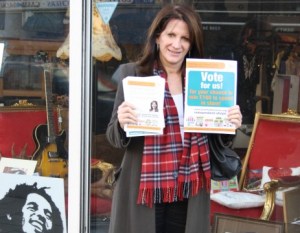
I’ve launched a competition to find our best local independent shops – and I’d like to invite everyone to take part via my website – www.LynneFeatherstone.org/Independent-Shops

Lynne Featherstone MP on Hornsey High Street, outside Brand New Start independent shop and gallery

There’s nothing I like more than taking a wander around my constituency and popping into some of our local independent retailers. From Highgate to Bounds Green – via Muswell Hill, Crouch End and Wood Green (to name but a few!) – we have independent antique shops, art galleries, bakeries, toy shops and more.

Far more often than not, our independents offer unique, high quality products, and the staff give excellent customer service. Many have wonderful shop fronts which contribute to our vibrant and diverse high streets.

But during these tough economic times, many of our local independents are struggling. Last year a Muswell Hill based retailer contacted me and reported months of poor trade around the Broadway.

The Labour Council isn’t doing our shops any favours either. They’ve raised high street parking charges to an extortionate £3 an hour, which is discouraging people from stopping off on our high streets. Instead, they go to superstores or shopping centres, where the parking is free or significantly cheaper.

I think it’s about time someone started standing up for our independent retailers. That’s why the Haringey Liberal Democrats and I launched the 30 minutes free parking campaign – which I wrote about here two months ago. We’re still fighting hard, pressuring the Council and collecting petition signatures on this campaign.

I also hope to encourage residents to start talking about our local shops by running a competition to find our best independent shops. I hope this will raise the profile of the constituency’s independents, and encourage more residents to try the retailers’ products and services.

Residents can vote for their favourite shops across three different categories:

  • Most attractive shop front
  • Best customer service
  • Best all-round independent shop

There are only two rules – the shop must be independent (not a chain store) and must be in my constituency of Hornsey and Wood Green.

By placing their votes in each category, residents will be entered into a prize-draw with the opportunity to win £100 to spend in one of their chosen shops. Residents have until the 30th May 2013 to choose and vote for their favourites.

The winning retailers in each category will also be invited to parliament for a drink with me on the parliamentary terrace. All voters and nominated retailers will be invited to a big, local event in the summer to announce the winners.

The competition is already well underway. We have had over 500 nominations and it is very tight at the top! Many independents have agreed to actively participate, and are handing out voting slips to their customers.

Please do take part and nominate your favourite shops here: www.LynneFeatherstone.org/Independent-Shops

If you are a resident or retailer who would like further information, just email me: Lynne@LynneFeatherstone.org.

Thanks for taking part – I very much look forward to seeing who wins!

Two genders – one future

On International Women’s Day (last Friday) I spoke at the Liberal Democrat Spring Conference Rally. Here is the full text of my speech:

Good evening, Conference…

It is a great pleasure to be speaking to you on International Women’s Day…

The day the world celebrates the women and girls who have made great strides on behalf of all of us in overcoming inequality…

Women like Shirley Williams, who is my political heroine and a powerful inspiration for all liberal British women…

Please join me in another round of applause for her…

International Women’s Day is also when we show solidarity with those who continue to suffer discrimination and violence simply because they are women and girls…

Conference, it is shocking and shameful what suffering so many women experience right across the globe…

In the 21st century, it is unbelievable that women aged 15 to 44 are more at risk from rape and domestic violence…than cancer, car crashes and malaria put together…

It is shocking that 15 year old Pakistani schoolgirl Malala was shot simply because she dared to want an education…

And it is horrific that a young Indian woman could be targeted, gang-raped and left for dead – just for being a woman…

Violence against women and girls is the most prevalent abuse of human rights on the planet…

This is not some second tier issue, or a preoccupation only of the privileged…

It is not a women’s only issue…

What affects half of the world’s population, affects all of us…

And frankly, International Women’s Day should not just be once a year – it should be every day, every year…

But, Conference, you already know this…

We are Liberal Democrats…

We know and believe that inequality, wherever it may fester, must be stamped out…

And Liberal Democrats in government are working hard to support women and girls – at home and abroad – and help them live the lives they would choose to live…

I am the UK ministerial champion for tackling violence against women and girls overseas, and in September I became a minister in the Department for International Development…

Jobs that I believe make me the luckiest Lib Dem in government…

In my new role I’ve travelled to African countries, and I’ve seen first-hand the difference we can make…

Conference, I wish I could take everyone in the UK to these places so they could see what I have seen.

In Uganda, I remember seeing a woman with stumps for arms trying to carry a baby. Her husband had cut her arms off to punish her…

In Zambia, I remember meeting a 12 year old girl who had been raped by her uncle…

In South Sudan, I remember seeing hundreds of women, struggling after years of civil war and famine had left their children stunted.  They made stoves out of animal faeces, to try and cook nutritious food and become more sustainable…

This is why I’m proud that Britain is a world leader in international development, respected widely for how effective our work is…

Thanks to this Coalition Government and the Girls’ Education Challenge that Nick Clegg launched in 2011, two and a half million girls across the developing world will get into primary school…

Nearly 250,000 women have their property and land rights secured…

One million more women have access to modern methods of family planning…

And as I announced in New York earlier this week, when I was representing the UK at the 57th session of the UN Commission on the Status of Women…

I want Female Genital Mutilation ended within a generation…

To make this happen, the UK is becoming the world’s biggest investor – committing up to £35 million – to stop this most extreme form of gender-based violence…

But Conference, you already know what a difference UK aid can make…

Liberal Democrats are internationalists, and we understand instinctively why supporting the world’s poorest people is the right and smart thing to do…

I am proud that this year the Coalition Government will deliver our manifesto commitment to spend 0.7 per cent of GNI on overseas development…

I am prouder still that our party continues to stand behind this commitment…

No doubt it is a controversial decision to increase the UK’s aid budget while other domestic spending is being reined in…

But as we have said time and again, we are not going to balance our books on the backs of the world’s poorest…

And – don’t forget – preventing war is cheaper than fighting it!…

Conference, to conclude…

Equal marriage is my proudest achievement in government to date…

But our ambition and dedication should be set just as high to advance gender equality across the globe…

The Liberal Democrat message to those who fight for dignity, respect and equality – wherever in the world it is denied – is we see you, we hear you, we stand with you….

This effort requires all of us – especially brothers, fathers, nephews, uncles, sons, partners and husbands – all who care for the women in their lives…

Good men must not sit back…

Good men like Nick Clegg are helping to lead the charge…

And I am so pleased that Liberal Democrats in government are delivering fairness…

Not just for British women, but for women everywhere…

We may be two genders, but we have only one future…

Thank you…

Push for Change on Women's Rights

Here’s a blog from my last day in New York. Also Available on Huffington Post.

It’s my last day at the 57th session of the Commission on the Status of Women, and I’ve started the day speaking at a breakfast reception for Afghan women.

Under the Taleban, Afghan women suffered some of the worst oppression in the world. To this day the situation remains challenging.

According to the UN’s 2011 Gender Equality Index, Afghan women’s status ranked amongst the worst in the world – rated 141th out of 146. A shocking 87% of Afghan women have experienced at least one form of physical, sexual or psychological violence or forced marriage.

Nevertheless, I am heartened by the progress the international community has made in partnership with Afghanistan in the last decade. Almost 40% of children regularly attending school are girls – up from virtually nil in 2001. Almost one in two pregnant women receives antenatal care now – compared with only one in six in 2003. And women hold over a quarter of seats in the Afghan Parliament.

My colleague Justine Greening made it clear on Monday that we will do whatever the UK can to ensure the gains for girls and women in Afghanistan are not lost. As part of this effort, we are making tackling violence against women and girls in Afghanistan a strategic priority for the Department For International Development’s (DFID) country programmes.

Bringing about change is a long-term task, in which girls’ education, economic opportunities and women’s representation and rights are all key.

This is why the UK’s programmes and the benefits they bring to Afghan women and girls will continue long after British troops come home in 2014.

Ending early marriage

One in nine girls will marry before their 15th birthday. For those girls, their childhood will be cut short and their chances of an education, a job and enjoying the delights of safe motherhood will be dashed. In short, early marriage is bad for girls and bad for development.

2013-03-07-Girlsgembemversion2UK aid is supporting UNICEF to run Girl and Boy Education Movement’s in schools in South Africa to raise awareness about issues affecting young people. Picture: Lindsay Mgbor/DFID
At an event hosted by World Vision, I set out how the Coalition Government is working hard to tackle this issue.

We know that education is the single most important factor in reducing child marriage. That’s why in 2011 the Deputy Prime Minister Nick Clegg launched DFID’s Girls’ Education Challenge, which commits us to help up to 1 million of the world’s poorest girls in 22 focus countries get into school.Nick and I launched two of these country programmes on our recent visit to Mozambique and Ethiopia.

We also know that communities are key to changing attitudes and behaviours towards girls and women, so for example in Ethiopia DFID is working with religious leaders, families, boys, men, the media and schools to change how they view early marriage.

There is no silver bullet for ending early marriage – no complex issue has an easy solution. But all countries have a role to play and we can all work in a direction to build on each other’s successes.

UK commitment to end gender-based violence

My time at this session of the Commission on the Status of Women is drawing to a close. After three packed days of individual meetings with African, Middle Eastern and Asian countries, and speaking at eight panel events on an array of issues, I come away inspired and with renewed hope for tackling violence against women worldwide.

And I’m proud that the UK’s efforts are inspiring others in kind.

I’ve just been at my last panel event and Dutch MP Jet Bussemaker and I presented adverts running in our respective countries, designed to change young people’s perceptions about violence and abuse in their relationships. In the UK our adverts have reached more young people than many expected and I hope these efforts can be replicated with great effect in other countries.

CSW continues for another week and it is vital that by the end of the session a common set of global standards to protect women and girls is agreed. It isn’t easy. Last year, for the first time ever, no Agreed Conclusions emerged.

So I’ve been sending clear signals here in New York that the UK is 100% committed to pushing forward global action to stop gender-based violence. For all our sakes – and for the future of the multilateral system – I hope this year will be a success.

Take a look at this map which shows UK government action to support and empower women across the globe.

Join our Facebook campaign to end violence against girls and women and call on the UN to take action.

Read our feature and stories on how UK aid is working to prevent violence against girls and womenand see our South Africa picture gallery on how we’re working to protect vulnerable children from violence.

Ending Female Genital Cutting in a Generation

Also available on the Huffington Post

I want to end female genital mutilation (or cutting), I want to see it happen within a generation. I’ve just been with hundreds of people who share this ambition, including the first lady of Burkina Faso and the women’s minister of Niger. The annual meeting of the UN Commission of the Status of Women in New York has brought us together today.

Female genital cutting (FGC) has been neglected by the international community – and international development – for too long. Too little has been invested in stopping this practice – too little money, too little research, too little attention.

The time is ripe for change.

Niger has just seen a reduction of incidents of FGC by 50%. In Senegal, thousands of villages have abandoned the practice entirely. National laws have been put in place making FGC illegal in 25 African countries. And in December last year the UN General Assembly passed a resolution calling for a global ban on FGC – a resolution championed by African countries.

The UK has a duty to get behind this momentum and do all we can to keep it going. We owe it to the millions of girls who are at risk of being cut every year. And this is why the UK, through the Department for International Development, will this year become the largest single investor in ending FGC.

I pay homage to the tireless efforts of NGOs and other governments who have fought FGC for years. Because of them, we’re at a tipping point. And I hope the UK’s new commitment will deliver the final blow.

Find out what the UK is doing to end FGC within a generation.

Take a look at this map which shows UK government action to support and empower women across the globe.

Join our Facebook campaign to end violence against girls and women and call on the UN to take action.

Visit to New York – Day Two

Here’s a blog from the second day of my visit to New York – on Body Confidence and how it links with violence against women:

It’s Day 2 of my visit to the UN for the Commission on the Status of Women, and I’ve just come from a Danish event, where we discussed the links between social controls – like bodily perfection – and violence.

In every society with a mass media, whether in developing or developed countries, women are subject to a daily bombardment of images and messages about what they should look like.

Of course, nothing is wrong with having ideals of beauty and admiring it! We’re only human.

What is different now, however, is the sheer volume of images, the impossibility of escaping them and the rise of a celebrity culture that mercilessly dissects how our idols look – pulling them down to size, while simultaneously telling us we can be like them too, if we just look the part.

But is body confidence a means of violence against women? Undoubtedly yes.

When gender stereotypes restrict and deny individual free will and self-expression, this is violence.

Put another way: If your body must be ‘perfect’ – whether ‘perfect’ means bleached, starved or put through Female Genital Mutilation – before you can expect equality and respect, this is violence.

I have worked on Body Confidence issues for years: inside and outside government, from the Home Office and now in DFID. From each of these perspectives it is clear that this is a universal issue for all women. It’s also clear that progress is possible, particularly when we work across local and national boundaries.

The Coalition Government wants to end violence against women and girls – in all its forms, at home and overseas. We want to value people for who they are and what they can contribute, not for what they look like.

UN Commission on the Status of Women

Here’s a blog about my trip to New York for the annual meeting of the UN Commission on the Status of Women. You can also read the blog on the Huffington Post here.

I’ve finally arrived in New York for the annual meeting of the UN Commission on the Status of Women (CSW) – one of the big annual events in my diary and one that Justine Greening and I have been working hard on for months.

So far I’m overwhelmed by the sheer number of women (and men!) here from across the world, not only representing various countries but countless NGOs as well, all fighting for women’s rights and equality internationally.

This year’s CSW theme is eliminating violence against women: an issue everyone knows I care passionately about – not least because of my ministerial champion role exactly on this topic – and raise at every opportunity.

Britain taking a lead

The UK has a good story to tell.

The Coalition Government has provided nearly £40 million of ring-fenced funding for specialist domestic and sexual violence services, and national helplines.

We’ve invested in changing attitudes and behaviours. You may have seen the UK television adverts we’ve launched to tackle rape and relationship abuse amongst teenagers.

We’ve reformed our legislation, introducing two new stalking offences to better protect victims and better support the police and prosecutors who bring about justice.

And the Coalition Government has also announced plans to criminalise forced marriage.

But we can and must do more. Just last year around 400,000 women were sexually assaulted in the UK. Sharing best practice and learning from other countries’ successes is a great place to start.

Tackling the root causes of violence against women and girls

The root causes of violence against women and girls are gender inequality and related social norms – or, traditional ‘rules’ of societies.

In short, to end violence against women, we have to change minds.

I’ve just been on a discussion panel with Finland, South Africa and the OECD to discuss the best ways to do just this.

The evidence shows, for example, that you cannot change unequal social norms, and gender-based violence, without working with men and boys. This may seem obvious to some, but when it comes to experiences of violence and abuse it’s common for women only to talk to women!

Watch this video showing how UK aid is helping to tackle violence against women and girls in South Africa:

Violence must be seen as a community issue that needs solving at the community level – rather than a private matter or a ‘women’s issue’ only.

DFID is investing £25 million in a new Violence Against Women and Girls Research and Innovation Fund. This ground-breaking work will test new approaches and rigorously evaluate existing programmes, so we can help build up global evidence of what works (and what simply doesn’t).

Ultimately this evidence base will need contributions from across the world and I hope other countries will join in on our efforts. No one country can tackle this alone, but the UK is committed to doing our bit.