Today we’ve been debating our plans to make Britain carbon neutral by 2050:
http://video.google.com/googleplayer.swf?docId=5423954931366657235
Running time: 92 seconds

Today we’ve been debating our plans to make Britain carbon neutral by 2050:
http://video.google.com/googleplayer.swf?docId=5423954931366657235
Running time: 92 seconds
Yesterday I also spoke at the Shelter fringe meeting on housing. I started by highlighting one scandalous case from Hornsey and Wood Green:
I went to visit in their own home a constituent with a housing problem. “Housing problem” doesn’t begin to describe the situation. Nice three bedroom flat – but the flat didn’t start until the first floor. And to get to the first floor you had to mount a narrow and long staircase.
Now, the daughter – quadriplegic – had to be carried up and down that staircase. That was barely manageable when they moved in and she was five – but now she was eleven. The father worked and his work meant he wasn’t there to help. And the little brother was too small and young.
When I went in, I met the daughter – who was strapped vertically to a contraption that enabled her to be placed in front of a television to entertain her in the hours and hours that she had to spend immobile. She had no movement in any limb, couldn’t speak, but she could see and hear and her brain function and understanding were normal. I can’t even begin imagine what that is like.
For over five years since they applied to move to a ground floor – they were told – no three bedroom ground floor accommodation had become available – in the whole borough!
Five years – no progress. I mean, goodness me, the council could have gone down to the local estate agents and purchased a new house – if they’d really wanted to fix the problem. Because you see – this wasn’t a case of the council saying, “sorry, we’ve got no money” – although that often is an issue – but instead it was a case of the deadhand of bureaucracy mindlessly churning through the administrative wheels without any real desire to fix the problem.
I want on to talk about how we should change the housing system, as you can read about in the full speech.
So – last night was the Liberal Democrat Blog of the Year Awards – bigger and better than even, as they say.
Congratulations to all the highly deserved winners – and who better to tell you who they were than the winner of the blog of the year himself?
Shame only about Georgio Armani, as you can read about in the speech I gave.
Speech given to the Liberal Democrat Blog of the Year awards ceremony, Brighton Party Conference, 2007
I was a judge last year – and a new blog-star was born – Stephen Tall! And how right we were!
Last year was also the first blog awards for the Liberal Democrats. This year – it’s a matter of more awards and a bigger room (thankfully, remembering how hot it all got last year!).
Clearly, subsequently there must have been much blog fornication – as bloggers have begot bloggers – and, if I may say, gone forth and multiplied somewhat.
Judging this year, it was great to have not only an there an explosion of categories – but also a veritable army of Liberal Democrat blogs competing for the honours.
And such high quality. I want to take the opportunity to thank all who valiantly put their thoughts out in there in public. The nominations were many and various – and the task even to get to a short-list was pretty tough – not to mention time-consuming. But blogging is now as much part of the political scene as the Chamber of the House of Commons – well that’s not hard!
Across the internet, Liberal Democrat bloggers have argued, chastened, exposed and rubbished all comers. There are undoubtedly dangers for politicians and political parties in partaking in the blogosphere – but in the end –the greater good is by having our views, discussion and arguments out there. Yes – there can be abuse and misuse – but life’s for living.
I want to congratulate all those shortlisted in their categories. It does take time and effort – but it is sooooooo worthwhile.
For myself – barred from the best elected blog category as a judge again! – I would say that blogging is a crucial defence we politicians have to present ourselves as we really are rather than through the cynical veneer the media nearly always applies to its political reporting.
The media’s instincts are to always portray us as self-seeking, egotistical, lazy good for nothings who only care about self-promotion, getting our snouts in the trough and doing sweet FA for our constituents. Clearly we drink ourselves into oblivion and eat lavishly every evening, all evening at the House of Commons. We go on junkets to foreign places at the expense of the public purse, get whacking allowances for staff and expenditure and put our family on the pay roll. In life’s pecking order – we are the bottom of the pile.
Well – that’s what how we lot are variously described – and it is wrong.
It isn’t an accurate description of the majority of MPs – and it’s interesting how often the public rate the politicians they know so much more highly than politicians overall.
Blogging gives us our means to fight back, to cut out the crap from the middle men and tell our side, our vision our version of events.
And all the bloggers blog for a reason. Blogging is the poetry of the 21st century. We all go off and commune with out thoughts – to send out our feelings, our messages our words. It can be done by anyone – and despite competitions and awards like this – that freedom of expression, that liberty to say and put out there the outrageous, the unthinkable and the fantasy – is the medium of our day.
So in this brave new world, tonight we will see winners in each of these categories.
And hey – this is just so Academy Awards – but why, again, have no designers phoned me to beg me to wear there frock? When Georgio Armani phones me to say, Lynne I’d like you to wear my new creation for the Lib Dem Blogger awards – then we will have made it. Never-the-less – with only one year under our belt – this is the event to be at this Conference!
Before presenting some of the awards, I want to take this opportunity to pay credit to one very special blogger who didn’t make the short list. But his blog, a very particular blog, earned the respect of experts from all parties in its field of expertise – defence and foreign affairs. His blog was the blog of a man whose wisdom, clarity, experience, professionalism, liberalism, humanity and integrity earned the respect of all political parties and political pundits.
I am sure that everyone in this room will know that it is to Tim Garden and Tim Garden’s Foreign & Security Policy Weblog that I want to pay public tribute.
Tim’s last posting sums up well his expertise and clarity:
MISSILE DEFENCE SITES FOR EUROPE?
Reports that Tony Blair has been asking to have US missile defence facilities in the UK have again raised the question of whether this is a good idea. It has many drawbacks: not least that it does not work.
Very succinct. Very to the point. Very Tim. And if you were to click on read more – you would then find a merciless dissection of the failure of missile sights over the years and ruthless condemnation of Blair for acceding and in secrecy.
It was – and still is – well worth clicking on all Tim’s read more labels – for you will find a sharp political analysis combined with real knowledge and expertise. It is no wonder that Tim commanded respect and admiration across the political divide and from the media. We will miss him for many, many reasons – this is just one of them. Our party was fortunate to have such a man – and we are all bereft by his premature and untimely death.
So – Tim – as bloggers and as fellow Liberal Democrats we remember you with affection and respect.
Party conference is back in Brighton, and I’m back doing a daily video diary too. Here’s the first:
http://video.google.com/googleplayer.swf?docId=409161283052341554&hl=en-GB
Running time: 69 seconds
 Lovely event. Opening (or launching) a commemorative bench. Am never quite sure of the correct terminology. Anyway Liz Murchie and Maeve McAlliston were two wonderful ladies, founder members of the Hornsey Lane Residents Association who not only cared about the local community – but actively campaigned to improve things. Two of their campaigns were for the 20mph speed limit and the celebrations for Archway Road Bridge.
Families of both women came to see the bench launched and what a fine bench it is – kindly donated by Thames Water – which after five months of work on the bridge was a very welcome goodwill gesture.
Pictured here with Richard Taylor from Living Streets, are relatives and members of Hornsey Lane Residents Association.
Later dash to the launch of the Muslim Youth Forum at Wightman Road Mosque. This is a great initiative which sees Haringey Police Boxing Club and Spurs both there to tell the boys what is on offer free in terms of training. But the Muslim Youth Forum is more than that – in that is specifically aimed at ensuring that young Muslims are part of society – and showing that it is a tiny minority of extremists who damage the good name of good Muslims. Positive activities, positive debates and leadership teaching – these are the wonderful ambitions for this group. Mr Ali (Chair of the Elders), as ever, is spot on – what a lot of wisdom that man has!
So – arrive back at 6.30am yesterday morning from three extraordinary days in South Africa looking at AIDS projects. I was invited on this trip by a Labour MP, Sally Keeble, who has a long record of work and commitment to Africa and to International Development. Another Labour MP, David Borrow, was also on this trip – as he has been pursing the AIDS issue for some years. Sadly, the Conservative, Mark Lancaster, had to drop out at the last minute because of family illness.
The trip was put together by an umbrella organisation (relatively new) Business Action for Africa.
South Africa hosts a massive HIV positive and AIDS population – a pandemic – which is a pandemic mainly because nothing was done early enough to address it. In early years the South African government denied HIV, British and American governments viewed Africa as untreatable and so the disease sowed the seeds that today sees it with estimated numbers of six million infections.
Interestingly enough, businesses, such as the ones involved in this trip, are the ones who relatively early on began to address the devastating consequences of non-recognition and non-treatment – as they saw their workforces become sick and literally die. And in the end – when they did their sums, they realised that the cost of not addressing and treating AIDS was costing them far more than taking action would. (And I like to think some humanity also entered into their calculations!)
Out of this hard economic fact was born a real success story – in process. What firms like SABMiller and AngloAmerican are doing is trying to get their entire workforces to voluntarily come forward for testing for HIV and counselling. If an employee turns out to be positive – then the message is that the employee will be treated, supported – free of charge – and looked after in the health support program.
The objective – apart from the six thousand lives that AngloAmerican alone have probably saved to date – is to get to a point where no one who is HIV negative becomes positive and no-one who is found to be HIV positive dies. And they are well on there way with upwards of 85% of employees coming forward for testing. There are still new infections occurring – but the rate is dropping. In the five years since the programs were started – a real sea-change is occurring.
I am going to break up different parts of my experiences in Africa and write several separate blog pieces – as I witnessed a huge amount and had many thoughts. The reason these businesses under Business Action for Africa had gotten involved and wanted us MPs there was to really look at how business and government could work together. Despite a dreadful start by the South African government in terms of denial of HIV, they have now recognised how serious the situation is and while we were there actually launched a National Strategic Proposal for tackling HIV and AIDS. But it will take huge political leadership and will to drive this through – and what I came away thinking was how, how, how to get the South African government to welcome a partnership with business, and non-government organisations and donors.
If HIV and AIDS is to be beaten to the point where it becomes a disease you live with, not die with – and if new infections are to be reduced and reduced and reduced – it will take all of them together to turn this pandemic around.
So – the picture you see here – is me outside one of the ‘dwellings’ – I couldn’t think of an appropriate name for what was a stinking, disgusting, not fit for human habitation. I had come into Alexandra – the shanty town dwelling for the poor black population which was situated cheek by jowl with the very wealthy white area of Sandton. I had come to visit AIDS patients courtesy of a good scheme called Friends for Life, and visited three people in particular.
The first person I visited was Pinky. I went up a filthy, mouldy stair to her flat. The front room where her mother sat was covered in smears from her glue-sniffing son. It was sordid and filthy – but her mother who was sitting on a chair welcomed me. I (and the others) walked into the second tiny room where on a bed lay a stick thin figure. This was Pinky. She looked 80 years old but was, in fact, only 35. She had been found by the program when quite ill already. I will go into the ins and outs of AIDS treatment in another posting – but suffice to say that there is an optimum period to start treatment – and this had passed long ago for Pinky.
She sat up to greet us and told us that the main thing bothering her now was the pain in her feet. One of the dreadful side affects of the drug she was being treated with – was this terrible pain. But they wouldn’t change the drugs. There are alternatives – but this is the cheaper drug – so those who get it just have to put up with the pain. Pinky had been on treatment for three months and despite looking at death’s door was recovering and probably will return to normal – and then live with AIDS. She has to be taken to the clinic every day so they can check her and watch her taking her medication. That is the great challenge – as medication missed sees the viral load rocket and then resistance to the drugs can set in. At Pinky’s stage of illness – keeping even one tablet down is almost more than she can manage. But – she is being treated. And she will, all things being even, recover – however bad she looked.
 The second dwelling – the one pictured – was worse than Pinky’s flat. As we went in, we had to duck as bits of metal protruded from the crude metal sheet ceiling. This was one tiny room with a bucket for faeces and urine. You can see from the picture how bad this was – but what you can’t do is feel the rain that comes in from a tin roof with holes and rains on the huddled figure on the putrid bed. Neither can you smell the stench from fouling.
The chap living here was youngish and disabled (so permanently on the bed). He was sitting up. He had mental problems the nurses who took me there said. Apparently he had a mother who came once a week to collect his ‘grant’ and took the money away – and all they left him with for sustenance was a few cans and a packet of crisps – yes – for the week. I have never seen anything this pitiful.
Talking to Jenni Gillies (SABMiller) – and Jenny is one hell of a woman – later on in our trip – she told me that she personally was just going to get his roof fixed because it was inhuman and it could be done – just like that. Of course – that’s not an answer to the raging inequality and racial divide – but it is humane on an individual scale.
The man did not have AIDS – but they thought we should see him to bear witness to the appalling nature of the reality many are living with.
Coming out of that stinking, hell hole, I said to one of the people taking us around how uncomfortable it felt to walk into someone’s private life and gawk at the him and his terrible state. She said to me that that was just my western projection. Just because I would feel like that if someone came to observe me because of my appalling state – in fact the people we visited were proud they they were being visited because it symbolised to them that they were not forgotten and abandoned, that the world out there was watching and that perhaps good would come of it. I bloody well hope so.
The last visit was to another man living with AIDS. His dwelling was much better. Whilst not that different looking from the outside – on entering it was reasonably appointed, clean and there was electricity and a television. He was recovering since being put on the treatment – but he too complained of the searing pain in this feet.
A recurring theme of the visit was that the solutions to the problems were there – but they were not being pursued. There is effective treatment for AIDS.
T
here are alternative pills that won’t give such terrible side effects.
There is also a new pill, which has been licensed in America but which still awaits South African licensing – which will only require one pill a day to provide all the combined medication needed. And given that it is the remembering to take all the different pills and the pain and difficulty of swallowing pills that often leads to patients giving up their medication – you would think the government would get a shifty on and license the new all in one pill. The frustration, recurring and recurring, was that there were answers just waiting for someone to grab hold of them.
So – that’s just a very short intro to some of what I experienced. Believe me – that’s just a tiny snapshot of a few hours in Alexandra, Johannesburg.
Some of the photos from my visit are now up on Flickr.
Speech given at Brighton Party Conference, 2007
I am delighted to be invited to speak at the launch of Under 10 and Under Pressure. It’s a really important issue – and a growing problem.
Pressure wasn’t this bad when I was under ten – and no – I’m not going to divulge how many decades ago that was!
There has always been pressure on women’s appearances – throughout history. And although in the end – most people come to the realization that ‘it’s what is on the inside that counts’, there are still relatively few women, almost none, who are immune from self-doubt about their looks.
We all have a hard time growing up. Some of it really painful. Much of it to do with will I be liked? Will boys ask me out? And even if they do -that never really assuages the self doubt. And even if it does – just wait until you next see the TV, read a newspaper or pick up a magazine. Look younger now. Be slimmer tomorrow. The pressure to be self-conscious and anxious about your image is nearly relentless – and that much harder to deal with the younger you are.
I realise that by speaking here about young women and self-esteem, I really am preaching to the choir here. If you choose to come to this fringe chances are that you are interested in how to improve girls’ self-esteem or concerned about issues surrounding that.
We – and by this I mean society as a whole – have a tendency to measure self-esteem through external factors. This is also reinforced in the Opinion Leader Research which shows girls’ self-esteem to be intrinsically linked with having strong and supportive friendship groups.
So what kind of identity does Western society offer to women and girls? And why does this lead to such dramatic problems of self-esteem, such as depression and eating disorders?
First, I believe there are certain ‘universals’ that underpin the Western conception of self, regardless of gender.
These include notions of individual freedom and individual responsibility; religious and moral notions of good and evil, reward and punishment; and a kind of fairytale idealism – the pursuit of happiness-ever-after.
In other words, we control our destiny, and if we fail to achieve the ideal size, shape and life, it is our own fault. Of course the reality is often very different. But the myth is very strong.
Children are taught from an early age that ‘good’ behaviour is rewarded and ‘bad’ behaviour is punished. This is internalised to such an extent that, subconsciously, we learn to expect punishment if we are ‘bad’, and vice versa – if we are good, we should get what we deserve.
However, within this world view, cause and effect can easily become confused, to the extent that anything which is ‘rewarded’ is automatically perceived as being ‘good’. Therefore, anything that is expensive must be good; a TV show that has high ratings must be good and so on.
This is problematic for obvious reasons. However, the hidden implications are even more serious. Anyone who does not conform to this ideal standard must, logically, be ‘bad’. And if she is bad, that’s her fault and she must be punished. This creates huge psychological pressures: “I am not perfect, therefore I am bad and therefore I should be punished” – which triggers all sorts of depression, anxiety, anorexia, self-harm and other problems.
I believe that self-harm and eating disorders are symptoms of the mind’s attempt to restore balance in accordance with the unreasonable expectations created by society and ones self. So often, and you only have to look at postings on pro-ana or pro-mia blogs where those with anorexia or bulaemia post their feelings, to see this – that the girl suffering from an eating disorder does not feel she deserves to exist. “Why do people love me? I don’t deserve it!” “I do well at school, but I don’t deserve it”.
Women also seem more susceptible to this than men.
If you ask a woman what she likes least about herself, she will rarely say “I hate my personality”; instead she will say “I hate my teeth”, or thighs, or some other physical attribute.
It’s very easy to blame the media for promoting these superficial values, where physical perfection is prized over internal integrity. And certainly, the media IS the primary arbiter of our culture; its influence is ubiquitous and provides the benchmark by which we judge ourselves. However, laying the blame solely at their door is not desperately constructive.
Of course, the younger a person is, the less capacity they have to counter negative influences, due to their lack of experience and intellectual maturity. Children will be influenced by myths of perfection much more easily than adults. And it is becoming increasingly difficult for them to resist, given that ever-younger demographics are being targeted by advertisers, acting on behalf of business wishing to sell products to a new market.
Advertising is a highly refined form of psychological warfare based on the greatest motivator of all – fear. Advertising works because it creates the perpetual fear that we are not good enough, that we could become just a little better with product X or Y. This is another huge source of low self-esteem in our culture.
The lifestyle of the pre-teens has been the focus of a relatively recent campaign of commercialization, including adult-style clothing and makeup. Their role models are sexualized teenage pop stars and cartoon characters such as the fashion-conscious “Bratz” – impossibly-formed women-children – and the even scarier “Bratz Babyz” – fashionable toddlers with makeup, huge lips and huge eyes.
At the same time as being on the receiving end of unprecedented marketing and pressure, pre-teens have unprecedented access to the media via the internet – a double dose of pressure.
So the pressure to become mini-clones and mini-consumers is immense – and the effect on some girls has clearly been the same as on their teenage counterparts.
So what can we do to address these issues?
We have to counter the mantra that apparently you cannot be a complete and successful woman unless you have the appearance to match. I do not believe that this is the sort of message we want to be conveying to our children. However, neither do I think it is productive to deny the role that appearance has in our society.
The answer is balance – and alternatives and valuing other forms of status other than simply appearance. So, friends, activities, sport, study – and just being a nice person – kindness, humour, gentleness – need to become valued virtues.
There is obviously no easy solution, but I do believe that we must set examples to young girls to show that it is ok not to be perfect – in fact it is better.
Part of the solution lies with the media – and what a fantastic service it is that the BBC provides with its CBeebies channel, allowing children to enjoy the best of what TV can bring – the fun, the entertainment, the education – without being subjected to a commercial barrage of advertisements. That is public broadcasting at its very best.
In addition, one of the dominant themes of the report you are launching now is how important peer relationships are to young girls’ self-esteem.
This is why girl-guiding, or groups such as these, are so important, as they offer the perfect environment for girls to develop in a safe and secure environment – helping them to improve and develop positive self-esteem and to see values both in life and in their compatriots that go beyond appearance.
So thank you for what you’ve done so far, thank you for such an interesting and important report – and best of luck for the much more there is still to do.
In mad panic to try and finish off everything as I leave for South Africa tonight. I am going to look at AIDS projects there. Several companies who have many employees with AIDS are funding these projects, and three MPs are going to see how this aspect of international development really works on the ground. Needless to say, having perused my wardrobe – I don’t think I will be suitably attired – but there ain’t no time to worry about that!
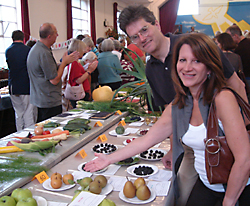 Straight on to the Hornsey Horticultural Show at the Moravian Church. Well – what a show – and incredibly well attended. On this occasion I am just looking (no prizes for me to give out this time) so able to meander and admire.
What fantastic exhibits and what a lot of work goes into organising a show like this. Well done to the organisers and to my colleague Cllr Bob Hare (pictured, Liberal Democrat councillor for Highgate) who got a first prize for his golden pears!

