Calling a meeting with new rail bosses

Lynne Featherstone MP has requested a meeting with Govia, the company recently awarded the management contract for the new Thameslink rail franchise – which covers rail stations and services in Haringey.

From 14th September this year, Govia will replace current service providers, First Capital Connect, in running services in and out London, via Haringey. Govia have committed to provide new trains, 50% more capacity and extra services at peak time – alongside promises of free wifi at stations and extended staff hours.

From December 2015, services from Alexandra Palace, Hornsey and Harringay will run in and out of Moorgate from 6am – midnight on weekdays, and also at weekends, to reflect the demand for more Moorgate services.

The changes are funded by a multi-billion pound investment by the Coalition Government.

A campaign by Lynne Featherstone MP and local residents last year secured a guarantee from the Department for Transport that no local services from Hornsey and Harringay would be lost.

Lynne Featherstone MP commented:

“Many residents have contacted me over the last few years, expressing their dissatisfaction with local rail services provided by First Capital Connect.

“I of course welcome the Government investment in our local services, and hope to see positive changes as soon as possible.

“I have called a meeting with new providers, Govia, to discuss the timescales for changes made and to make sure they are fully aware of the improvements we need at our local stations. If you would like me to pass on any comments about our local rail services and how they can be further improved – please let me know.”
Opening a pre-school in Rwanda

Yesterday I got back from Rwanda. I visited in my capacity as Minister for International Development, and on the final day, I opened a new school:

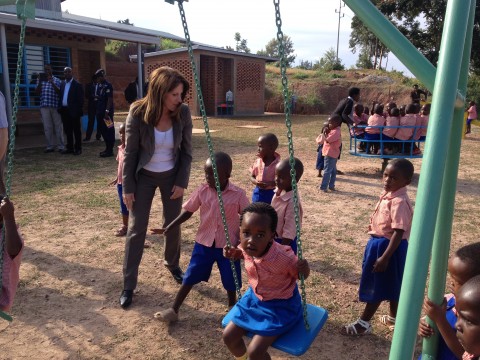
There’s an amazing sense of positive energy and happiness as you come in to the school I’m here to open. It’s a brilliant space filled with bright colours and content children and it’s set against the most dramatic backdrop of peaks and valleys of the Rwandan hills. It all combines in a way that makes me want to set aside my packed programme of meetings ahead and play on the swings with the children all day instead.

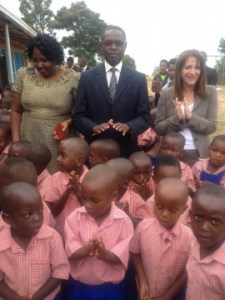
Lynne Featherstone MP opening a pre school in Rwanda

I’m here with Noala Skinner, Rwanda’s UNICEF representative and the Honourable Minister of State for Education, Dr Harebamungu Mathias, and we’re surrounded by a sea of little faces – I must confess that they look a little bemused about all the fuss of having so many visitors to their school, but they sit very quietly and patiently whilst the grown-ups make their speeches and officially declare their pre-school to be open.

Initiatives like this one are so important. The early years of life are crucial in a child’s development, and investing in young children can have so any benefits. As I walk round the compound and watch the children busily building houses and skyscrapers with their wooden blocks, I think about how many doors a good start in life will open for them in the future. I’m really pleased when the Minister of State for Education tells me that the Government of Rwanda has made a commitment to expanding access to pre-primary programmes across the country. The UK is helping too – the school I’m visiting today is only one of ten community based childhood facilities that we’re supporting.

Lynne Featherstone MP opening a DFID funded pre-school in RwandaDuring the speeches, there’s lots of formal talk about education sector plans and government commitments, but what it all really comes down to is families and teachers. The desire for children to have the best start in life is one I think will resonate with all parents, and I’m really pleased to see that many of them are joining us for the opening of the building. It’s great that they are seen as partners in the school and they’ve worked just as hard as anyone to get it all up and running. The teachers keep a close watch on the children – and without their expertise, enthusiasm and dedication, we wouldn’t be here today. Providing the foundation for learning for young children is a very specialised and important job, and one that deserves the utmost respect.

I leave the school feeling uplifted and happy. I feel very lucky to have been a part of this pre-primary. I’m sure this is where the journey starts for the leaders, professionals and politicians of Rwanda’s future.

Genocide – Never Again.

I’m currently in Rwanda in my capacity as Minister for International Development. Here’s my first blog from the three-day visit:

On arrival in Kigali this morning, I went straight to the genocide memorial at Ntarama Church to lay a commemorative wreath for the Rwandans who lost their lives in 1994. Only twenty years have passed since the Genocide, and – understandably – it remains an episode that defines and shapes the political, social, economic and development context of the country today.

At Ntarama church, the story of the genocide unfolds before me as my guide from the Aegis Trust explains the harrowing events that took place in April 1994.  The militia told Tutsis in and around Ntarama to stay together on the church compound so that the government could guarantee their safety. As large numbers of Tutsis sought protection, they thought they would escape unharmed.

They did not.

Soldiers and militia attacked the church where the Tutsis sheltered. Five thousand people lost their lives as violent atrocities almost too difficult to speak of took place.

I knew that visiting the memorial would be distressing, but nothing could have prepared me for the sight of coffins filled with multiple bodies, or the rows upon rows of skulls of those who had perished, some small enough to fit in to the palm of my hand. Most upsetting of all – a corner of the church’s Sunday School room remains forever stained by blood where children were swung by their legs and smashed repeatedly against the stone until dead.  I cannot bring myself to imagine the terrified screams of the little ones who were faced with such brutality.

As I laid the commemorative wreath amongst the remnants of clothes and shoes belonging to those who perished, I reflect that Ntarama is just one of many similar sites across the country. It is truly sobering  to visit a genocide memorial, but it is so very important that we remember – it’s vital in making sure these terrible events are not repeated. With UK support, the Aegis Trust is working to turn the site at Ntarama in to an exhibition that – alongside the main Genocide Memorial in Kigali – will provide a space for reflection, remembrance and healing.

In the bloodied Sunday School building, there is a large banner where the school children of today write messages to the children who died. One simply and bravely reads “I will stand in your place”, and – although communities are still coming to terms with the tragedy, the country has made remarkable progress and people are looking to the future. A stronger, more cohesive future where the motto of my hosts for today – the Aegis Trust – rings loudly: ‘Genocide. Never Again.’