Local MP joins visually impaired residents in successful fight for accessible hospital information

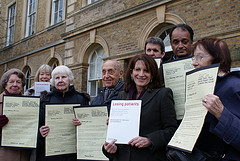
Following a successful meeting with hospital bosses last week, where Lynne Featherstone MP and members of a local group for visually impaired residents demanded the right to get hospital information in accessible formats, the Whittington Hospital has now agreed to produce information in large print, Braille and audio.

The Liberal Democrat MP and the members of the Haringey Phoenix Group that represents blind and partially sighted people locally, were taking part in the RNIB’s ‘Losing Patients’ campaign, to turn the right to get, by law, hospital information in accessible formats, into reality, on the ground.

The Hornsey and Wood Green MP has now also written to the local hospital service, to ask for local GPs follow suit.

Lynne Featherstone MP, comments:

“Getting the chance to find out about personal and sensitive hospital information, without first having to share it with a family member or neighbour, is something most of us take for granted. But for many blind and partially sighted people here in Haringey, that’s just not the case.

“I’m really delighted that, after our meeting, the Whittington has agreed to make this a reality for all its visually impaired patients. And hopefully, this is just the first hurdle; I look forward to the day when all GPs and hospitals, locally, will do the same!”

Mr Frank Bonus, a Haringey Phoenix Group member and Muswell Hill resident, aged 97, adds:

“I live alone and am registered as partially sighted.  When I receive a hospital appointment letter, I have to wait until someone comes to visit me and ask them to read it to me.

“If I could receive the information on cassette or CD, I could listen to it for myself, without having to rely on anyone else.”
Real Women

I see that a German magazine, Brigitte, is catching up with Liberal Democrat policy. You can read here a Times Online article about the fact that this magazine has now resolved to use real women in its pages.

The Liberal Democrats, myself as Equalities Spokesperson and Jo Swinson, MP as Chair of the Policy Working Group welcome this debate widening. So many women and young people are made to feel bad by the constant drip drip of perfected images (perfected by airbrushing and retouching) that surround us on a daily basis. The LibDem policy arising from the working group and passed at last autumn’s conference would see advertisers have to inform the public whether the ad has been retouched. It’s not about stopping advertisers – it’s about introducing some honesty and transparency.

The Whittington says yes!

No – this isn’t about the A&E – I wish they said yes to that too. No – this is my visit to the Whittington with members of the Haringey Phoenix Group who work with blind and visually impaired people in Haringey.

Have you ever thought about this – you get the results to your tests for cancer – and because it is in print – you can’t read it and have to ask a neighbour to help. Can you imagine how dreadful it must be to have to bring someone else into what is a private matter. Of course – you may be lucky and have a partner or friend who you are happy to see your most intimate correspondence – but there are times when this just isn’t appropriate. Or the letter might be about an appointment – and you don’t get to see it or know about it until too late. And quite frankly – it should be a basic right in a civilised society to receive medical information in a form that is accessible to those who are blind or visually impaired.

Well – actually it is a right – in legislation! The Disability Discrimination Act 1995 and the Equality Duty of 2006 say this should be the case – but the actuality just isn’t happening. Partly this is because patients don’t ask – and partly because hospitals and GPs don’t offer or aren’t set up to deliver.

Hence my visit with the wonderful Haringey Phoenix Group. We met with Kate Slemeck and two other Whittington officials to discuss how we could arrive at a situation where asking wasn’t necessary because the IT system flagged up both that the patient was visually impaired but also what type of communication results, appointments – any communication – should be in. This could be anything from braille, to large print format (different point sizes for different degrees of impairment), audio tapes, etc.  Then automatically – all communication would be in that format. This is part of a campaign by the RNIB to convert the right in law – to the reality on the ground.

Three cheers for the Whittington – who embraced this and said they could see no reason why not – and were prepared to run a pilot. This would be a real breakthrough and the Whittington would be the first hospital to trial and hopefully become a beacon for provision of communication in appropriate format.

Of course – there’s a bit of a way to go – but they were welcoming, said that their IT system could flag this information up as we suggested. The next stage is to get GPs to ensure that this information – that the patient is visually impaired and identify the format required – so that it can be put onto the hospital system. And of course – it needs to be on the GP system – and all blind and visually impaired people need to make sure that the GP does this and so on.

So next step is to get Haringey PCT to write to all the GPs locally asking them to make sure that both on their own system and when they refere patients to the Whittington – it is made clear that this information has to be entered for flagging and so on.

I am assuming that the PCT will be delighted and willing to do so. I cannot imagine any reason why not – and this is the sort of small change that will make a huge difference.

Three cheers for the Whittington!